 Add to Chrome
 Add to Firefox
 Add to Edge
Mixtures of Subspaces for Bandwidth Efficient Context Parallel Training
Jun 15, 2026
Pretraining language models with extended context windows enhances their ability to leverage rich information during generation. Existing methods split input sequences into chunks, broadcast them across multiple devices, and compute attention block by block which incurs significant communication overhead. While feasible in high-speed clusters, these methods are impractical for decentralized training over low-bandwidth connections. We propose a compression method for communication-efficient context parallelism in decentralized settings, achieving a remarkable compression rate of over 95\% with negligible overhead and no loss in convergence. Our key insight is to exploit the intrinsic low-rank structure of activation outputs by dynamically constraining them to learned mixtures of subspaces via efficient reparameterizations. We demonstrate scaling billion-parameter decentralized models to context lengths exceeding 100K tokens on networks as slow as 300Mbps, matching the wall-clock convergence speed of centralized models on 100Gbps interconnects.

Taming Curvature: Architecture Warm-Up for Stable Transformer Training
Jun 15, 2026Training billion-parameter Transformers is often brittle, with transient loss spikes and divergence that waste compute. Even though the recently developed Edge of Stability (EoS) theory provides a powerful tool to understand and control the stability of optimization methods via the (preconditioned) curvature, these curvature-controlling methods are not popular in large-scale Transformer training due to the complexity of curvature estimation. To this end, we first introduce a fast online estimator of the largest (preconditioned) Hessian eigenvalue (i.e., curvature) based on a warm-started variant for power iteration with Hessian-vector products. We show theoretically, and verify empirically, that the proposed method makes per-iteration curvature tracking feasible at billion parameter scale while being more accurate. Using this tool, we find that training instabilities coincide with surges in preconditioned curvature and that curvature grows with depth. Motivated by these observations, we propose architecture warm-up: progressively growing network depth to carefully control the preconditioned Hessian and stabilize training. Experiments on large Transformers validate that our approach enables efficient curvature tracking and reduces instabilities compared to existing state-of-the-art stabilization techniques without slowing down convergence.
Unextractable Protocol Models: Collaborative Training and Inference without Weight Materialization
May 22, 2026We consider a decentralized setup in which the participants collaboratively train and serve a large neural network, and where each participant only processes a subset of the model. In this setup, we explore the possibility of unmaterializable weights, where a full weight set is never available to any one participant. We introduce Unextractable Protocol Models (UPMs): a training and inference framework that leverages the sharded model setup to ensure model shards (i.e., subsets) held by participants are incompatible at different time steps. UPMs periodically inject time-varying, random, invertible transforms at participant boundaries; preserving the overall network function yet rendering cross-time assemblies incoherent. On Qwen-2.5-0.5B and Llama-3.2-1B, 10,000 transforms leave FP32 perplexity unchanged ($Δ$PPL $< 0.01$; Jensen-Shannon drift $< 4 \times 10^{-5}$), and we show how to control growth for lower precision datatypes. Applying a transform every 30s adds 3% latency, 0.1% bandwidth, and 10% GPU-memory overhead at inference, while training overhead falls to 1.6% time and $< 1$% memory. We consider several attacks, showing that the requirements of direct attacks are impractical and easy to defend against, and that gradient-based fine-tuning of stitched partitions consumes $\geq 60$% of the tokens required to train from scratch. By enabling models to be collaboratively trained yet not extracted, UPMs make it practical to embed programmatic incentive mechanisms in community-driven decentralized training.
* Accepted at NeurIPS 2025. 34 pages, 6 figures (5 in main body, 1 in appendix). Alexander Long and Chamin Hewa Koneputugodage contributed equally
SENTINEL: Stagewise Integrity Verification for Pipeline Parallel Decentralized Training
Mar 03, 2026Decentralized training introduces critical security risks when executed across untrusted, geographically distributed nodes. While existing Byzantine-tolerant literature addresses data parallel (DP) training through robust aggregation methods, pipeline parallelism (PP) presents fundamentally distinct challenges. In PP, model layers are distributed across workers where the activations and their gradients flow between stages rather than being aggregated, making traditional DP approaches inapplicable. We propose SENTINEL, a verification mechanism for PP training without computation duplication. SENTINEL employs lightweight momentum-based monitoring using exponential moving averages (EMAs) to detect corrupted inter-stage communication. Unlike existing Byzantine-tolerant approaches for DP that aggregate parameter gradients across replicas, our approach verifies sequential activation/gradient transmission between layers. We provide theoretical convergence guarantees for this new setting that recovers classical convergence rates when relaxed to standard training. Experiments demonstrate successful training of up to 4B-parameter LLMs across untrusted distributed environments with up to 176 workers while maintaining model convergence and performance.
AsyncMesh: Fully Asynchronous Optimization for Data and Pipeline Parallelism
Jan 30, 2026Data and pipeline parallelism are key strategies for scaling neural network training across distributed devices, but their high communication cost necessitates co-located computing clusters with fast interconnects, limiting their scalability. We address this communication bottleneck by introducing asynchronous updates across both parallelism axes, relaxing the co-location requirement at the expense of introducing staleness between pipeline stages and data parallel replicas. To mitigate staleness, for pipeline parallelism, we adopt a weight look-ahead approach, and for data parallelism, we introduce an asynchronous sparse averaging method equipped with an exponential moving average based correction mechanism. We provide convergence guarantees for both sparse averaging and asynchronous updates. Experiments on large-scale language models (up to \em 1B parameters) demonstrate that our approach matches the performance of the fully synchronous baseline, while significantly reducing communication overhead.
Nesterov Method for Asynchronous Pipeline Parallel Optimization
May 02, 2025Pipeline Parallelism (PP) enables large neural network training on small, interconnected devices by splitting the model into multiple stages. To maximize pipeline utilization, asynchronous optimization is appealing as it offers 100% pipeline utilization by construction. However, it is inherently challenging as the weights and gradients are no longer synchronized, leading to stale (or delayed) gradients. To alleviate this, we introduce a variant of Nesterov Accelerated Gradient (NAG) for asynchronous optimization in PP. Specifically, we modify the look-ahead step in NAG to effectively address the staleness in gradients. We theoretically prove that our approach converges at a sublinear rate in the presence of fixed delay in gradients. Our experiments on large-scale language modelling tasks using decoder-only architectures with up to 1B parameters, demonstrate that our approach significantly outperforms existing asynchronous methods, even surpassing the synchronous baseline.
ViewFusion: Towards Multi-View Consistency via Interpolated Denoising
Feb 29, 2024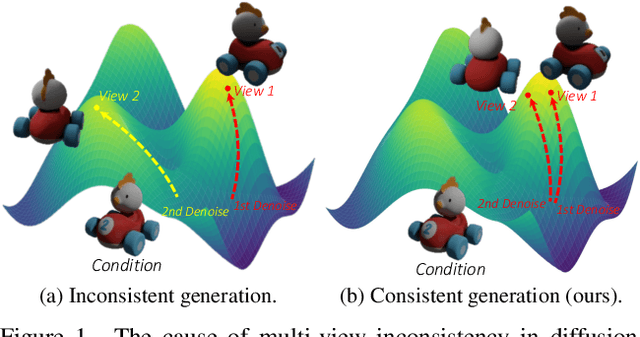
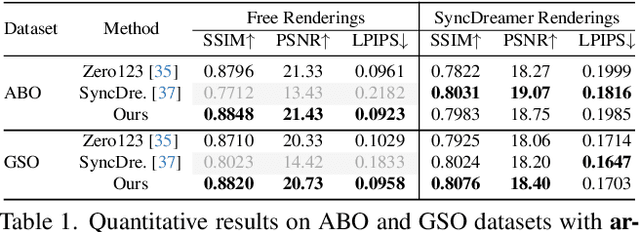


Novel-view synthesis through diffusion models has demonstrated remarkable potential for generating diverse and high-quality images. Yet, the independent process of image generation in these prevailing methods leads to challenges in maintaining multiple-view consistency. To address this, we introduce ViewFusion, a novel, training-free algorithm that can be seamlessly integrated into existing pre-trained diffusion models. Our approach adopts an auto-regressive method that implicitly leverages previously generated views as context for the next view generation, ensuring robust multi-view consistency during the novel-view generation process. Through a diffusion process that fuses known-view information via interpolated denoising, our framework successfully extends single-view conditioned models to work in multiple-view conditional settings without any additional fine-tuning. Extensive experimental results demonstrate the effectiveness of ViewFusion in generating consistent and detailed novel views.
Divide and Conquer: Rethinking the Training Paradigm of Neural Radiance Fields
Jan 29, 2024Neural radiance fields (NeRFs) have exhibited potential in synthesizing high-fidelity views of 3D scenes but the standard training paradigm of NeRF presupposes an equal importance for each image in the training set. This assumption poses a significant challenge for rendering specific views presenting intricate geometries, thereby resulting in suboptimal performance. In this paper, we take a closer look at the implications of the current training paradigm and redesign this for more superior rendering quality by NeRFs. Dividing input views into multiple groups based on their visual similarities and training individual models on each of these groups enables each model to specialize on specific regions without sacrificing speed or efficiency. Subsequently, the knowledge of these specialized models is aggregated into a single entity via a teacher-student distillation paradigm, enabling spatial efficiency for online render-ing. Empirically, we evaluate our novel training framework on two publicly available datasets, namely NeRF synthetic and Tanks&Temples. Our evaluation demonstrates that our DaC training pipeline enhances the rendering quality of a state-of-the-art baseline model while exhibiting convergence to a superior minimum.
Bayesian Optimisation for Mixed-Variable Inputs using Value Proposals
Feb 17, 2022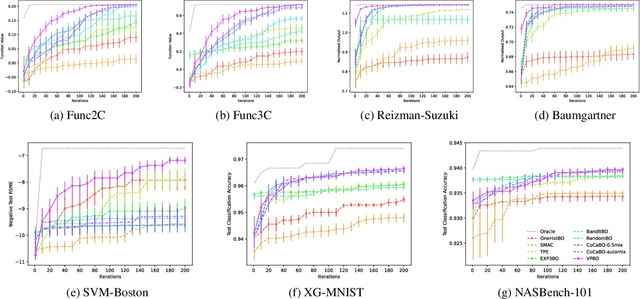
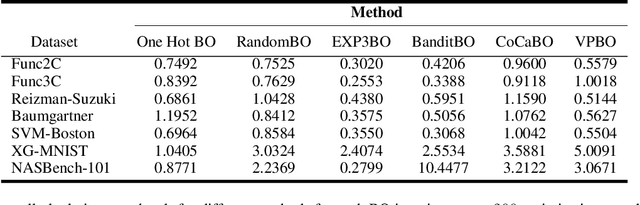

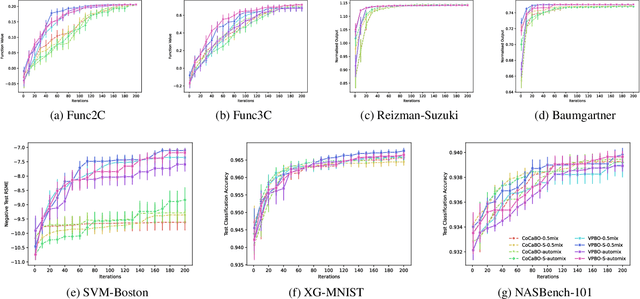
Many real-world optimisation problems are defined over both categorical and continuous variables, yet efficient optimisation methods such asBayesian Optimisation (BO) are not designed tohandle such mixed-variable search spaces. Recent approaches to this problem cast the selection of the categorical variables as a bandit problem, operating independently alongside a BO component which optimises the continuous variables. In this paper, we adopt a holistic view and aim to consolidate optimisation of the categorical and continuous sub-spaces under a single acquisition metric. We derive candidates from the ExpectedImprovement criterion, which we call value proposals, and use these proposals to make selections on both the categorical and continuous components of the input. We show that this unified approach significantly outperforms existing mixed-variable optimisation approaches across several mixed-variable black-box optimisation tasks.
Learning Instance and Task-Aware Dynamic Kernels for Few Shot Learning
Dec 07, 2021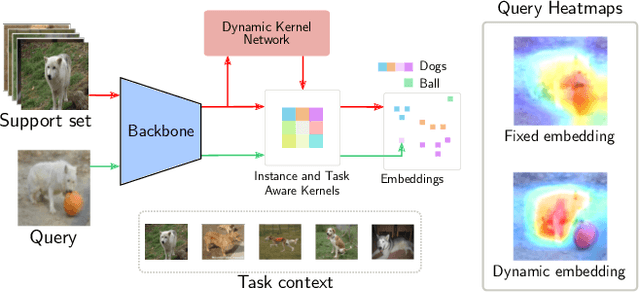
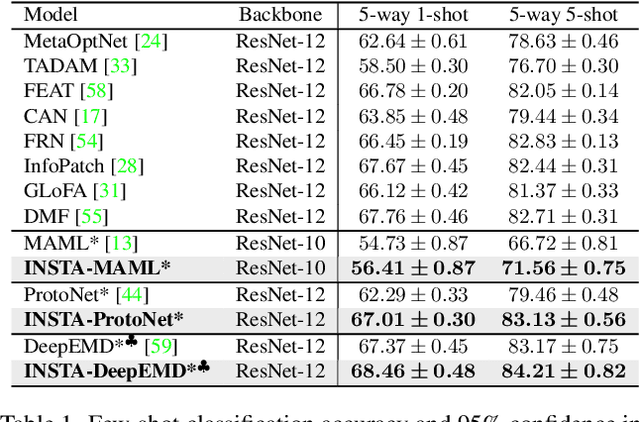
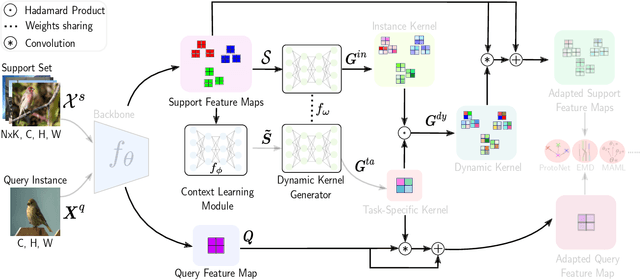
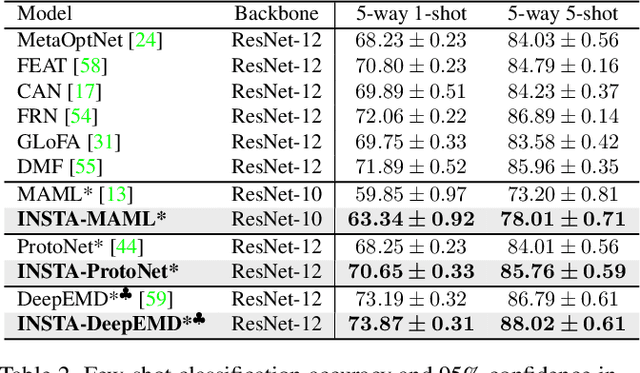
Learning and generalizing to novel concepts with few samples (Few-Shot Learning) is still an essential challenge to real-world applications. A principle way of achieving few-shot learning is to realize a model that can rapidly adapt to the context of a given task. Dynamic networks have been shown capable of learning content-adaptive parameters efficiently, making them suitable for few-shot learning. In this paper, we propose to learn the dynamic kernels of a convolution network as a function of the task at hand, enabling faster generalization. To this end, we obtain our dynamic kernels based on the entire task and each sample and develop a mechanism further conditioning on each individual channel and position independently. This results in dynamic kernels that simultaneously attend to the global information whilst also considering minuscule details available. We empirically show that our model improves performance on few-shot classification and detection tasks, achieving a tangible improvement over several baseline models. This includes state-of-the-art results on 4 few-shot classification benchmarks: mini-ImageNet, tiered-ImageNet, CUB and FC100 and competitive results on a few-shot detection dataset: MS COCO-PASCAL-VOC.