 Add to Chrome
 Add to Firefox
 Add to Edge
Bad Memory: Evaluating Prompt Injection Risks from Memory in Agentic Systems
Jul 16, 2026
A growing class of agentic systems maintain persistent state across sessions through memory files, behavioral preferences, and knowledge bases. While this makes agents more useful and self-improving, it also creates a new attack surface for prompt injections in which malicious instructions can be embedded within persistent files and influence future behavior. In this work, we study prompt injection attacks in memory-based agentic systems using a sandboxed synthetic workspace. We evaluate two agentic systems, Anthropic Claude Code and OpenAI Codex, across four models: Claude Haiku 4.5, Claude Opus 4.7, GPT-5.2, and GPT-5.5. Our results show that although it is difficult to make an agent overwrite its own memory files using untrusted external content, payloads already planted in those files can successfully attack current and future sessions. Attack success and payload persistence vary substantially across systems, models, adversarial goals, and multi-session attack sequences. These findings show that persistent memory changes the threat model for prompt injection and motivate defenses that protect memory updates without removing useful agent adaptation.

Pneuma: Leveraging LLMs for Tabular Data Representation and Retrieval in an End-to-End System
Apr 12, 2025Finding relevant tables among databases, lakes, and repositories is the first step in extracting value from data. Such a task remains difficult because assessing whether a table is relevant to a problem does not always depend only on its content but also on the context, which is usually tribal knowledge known to the individual or team. While tools like data catalogs and academic data discovery systems target this problem, they rely on keyword search or more complex interfaces, limiting non-technical users' ability to find relevant data. The advent of large language models (LLMs) offers a unique opportunity for users to ask questions directly in natural language, making dataset discovery more intuitive, accessible, and efficient. In this paper, we introduce Pneuma, a retrieval-augmented generation (RAG) system designed to efficiently and effectively discover tabular data. Pneuma leverages large language models (LLMs) for both table representation and table retrieval. For table representation, Pneuma preserves schema and row-level information to ensure comprehensive data understanding. For table retrieval, Pneuma augments LLMs with traditional information retrieval techniques, such as full-text and vector search, harnessing the strengths of both to improve retrieval performance. To evaluate Pneuma, we generate comprehensive benchmarks that simulate table discovery workload on six real-world datasets including enterprise data, scientific databases, warehousing data, and open data. Our results demonstrate that Pneuma outperforms widely used table search systems (such as full-text search and state-of-the-art RAG systems) in accuracy and resource efficiency.
Bayesian Optimisation for Mixed-Variable Inputs using Value Proposals
Feb 17, 2022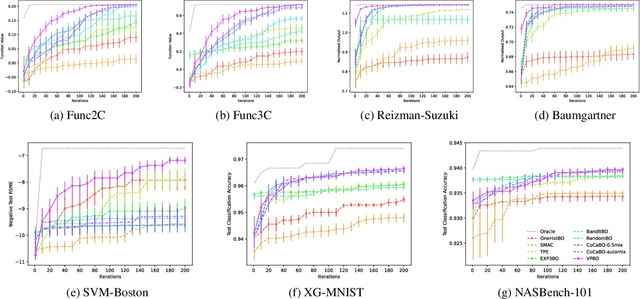
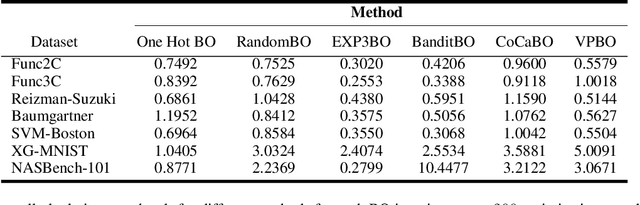

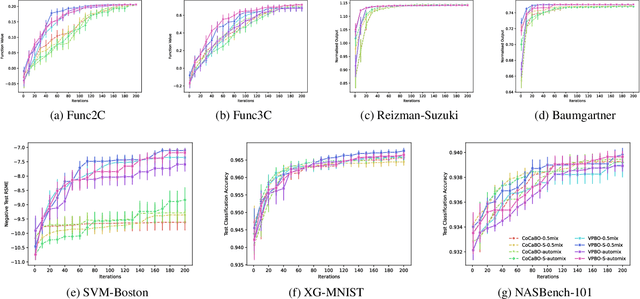
Many real-world optimisation problems are defined over both categorical and continuous variables, yet efficient optimisation methods such asBayesian Optimisation (BO) are not designed tohandle such mixed-variable search spaces. Recent approaches to this problem cast the selection of the categorical variables as a bandit problem, operating independently alongside a BO component which optimises the continuous variables. In this paper, we adopt a holistic view and aim to consolidate optimisation of the categorical and continuous sub-spaces under a single acquisition metric. We derive candidates from the ExpectedImprovement criterion, which we call value proposals, and use these proposals to make selections on both the categorical and continuous components of the input. We show that this unified approach significantly outperforms existing mixed-variable optimisation approaches across several mixed-variable black-box optimisation tasks.