 Add to Chrome
 Add to Firefox
 Add to Edge
Envision4D: Envisioning Visual Futures via Feed-forward 4D Gaussian Splatting for Autonomous Driving
Jun 09, 2026
Forecasting the future evolution of dynamic scenes is crucial in autonomous driving. However, existing feed-forward paradigms are primarily designed for interpolation. When extended to future extrapolation, they suffer from ghosting artifacts under large displacements and are constrained by simplified motion assumptions or strict future priors. To overcome these challenges, we propose Envision4D, a fully self-supervised feed-forward framework for pose-free future extrapolation. Specifically, we introduce a Future Pose Prediction module that infers future camera parameters via an iterative denoising process. Furthermore, to capture non-linear dynamics, we propose In-layer Temporal Attention and employ Conditioned Motion Lifting, which transforms the highly uncertain extrapolation process into robust relational mappings. Finally, a Progressive Training Strategy is utilized to stabilize unsupervised motion learning against error accumulation. Extensive experiments demonstrate that Envision4D achieves state-of-the-art performance, significantly outperforming existing methods in future view synthesis.

A Survey on Monocular Re-Localization: From the Perspective of Scene Map Representation
Nov 27, 2023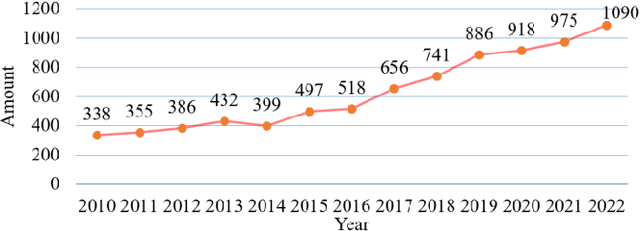
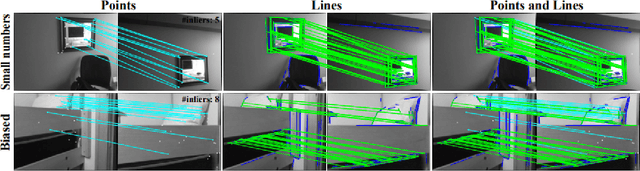
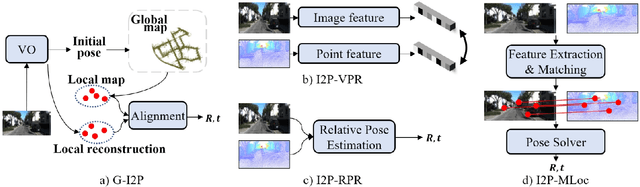
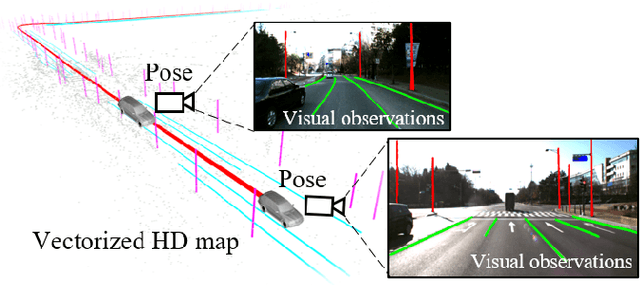
Monocular Re-Localization (MRL) is a critical component in numerous autonomous applications, which estimates 6 degree-of-freedom poses with regards to the scene map based on a single monocular image. In recent decades, significant progress has been made in the development of MRL techniques. Numerous landmark algorithms have accomplished extraordinary success in terms of localization accuracy and robustness against visual interference. In MRL research, scene maps are represented in various forms, and they determine how MRL methods work and even how MRL methods perform. However, to the best of our knowledge, existing surveys do not provide systematic reviews of MRL from the respective of map. This survey fills the gap by comprehensively reviewing MRL methods employing monocular cameras as main sensors, promoting further research. 1) We commence by delving into the problem definition of MRL and exploring current challenges, while also comparing ours with with previous published surveys. 2) MRL methods are then categorized into five classes according to the representation forms of utilized map, i.e., geo-tagged frames, visual landmarks, point clouds, and vectorized semantic map, and we review the milestone MRL works of each category. 3) To quantitatively and fairly compare MRL methods with various map, we also review some public datasets and provide the performances of some typical MRL methods. The strengths and weakness of different types of MRL methods are analyzed. 4) We finally introduce some topics of interest in this field and give personal opinions. This survey can serve as a valuable referenced materials for newcomers and researchers interested in MRL, and a continuously updated summary of this survey, including reviewed papers and datasets, is publicly available to the community at: https://github.com/jinyummiao/map-in-mono-reloc.