 Add to Chrome
 Add to Firefox
 Add to Edge
MotionHalluc: Diagnosing Kinematic Hallucinations in Fine-Grained Motion Reasoning
Jun 22, 2026
Motion instruction generation in cross-video comparison aims to produce corrective feedback that describes the differences between a query and a reference motion. However, existing models often generate instructions that exhibit motion hallucinations, failing to reflect actual kinematic differences between paired videos. To systematically investigate these hallucinations, we introduce MotionHalluc, a dedicated benchmark for evaluating motion hallucinations in paired-video comparison. MotionHalluc comprises 1540 fine-grained questions over 553 video pairs, evaluating hallucinations along three core dimensions: (1)directional hallucination, (2)attributional hallucination, and (3)temporal hallucination. Extensive evaluations of state-of-the-art large multimodal models demonstrate high susceptibility to these hallucinations. Furthermore, we provide Perceive-Parse-Verify (PPV) as a training-free measurements extraction and verification baseline that converts candidate instructions into executable measurement queries and supplies kinematic measurements at inference time. Our results show that this simple measurements injection yields an average 10.6% performance gain across models, suggesting that motion reasoning with explicit quantitative measurements is a key factor in reducing hallucinations in cross-video comparison. Our code and dataset will be made publicly available upon acceptance.

From Verdict to Process: Agentic Reinforcement Learning for Multi-Stage Fact Verification
Jun 11, 2026Recent approaches combining Large Language Models (LLMs) with retrieval-augmented reasoning have shown promise for automated fact verification. To process complex claims, these verification pipelines typically execute multi-stage workflows that coordinate tightly coupled modules, including claim decomposition, evidence gathering, and verdict prediction. However, existing methods optimize individual stages in isolation or rely on fixed heuristics, which limits adaptive coordination among stages and can lead to suboptimal outcomes. In this work, we propose ProFact, an agentic reinforcement learning framework for end-to-end optimization of multi-stage fact verification trajectories. ProFact trains a unified policy to coordinate claim decomposition, evidence seeking, answer generation, and verdict prediction. To address the sparse and delayed supervision provided by final veracity labels, ProFact introduces process-aware rewards that provide stage-level learning signals throughout the verification process. Empirical evaluation shows that ProFact consistently outperforms strong baselines in both verification performance and inference efficiency. These results highlight the effectiveness of process-aware trajectory optimization for multi-stage fact verification.
Adaptive Coarse-to-Fine Subgoal Refinement for Long-Horizon Offline Goal-Conditioned Reinforcement Learning
May 27, 2026Offline goal-conditioned reinforcement learning (GCRL) is challenging in long-horizon tasks, where distant state--goal pairs provide weak supervision and value estimates become vulnerable to accumulated bootstrapping errors. Hierarchical methods mitigate this difficulty by introducing intermediate subgoals, but fixed temporal abstractions or fixed hierarchy depths can be mismatched to state--goal pairs with different reachability horizons. We propose Coarse-to-Fine Hierarchical Goal Reinforcement Learning (CFHRL), a fully offline GCRL framework that adaptively refines distant goals before execution. Starting from the final goal, CFHRL recursively proposes intermediate targets, trained from replay-supported candidates, and stops refinement once the current target is estimated to be locally executable by a learned reachability cost. The key idea is that a subgoal need not be an exact midpoint or globally optimal waypoint; it only needs to provide reliable progress and reduce the remaining reaching difficulty, enabling subsequent refinement over shorter horizons. A stylized analysis further supports the robustness of approximate recursive contraction. Experiments on OGBench show substantial gains on several long-horizon tasks, with ablations validating the proposed refinement and stopping mechanisms
Advantage-based Temporal Attack in Reinforcement Learning
Feb 23, 2026Extensive research demonstrates that Deep Reinforcement Learning (DRL) models are susceptible to adversarially constructed inputs (i.e., adversarial examples), which can mislead the agent to take suboptimal or unsafe actions. Recent methods improve attack effectiveness by leveraging future rewards to guide adversarial perturbation generation over sequential time steps (i.e., reward-based attacks). However, these methods are unable to capture dependencies between different time steps in the perturbation generation process, resulting in a weak temporal correlation between the current perturbation and previous perturbations.In this paper, we propose a novel method called Advantage-based Adversarial Transformer (AAT), which can generate adversarial examples with stronger temporal correlations (i.e., time-correlated adversarial examples) to improve the attack performance. AAT employs a multi-scale causal self-attention (MSCSA) mechanism to dynamically capture dependencies between historical information from different time periods and the current state, thus enhancing the correlation between the current perturbation and the previous perturbation. Moreover, AAT introduces a weighted advantage mechanism, which quantifies the effectiveness of a perturbation in a given state and guides the generation process toward high-performance adversarial examples by sampling high-advantage regions. Extensive experiments demonstrate that the performance of AAT matches or surpasses mainstream adversarial attack baselines on Atari, DeepMind Control Suite and Google football tasks.
Hierarchical Multi-agent Meta-Reinforcement Learning for Cross-channel Bidding
Dec 26, 2024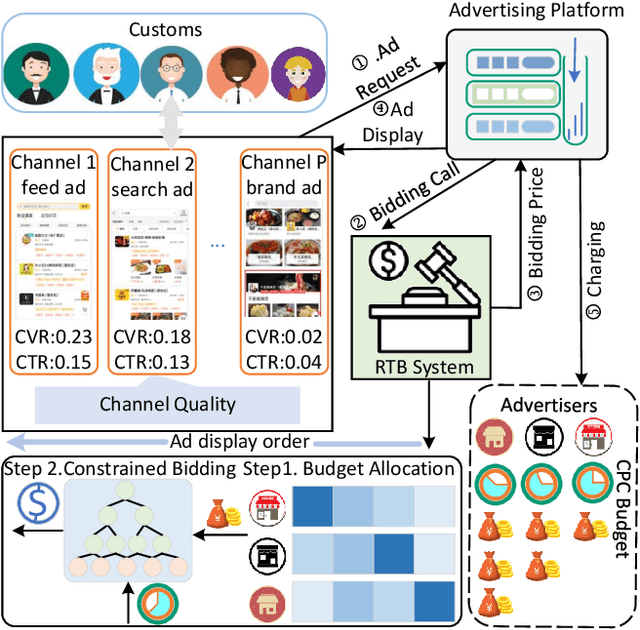
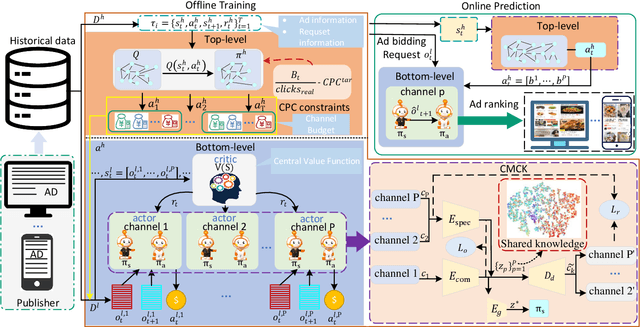

Real-time bidding (RTB) plays a pivotal role in online advertising ecosystems. Advertisers employ strategic bidding to optimize their advertising impact while adhering to various financial constraints, such as the return-on-investment (ROI) and cost-per-click (CPC). Primarily focusing on bidding with fixed budget constraints, traditional approaches cannot effectively manage the dynamic budget allocation problem where the goal is to achieve global optimization of bidding performance across multiple channels with a shared budget. In this paper, we propose a hierarchical multi-agent reinforcement learning framework for multi-channel bidding optimization. In this framework, the top-level strategy applies a CPC constrained diffusion model to dynamically allocate budgets among the channels according to their distinct features and complex interdependencies, while the bottom-level strategy adopts a state-action decoupled actor-critic method to address the problem of extrapolation errors in offline learning caused by out-of-distribution actions and a context-based meta-channel knowledge learning method to improve the state representation capability of the policy based on the shared knowledge among different channels. Comprehensive experiments conducted on a large scale real-world industrial dataset from the Meituan ad bidding platform demonstrate that our method achieves a state-of-the-art performance.