 Add to Chrome
 Add to Firefox
 Add to Edge
Closed-loop Auto Research for Molecular Property Prediction: Discovering and Certifying Generalizable Improvements
Jun 22, 2026
Closed-loop Auto Research extends automated machine learning from fixed-dataset fitting to changing the research workflow, with language-model agents editing representations and model code and acquiring external evidence. Molecular property prediction spans many small endpoints. We ask whether this action space yields improvements generalizing beyond the validation signal selecting them. We isolate three Auto Research axes, features, models, and external evidence, under a file-level ablation lock attributing each gain to one axis over a strong baseline. Across 36 endpoints in three benchmark suites we score each selected configuration once on a held-out test whose labels the search never read. A routed pipeline taking each endpoint's best validation axis reaches positive held-out gains of 0.013, 0.011, and 0.042, the transferable axis differing by suite, data on TDC, model on Polaris, feature and model on MoleculeNet. The largest model-search gain falls from 0.041 on validation to 0.003 on test, while curated data reaches 0.022 but negative 0.019 on test, two non-transfer signatures. Curated external data raises held-out CYP2C9-substrate performance by 0.17 and half-life by 0.08, admitted through a contamination filter rejecting same-source files overlapping 64 to 89 percent of test structures, necessary but not sufficient for transfer. A matched-trial automated machine learning control did not reproduce the agent's code-level model intervention, reaching 0.006 against 0.042, and the pipeline stays competitive with an 84M-parameter pretrained 3D model on the shared training split. The experiments stay within molecular property prediction, but separating discovery from held-out certification is a domain-agnostic lesson for any closed-loop system optimising a proxy for a held-out quantity.

Beyond Parallel Sampling: Diverse Query Initialization for Agentic Search
Jun 15, 2026Test-time scaling for agentic search typically increases depth (i.e., more turns and tokens per trajectory) or breadth (i.e., more parallel rollouts). Here we focus on breadth scaling, showing that standard parallel sampling yields diminishing returns, tracing this to query redundancy at the first turn. When models issue similar first queries across rollouts, the threads retrieve overlapping evidence, and subsequent turns are conditioned on this shared retrieval. We address this limitation with DivInit, a training-free intervention at the first turn. Rather than sampling k independent first queries, DivInit draws n candidates from a single call, picks k < n diverse seeds, and runs them as parallel trajectories. Across five open-weight models and eight benchmarks, DivInit consistently improves over standard parallel sampling, with average gains of five to seven points on multi-hop QA at matched compute. Code available at https://github.com/cxcscmu/diverse-query-initialization
Auto Research with Specialist Agents Develops Effective and Non-Trivial Training Recipes
May 07, 2026We study auto research as a closed empirical loop driven by external measurement. Each submitted trial carries a hypothesis, an executable code edit, an evaluator-owned outcome, and feedback that shapes the next proposal. The output is not a generated paper or a single model checkpoint, but an auditable trajectory of proposals, code diffs, experiments, scores, and failure labels. We instantiate this loop with specialist agents that partition recipe surfaces and share measured lineage across trials. The central empirical finding is that lineage feedback lets agents turn evaluator outcomes, including crashes, budget overruns, size failures, and accuracy-gate misses, into later program-level recipe edits rather than one-shot suggestions. Across 1,197 headline-run trials plus 600 Parameter Golf control trials after one-time setup and launch, humans did not choose proposals, edit recipes, override scores, or repair failed trials during the search. In the three headline runs, the same submitted-trial loop reduces Parameter Golf validation bpb by $0.81\%$, raises NanoChat-D12 CORE by $38.7\%$, and reduces CIFAR-10 Airbench96 wallclock by $4.59\%$, with each task measured by its own external evaluator and legality checks. The trace includes a strict architecture-domain audit of 157 headline-run submissions and program rewrites such as a NanoChat attention-kernel path change. Within this scope the loop autonomously writes code, submits experiments, absorbs feedback, applies and combines known techniques inside each environment, and improves public starting recipes.
SkillLearnBench: Benchmarking Continual Learning Methods for Agent Skill Generation on Real-World Tasks
Apr 22, 2026Skills have become the de facto way to enable LLM agents to perform complex real-world tasks with customized instructions, workflows, and tools, but how to learn them automatically and effectively remains unclear. We introduce SkillLearnBench, the first benchmark for evaluating continual skill learning methods, comprising 20 verified, skill-dependent tasks across 15 sub-domains derived from a real-world skill taxonomy , evaluated at three levels: skill quality, execution trajectory, and task outcome. Using this benchmark, we evaluate recent continual learning techniques, those leveraging one-shot, self/teacher feedback, and skill creator to generate skills from agent experiences. We find that all continual learning methods improve over the no-skill baseline, yet consistent gains remain elusive: no method leads across all tasks and LLMs, and scaling to stronger LLMs does not reliably help. Continual learning improves tasks with clear, reusable workflows but struggles on open-ended tasks, and using stronger LLM backbones does not consistently produce better skills. Our analysis also revealed that multiple iterations in continual learning facilitate genuine improvement via external feedback, whereas self-feedback alone induces recursive drift. Our data and code are open-source at https://github.com/cxcscmu/SkillLearnBench to enable further studies of automatic skill generation and continual learning techniques.
Revision or Re-Solving? Decomposing Second-Pass Gains in Multi-LLM Pipelines
Apr 01, 2026Multi-LLM revision pipelines, in which a second model reviews and improves a draft produced by a first, are widely assumed to derive their gains from genuine error correction. We question this assumption with a controlled decomposition experiment that uses four matched conditions to separate second-pass gains into three additive components: re-solving, scaffold, and content. We evaluate this design across two model pairs on three benchmarks spanning knowledge-intensive MCQ and competitive programming. Our results show that the gains of multi-LLM revision are not monolithic, but depend on task structure, draft quality, and the type of draft information. On MCQ tasks, where the answer space is constrained and drafts provide little structural guidance, most gains are consistent with stronger-model re-solving, and directly routing queries to the stronger model can be more effective than revising a weak draft. On code generation tasks, however, two-stage prompting remains useful because even semantically null drafts can provide substantial structural scaffolding, while weak draft content can be harmful. Finally, role-reversed experiments show that strong drafts clearly benefit weak reviewers. Ultimately, our findings demonstrate that the utility of multi-LLM revision is dynamically bottlenecked by task structure and draft quality, necessitating more targeted pipeline designs rather than blanket revision strategies.
GPCR-Filter: a deep learning framework for efficient and precise GPCR modulator discovery
Jan 27, 2026G protein-coupled receptors (GPCRs) govern diverse physiological processes and are central to modern pharmacology. Yet discovering GPCR modulators remains challenging because receptor activation often arises from complex allosteric effects rather than direct binding affinity, and conventional assays are slow, costly, and not optimized for capturing these dynamics. Here we present GPCR-Filter, a deep learning framework specifically developed for GPCR modulator discovery. We assembled a high-quality dataset of over 90,000 experimentally validated GPCR-ligand pairs, providing a robust foundation for training and evaluation. GPCR-Filter integrates the ESM-3 protein language model for high-fidelity GPCR sequence representations with graph neural networks that encode ligand structures, coupled through an attention-based fusion mechanism that learns receptor-ligand functional relationships. Across multiple evaluation settings, GPCR-Filter consistently outperforms state-of-the-art compound-protein interaction models and exhibits strong generalization to unseen receptors and ligands. Notably, the model successfully identified micromolar-level agonists of the 5-HT\textsubscript{1A} receptor with distinct chemical frameworks. These results establish GPCR-Filter as a scalable and effective computational approach for GPCR modulator discovery, advancing AI-assisted drug development for complex signaling systems.
Agentic Search in the Wild: Intents and Trajectory Dynamics from 14M+ Real Search Requests
Jan 24, 2026LLM-powered search agents are increasingly being used for multi-step information seeking tasks, yet the IR community lacks empirical understanding of how agentic search sessions unfold and how retrieved evidence is used. This paper presents a large-scale log analysis of agentic search based on 14.44M search requests (3.97M sessions) collected from DeepResearchGym, i.e. an open-source search API accessed by external agentic clients. We sessionize the logs, assign session-level intents and step-wise query-reformulation labels using LLM-based annotation, and propose Context-driven Term Adoption Rate (CTAR) to quantify whether newly introduced query terms are traceable to previously retrieved evidence. Our analyses reveal distinctive behavioral patterns. First, over 90% of multi-turn sessions contain at most ten steps, and 89% of inter-step intervals fall under one minute. Second, behavior varies by intent. Fact-seeking sessions exhibit high repetition that increases over time, while sessions requiring reasoning sustain broader exploration. Third, agents reuse evidence across steps. On average, 54% of newly introduced query terms appear in the accumulated evidence context, with contributions from earlier steps beyond the most recent retrieval. The findings suggest that agentic search may benefit from repetition-aware early stopping, intent-adaptive retrieval budgets, and explicit cross-step context tracking. We plan to release the anonymized logs to support future research.
DeepResearchGym: A Free, Transparent, and Reproducible Evaluation Sandbox for Deep Research
May 25, 2025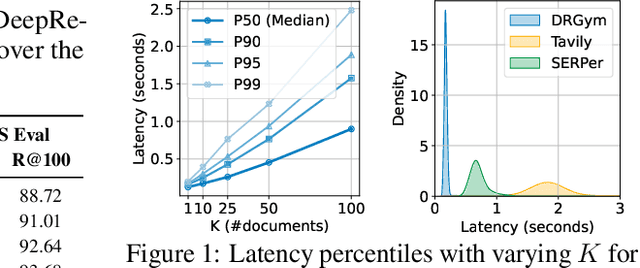
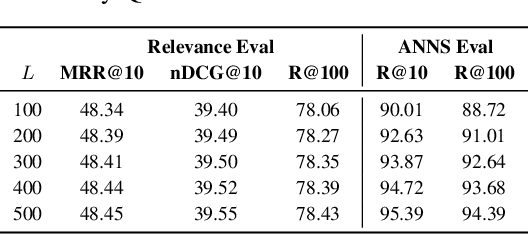
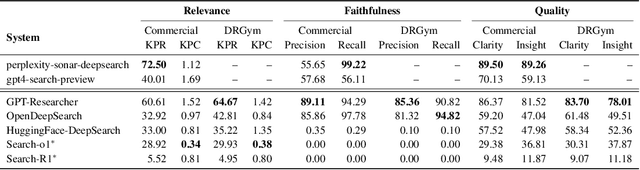
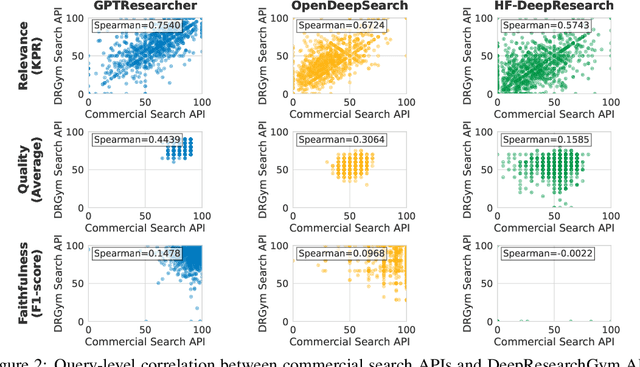
Deep research systems represent an emerging class of agentic information retrieval methods that generate comprehensive and well-supported reports to complex queries. However, most existing frameworks rely on dynamic commercial search APIs, which pose reproducibility and transparency challenges in addition to their cost. To address these limitations, we introduce DeepResearchGym, an open-source sandbox that combines a reproducible search API with a rigorous evaluation protocol for benchmarking deep research systems. The API indexes large-scale public web corpora, namely ClueWeb22 and FineWeb, using a state-of-the-art dense retriever and approximate nearest neighbor search via DiskANN. It achieves lower latency than popular commercial APIs while ensuring stable document rankings across runs, and is freely available for research use. To evaluate deep research systems' outputs, we extend the Researchy Questions benchmark with automatic metrics through LLM-as-a-judge assessments to measure alignment with users' information needs, retrieval faithfulness, and report quality. Experimental results show that systems integrated with DeepResearchGym achieve performance comparable to those using commercial APIs, with performance rankings remaining consistent across evaluation metrics. A human evaluation study further confirms that our automatic protocol aligns with human preferences, validating the framework's ability to help support controlled assessment of deep research systems. Our code and API documentation are available at https://www.deepresearchgym.ai.