 Add to Chrome
 Add to Firefox
 Add to Edge
DoubtProbe: Black-Box Jailbreak Defense via Structural Verification and Semantic Auditing
Jun 15, 2026
As large language models (LLMs) are increasingly deployed in user-facing systems, black-box jailbreak defense has become an important practical problem. Existing defenses often rely on known-attack coverage, prompt-level semantic judgment, or local runtime control, yet these paths can become unstable under evolving prompt packaging, expression rewriting, and structure manipulation. We observe that many black-box jailbreaks do not remove the harmful goal, but reorganize the information needed to express and execute it, thereby evading safety alignment while remaining recoverable during generation. Motivated by this observation, we propose DoubtProbe, a dual-branch inference-time defense framework that combines structural verification with semantic auditing and formulates black-box jailbreak defense as consistency checking under controlled transformation. The structural branch extracts a structured representation from the original request, reconstructs the request under representation constraints, and detects information-preservation failures between the original and reconstructed requests; the semantic branch audits the original prompt directly. We evaluate DoubtProbe against representative black-box defenses on jailbreak and benign-request benchmarks, and further test backbone transfer from Qwen2.5-72B to Llama-3.1-70B. Results show that DoubtProbe achieves a stronger and more stable defense-utility trade-off: on Qwen2.5-72B, it reduces the JBB attack success rate from 0.293 to 0.100 and the CodeAttack attack success rate from 0.152 to 0.001, while maintaining false positive rates of 0.022 and 0.016 on AlpacaEval and OR-Bench; the same pattern remains stable on Llama-3.1-70B. These findings show that structural inconsistency signals provide a practical and generalizable basis for black-box jailbreak defense, especially when combined with semantic auditing.

HACHIMI: Scalable and Controllable Student Persona Generation via Orchestrated Agents
Mar 05, 2026Student Personas (SPs) are emerging as infrastructure for educational LLMs, yet prior work often relies on ad-hoc prompting or hand-crafted profiles with limited control over educational theory and population distributions. We formalize this as Theory-Aligned and Distribution-Controllable Persona Generation (TAD-PG) and introduce HACHIMI, a multi-agent Propose-Validate-Revise framework that generates theory-aligned, quota-controlled personas. HACHIMI factorizes each persona into a theory-anchored educational schema, enforces developmental and psychological constraints via a neuro-symbolic validator, and combines stratified sampling with semantic deduplication to reduce mode collapse. The resulting HACHIMI-1M corpus comprises 1 million personas for Grades 1-12. Intrinsic evaluation shows near-perfect schema validity, accurate quotas, and substantial diversity, while external evaluation instantiates personas as student agents answering CEPS and PISA 2022 surveys; across 16 cohorts, math and curiosity/growth constructs align strongly between humans and agents, whereas classroom-climate and well-being constructs are only moderately aligned, revealing a fidelity gradient. All personas are generated with Qwen2.5-72B, and HACHIMI provides a standardized synthetic student population for group-level benchmarking and social-science simulations. Resources available at https://github.com/ZeroLoss-Lab/HACHIMI
EduGuardBench: A Holistic Benchmark for Evaluating the Pedagogical Fidelity and Adversarial Safety of LLMs as Simulated Teachers
Nov 10, 2025Large Language Models for Simulating Professions (SP-LLMs), particularly as teachers, are pivotal for personalized education. However, ensuring their professional competence and ethical safety is a critical challenge, as existing benchmarks fail to measure role-playing fidelity or address the unique teaching harms inherent in educational scenarios. To address this, we propose EduGuardBench, a dual-component benchmark. It assesses professional fidelity using a Role-playing Fidelity Score (RFS) while diagnosing harms specific to the teaching profession. It also probes safety vulnerabilities using persona-based adversarial prompts targeting both general harms and, particularly, academic misconduct, evaluated with metrics including Attack Success Rate (ASR) and a three-tier Refusal Quality assessment. Our extensive experiments on 14 leading models reveal a stark polarization in performance. While reasoning-oriented models generally show superior fidelity, incompetence remains the dominant failure mode across most models. The adversarial tests uncovered a counterintuitive scaling paradox, where mid-sized models can be the most vulnerable, challenging monotonic safety assumptions. Critically, we identified a powerful Educational Transformation Effect: the safest models excel at converting harmful requests into teachable moments by providing ideal Educational Refusals. This capacity is strongly negatively correlated with ASR, revealing a new dimension of advanced AI safety. EduGuardBench thus provides a reproducible framework that moves beyond siloed knowledge tests toward a holistic assessment of professional, ethical, and pedagogical alignment, uncovering complex dynamics essential for deploying trustworthy AI in education. See https://github.com/YL1N/EduGuardBench for Materials.
3D Object Detection Method Based on YOLO and K-Means for Image and Point Clouds
Apr 21, 2020
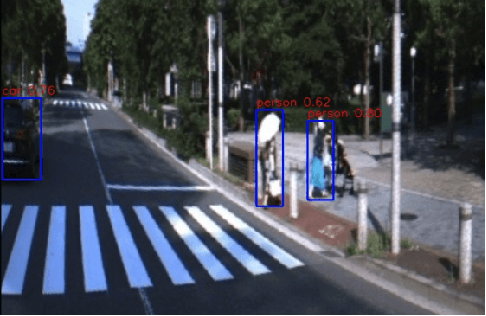
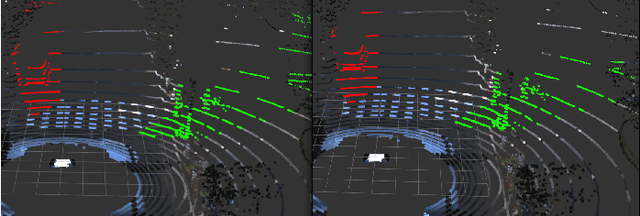

Lidar based 3D object detection and classification tasks are essential for autonomous driving(AD). A lidar sensor can provide the 3D point cloud data reconstruction of the surrounding environment. However, real time detection in 3D point clouds still needs a strong algorithmic. This paper proposes a 3D object detection method based on point cloud and image which consists of there parts.(1)Lidar-camera calibration and undistorted image transformation. (2)YOLO-based detection and PointCloud extraction, (3)K-means based point cloud segmentation and detection experiment test and evaluation in depth image. In our research, camera can capture the image to make the Real-time 2D object detection by using YOLO, we transfer the bounding box to node whose function is making 3d object detection on point cloud data from Lidar. By comparing whether 2D coordinate transferred from the 3D point is in the object bounding box or not can achieve High-speed 3D object recognition function in GPU. The accuracy and precision get imporved after k-means clustering in point cloud. The speed of our detection method is a advantage faster than PointNet.