 Add to Chrome
 Add to Firefox
 Add to Edge
Designing Spatial Architectures for Sparse Attention: STAR Accelerator via Cross-Stage Tiling
Dec 24, 2025
Large language models (LLMs) rely on self-attention for contextual understanding, demanding high-throughput inference and large-scale token parallelism (LTPP). Existing dynamic sparsity accelerators falter under LTPP scenarios due to stage-isolated optimizations. Revisiting the end-to-end sparsity acceleration flow, we identify an overlooked opportunity: cross-stage coordination can substantially reduce redundant computation and memory access. We propose STAR, a cross-stage compute- and memory-efficient algorithm-hardware co-design tailored for Transformer inference under LTPP. STAR introduces a leading-zero-based sparsity prediction using log-domain add-only operations to minimize prediction overhead. It further employs distributed sorting and a sorted updating FlashAttention mechanism, guided by a coordinated tiling strategy that enables fine-grained stage interaction for improved memory efficiency and latency. These optimizations are supported by a dedicated STAR accelerator architecture, achieving up to 9.2$\times$ speedup and 71.2$\times$ energy efficiency over A100, and surpassing SOTA accelerators by up to 16.1$\times$ energy and 27.1$\times$ area efficiency gains. Further, we deploy STAR onto a multi-core spatial architecture, optimizing dataflow and execution orchestration for ultra-long sequence processing. Architectural evaluation shows that, compared to the baseline design, Spatial-STAR achieves a 20.1$\times$ throughput improvement.

PADE: A Predictor-Free Sparse Attention Accelerator via Unified Execution and Stage Fusion
Dec 16, 2025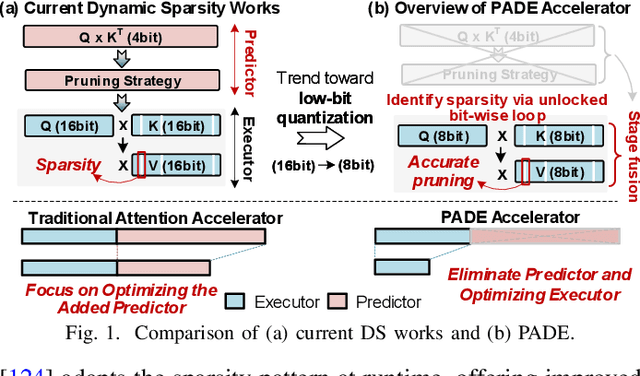
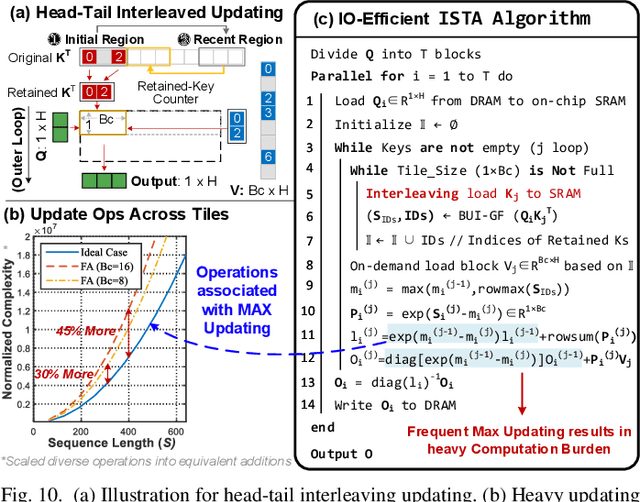
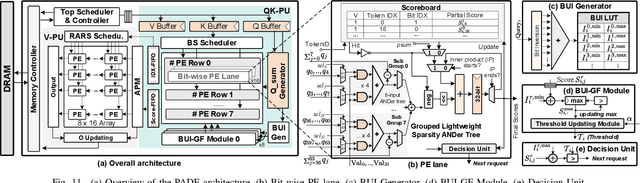
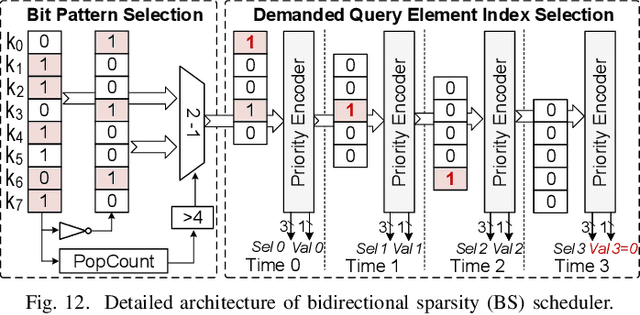
Attention-based models have revolutionized AI, but the quadratic cost of self-attention incurs severe computational and memory overhead. Sparse attention methods alleviate this by skipping low-relevance token pairs. However, current approaches lack practicality due to the heavy expense of added sparsity predictor, which severely drops their hardware efficiency. This paper advances the state-of-the-art (SOTA) by proposing a bit-serial enable stage-fusion (BSF) mechanism, which eliminates the need for a separate predictor. However, it faces key challenges: 1) Inaccurate bit-sliced sparsity speculation leads to incorrect pruning; 2) Hardware under-utilization due to fine-grained and imbalanced bit-level workloads. 3) Tiling difficulty caused by the row-wise dependency in sparsity pruning criteria. We propose PADE, a predictor-free algorithm-hardware co-design for dynamic sparse attention acceleration. PADE features three key innovations: 1) Bit-wise uncertainty interval-enabled guard filtering (BUI-GF) strategy to accurately identify trivial tokens during each bit round; 2) Bidirectional sparsity-based out-of-order execution (BS-OOE) to improve hardware utilization; 3) Interleaving-based sparsity-tiled attention (ISTA) to reduce both I/O and computational complexity. These techniques, combined with custom accelerator designs, enable practical sparsity acceleration without relying on an added sparsity predictor. Extensive experiments on 22 benchmarks show that PADE achieves 7.43x speed up and 31.1x higher energy efficiency than Nvidia H100 GPU. Compared to SOTA accelerators, PADE achieves 5.1x, 4.3x and 3.4x energy saving than Sanger, DOTA and SOFA.
WATOS: Efficient LLM Training Strategies and Architecture Co-exploration for Wafer-scale Chip
Dec 13, 2025Training large language models (LLMs) imposes extreme demands on computation, memory capacity, and interconnect bandwidth, driven by their ever-increasing parameter scales and intensive data movement. Wafer-scale integration offers a promising solution by densely integrating multiple single-die chips with high-speed die-to-die (D2D) interconnects. However, the limited wafer area necessitates trade-offs among compute, memory, and communication resources. Fully harnessing the potential of wafer-scale integration while mitigating its architectural constraints is essential for maximizing LLM training performance. This imposes significant challenges for the co-optimization of architecture and training strategies. Unfortunately, existing approaches all fall short in addressing these challenges. To bridge the gap, we propose WATOS, a co-exploration framework for LLM training strategy and wafer-scale architecture. We first define a highly configurable hardware template designed to explore optimal architectural parameters for wafer-scale chips. Based on it, we capitalize on the high D2D bandwidth and fine-grained operation advantages inherent to wafer-scale chips to explore optimal parallelism and resource allocation strategies, effectively addressing the memory underutilization issues during LLM training. Compared to the state-of-the-art (SOTA) LLM training framework Megatron and Cerebras' weight streaming wafer training strategy, WATOS can achieve an average overall throughput improvement of 2.74x and 1.53x across various LLM models, respectively. In addition, we leverage WATOS to reveal intriguing insights about wafer-scale architecture design with the training of LLM workloads.