 Add to Chrome
 Add to Firefox
 Add to Edge
DT-Guard: Intent-Driven Reasoning-Active Training for Reasoning-Free LLM Safety Guardrail
Jul 07, 2026
Large language models deployed in open-world applications require safety guardrails that are both robust to complex risks and efficient enough for low-latency runtime moderation. Existing guardrails face a practical trade-off between lightweight classification-based models, which are efficient but often struggle with concealed intent, ambiguous semantics, and borderline safety decisions, and reasoning-based guards, which improve judgment quality but introduce additional token generation and inference latency. We present DT-Guard, a content safety guardrail model based on a Reasoning-Active Training, Reasoning-Free Inference paradigm. The key idea is to use reasoning supervision during training while emitting only structured safety labels at inference time. DT-Guard formulates safety judgment as a progressive decision process, Intent - Category - Safety, and constructs an intent-driven dataset with intent labels, risk categories, safety labels, and structured reasoning trajectories. To further improve hard-case robustness, we propose Rollout-Guided Progressive Hard-Case Optimization (RG-PHO), which uses multi-rollout consistency to identify stably mastered, persistently failed, and preference-unstable samples, and applies targeted supervised and preference optimization accordingly. At inference time, DT-Guard directly generates structured labels without explicit reasoning traces, preserving deployment efficiency. Experiments on prompt-side and response-side safety benchmarks show that DT-Guard achieves average F1 scores of 0.886 and 0.870, respectively. With only a 4B backbone, it reaches a dual-side average F1 of 0.878, outperforming strong 8B guardrail baselines. These results demonstrate that reasoning supervision can be effectively internalized into low-latency safety discrimination.

GaussianEM: Model compositional and conformational heterogeneity using 3D Gaussians
Dec 25, 2025Understanding protein flexibility and its dynamic interactions with other molecules is essential for protein function study. Cryogenic electron microscopy (cryo-EM) provides an opportunity to directly observe macromolecular dynamics. However, analyzing datasets that contain both continuous motions and discrete states remains highly challenging. Here we present GaussianEM, a Gaussian pseudo-atomic framework that simultaneously models compositional and conformational heterogeneity from experimental cryo-EM images. GaussianEM employs a two-encoder-one-decoder architecture to map an image to its individual Gaussian components, and represent structural variability through changes in Gaussian parameters. This approach provides an intuitive and interpretable description of conformational changes, preserves local structural consistency along the transition trajectories, and naturally bridges the gap between density-based models and corresponding atomic models. We demonstrate the effectiveness of GaussianEM on both simulated and experimental datasets.
CryoAlign: feature-based method for global and local 3D alignment of EM density maps
Sep 17, 2023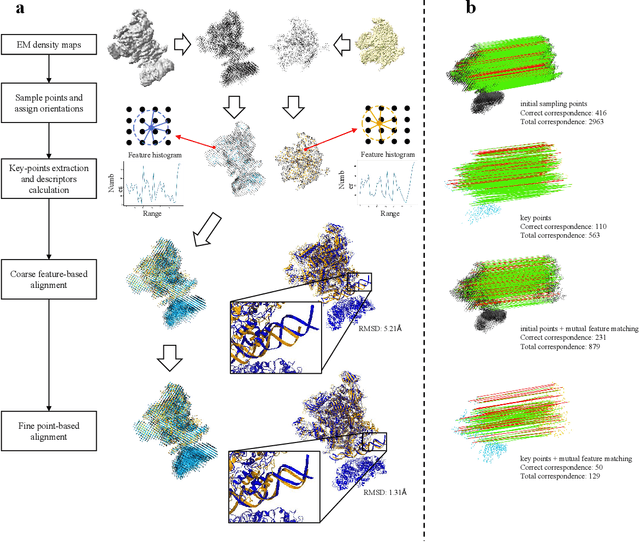
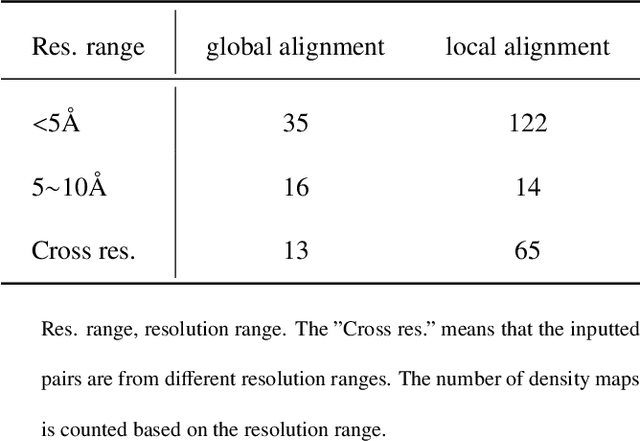
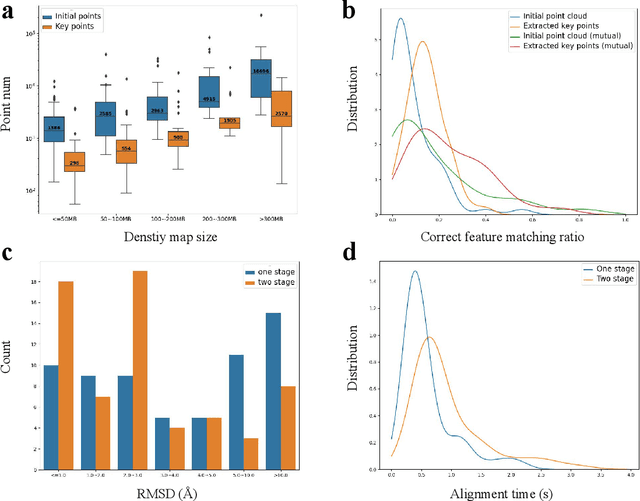
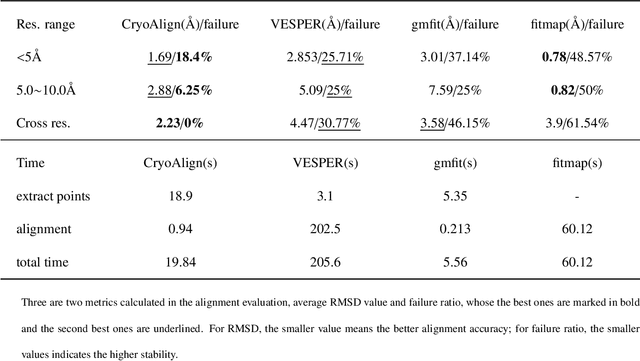
Advances on cryo-electron imaging technologies have led to a rapidly increasing number of density maps. Alignment and comparison of density maps play a crucial role in interpreting structural information, such as conformational heterogeneity analysis using global alignment and atomic model assembly through local alignment. Here, we propose a fast and accurate global and local cryo-electron microscopy density map alignment method CryoAlign, which leverages local density feature descriptors to capture spatial structure similarities. CryoAlign is the first feature-based EM map alignment tool, in which the employment of feature-based architecture enables the rapid establishment of point pair correspondences and robust estimation of alignment parameters. Extensive experimental evaluations demonstrate the superiority of CryoAlign over the existing methods in both alignment accuracy and speed.