 Add to Chrome
 Add to Firefox
 Add to Edge
Towards Successful Implementation of Automated Raveling Detection: Effects of Training Data Size, Illumination Difference, and Spatial Shift
Apr 14, 2026
Raveling, the loss of aggregates, is a major form of asphalt pavement surface distress, especially on highways. While research has shown that machine learning and deep learning-based methods yield promising results for raveling detection by classification on range images, their performance often degrades in large-scale deployments where more diverse inference data may originate from different runs, sensors, and environmental conditions. This degradation highlights the need of a more generalizable and robust solution for real-world implementation. Thus, the objectives of this study are to 1) identify and assess potential variations that impact model robustness, such as the quantity of training data, illumination difference, and spatial shift; and 2) leverage findings to enhance model robustness under real-world conditions. To this end, we propose RavelingArena, a benchmark designed to evaluate model robustness to variations in raveling detection. Instead of collecting extensive new data, it is built by augmenting an existing dataset with diverse, controlled variations, thereby enabling variation-controlled experiments to quantify the impact of each variation. Results demonstrate that both the quantity and diversity of training data are critical to the accuracy of models, achieving at least a 9.2% gain in accuracy under the most diverse conditions in experiments. Additionally, a case study applying these findings to a multi-year test section in Georgia, U.S., shows significant improvements in year-to-year consistency, laying foundations for future studies on temporal deterioration modeling. These insights provide guidance for more reliable model deployment in raveling detection and other real-world tasks that require adaptability to diverse conditions.

Deep Learning for Crack Detection: A Review of Learning Paradigms, Generalizability, and Datasets
Aug 14, 2025Crack detection plays a crucial role in civil infrastructures, including inspection of pavements, buildings, etc., and deep learning has significantly advanced this field in recent years. While numerous technical and review papers exist in this domain, emerging trends are reshaping the landscape. These shifts include transitions in learning paradigms (from fully supervised learning to semi-supervised, weakly-supervised, unsupervised, few-shot, domain adaptation and fine-tuning foundation models), improvements in generalizability (from single-dataset performance to cross-dataset evaluation), and diversification in dataset reacquisition (from RGB images to specialized sensor-based data). In this review, we systematically analyze these trends and highlight representative works. Additionally, we introduce a new dataset collected with 3D laser scans, 3DCrack, to support future research and conduct extensive benchmarking experiments to establish baselines for commonly used deep learning methodologies, including recent foundation models. Our findings provide insights into the evolving methodologies and future directions in deep learning-based crack detection. Project page: https://github.com/nantonzhang/Awesome-Crack-Detection
EscherNet++: Simultaneous Amodal Completion and Scalable View Synthesis through Masked Fine-Tuning and Enhanced Feed-Forward 3D Reconstruction
Jul 10, 2025We propose EscherNet++, a masked fine-tuned diffusion model that can synthesize novel views of objects in a zero-shot manner with amodal completion ability. Existing approaches utilize multiple stages and complex pipelines to first hallucinate missing parts of the image and then perform novel view synthesis, which fail to consider cross-view dependencies and require redundant storage and computing for separate stages. Instead, we apply masked fine-tuning including input-level and feature-level masking to enable an end-to-end model with the improved ability to synthesize novel views and conduct amodal completion. In addition, we empirically integrate our model with other feed-forward image-to-mesh models without extra training and achieve competitive results with reconstruction time decreased by 95%, thanks to its ability to synthesize arbitrary query views. Our method's scalable nature further enhances fast 3D reconstruction. Despite fine-tuning on a smaller dataset and batch size, our method achieves state-of-the-art results, improving PSNR by 3.9 and Volume IoU by 0.28 on occluded tasks in 10-input settings, while also generalizing to real-world occluded reconstruction.
A Novel Discrete Memristor-Coupled Heterogeneous Dual-Neuron Model and Its Application in Multi-Scenario Image Encryption
May 30, 2025Simulating brain functions using neural networks is an important area of research. Recently, discrete memristor-coupled neurons have attracted significant attention, as memristors effectively mimic synaptic behavior, which is essential for learning and memory. This highlights the biological relevance of such models. This study introduces a discrete memristive heterogeneous dual-neuron network (MHDNN). The stability of the MHDNN is analyzed with respect to initial conditions and a range of neuronal parameters. Numerical simulations demonstrate complex dynamical behaviors. Various neuronal firing patterns are investigated under different coupling strengths, and synchronization phenomena between neurons are explored. The MHDNN is implemented and validated on the STM32 hardware platform. An image encryption algorithm based on the MHDNN is proposed, along with two hardware platforms tailored for multi-scenario police image encryption. These solutions enable real-time and secure transmission of police data in complex environments, reducing hacking risks and enhancing system security.
Event-Based Eye Tracking. AIS 2024 Challenge Survey
Apr 17, 2024
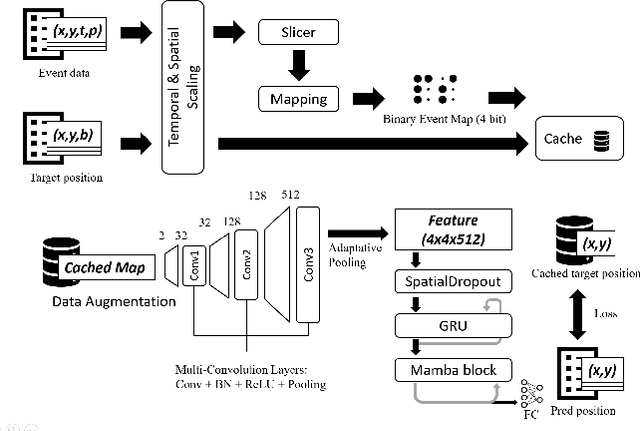
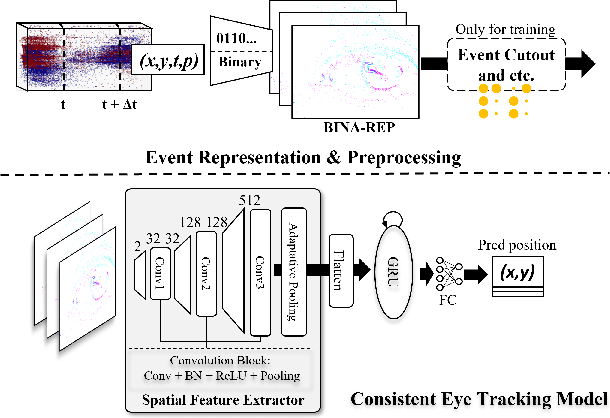

This survey reviews the AIS 2024 Event-Based Eye Tracking (EET) Challenge. The task of the challenge focuses on processing eye movement recorded with event cameras and predicting the pupil center of the eye. The challenge emphasizes efficient eye tracking with event cameras to achieve good task accuracy and efficiency trade-off. During the challenge period, 38 participants registered for the Kaggle competition, and 8 teams submitted a challenge factsheet. The novel and diverse methods from the submitted factsheets are reviewed and analyzed in this survey to advance future event-based eye tracking research.