 Add to Chrome
 Add to Firefox
 Add to Edge
Symbolic Regression via Latent Iterative Refinement
May 26, 2026
Symbolic regression (SR) seeks closed-form mathematical expressions that fit observed data. Neural SR methods amortize the search by training an encoder to map observations directly to expressions in a single pass, but this amortized inference leaves a residual amortization gap between its one-shot prediction and the true posterior. We propose Latent Equation Embedding (LEE), a framework that closes this gap through iterative amortized inference in a functionally grounded latent space. LEE learns a shared latent space Z equipped with three components: an encoder f_theta that jointly embeds symbolic tokens and numerical observations into a single latent vector z; an expression decoder g_expr that reconstructs formulas from z; and an evaluation decoder g_eval that predicts function values from z, explicitly grounding the latent space in functional behavior. At inference, LEE performs iterative refinement by re-encoding decoded expressions jointly with observations, progressively improving the latent estimate. LEE uses the encoder itself as a learned inference optimizer: each re-encoding step implicitly computes the mismatch between the candidate and the data. Because g_eval is differentiable in z, we additionally interleave continuous gradient descent with discrete re-encoding, yielding a hybrid iterative and gradient refinement procedure. On SRBench across three noise levels, against 19 baselines spanning genetic programming, symbolic-neural hybrids, and pre-trained Transformers, LEE produces expressions 2--10x simpler than the strongest accuracy-oriented baselines, including Operon, GP-GOMEA, TPSR, RAG-SR, and GenSR, with complexity 8--11 versus 20--90. These results advance the low-complexity region of the accuracy-complexity Pareto frontier and show graceful degradation as noise increases.

Symbolic Density Estimation: A Decompositional Approach
Mar 30, 2026We introduce AI-Kolmogorov, a novel framework for Symbolic Density Estimation (SymDE). Symbolic regression (SR) has been effectively used to produce interpretable models in standard regression settings but its applicability to density estimation tasks has largely been unexplored. To address the SymDE task we introduce a multi-stage pipeline: (i) problem decomposition through clustering and/or probabilistic graphical model structure learning; (ii) nonparametric density estimation; (iii) support estimation; and finally (iv) SR on the density estimate. We demonstrate the efficacy of AI-Kolmogorov on synthetic mixture models, multivariate normal distributions, and three exotic distributions, two of which are motivated by applications in high-energy physics. We show that AI-Kolmogorov can discover underlying distributions or otherwise provide valuable insight into the mathematical expressions describing them.
FrontierCS: Evolving Challenges for Evolving Intelligence
Dec 17, 2025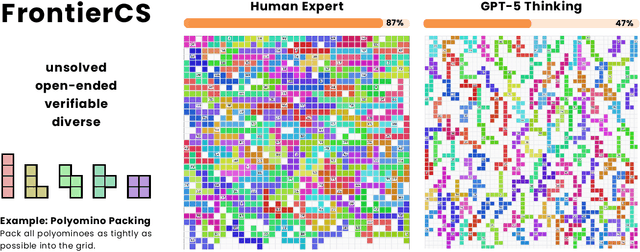

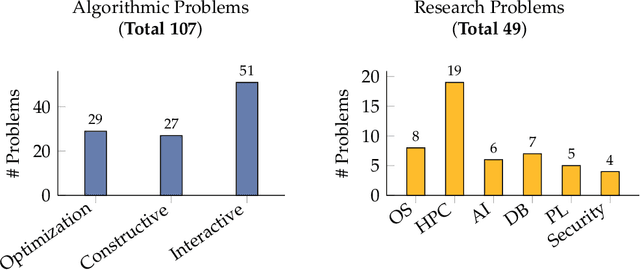

We introduce FrontierCS, a benchmark of 156 open-ended problems across diverse areas of computer science, designed and reviewed by experts, including CS PhDs and top-tier competitive programming participants and problem setters. Unlike existing benchmarks that focus on tasks with known optimal solutions, FrontierCS targets problems where the optimal solution is unknown, but the quality of a solution can be objectively evaluated. Models solve these tasks by implementing executable programs rather than outputting a direct answer. FrontierCS includes algorithmic problems, which are often NP-hard variants of competitive programming problems with objective partial scoring, and research problems with the same property. For each problem we provide an expert reference solution and an automatic evaluator. Combining open-ended design, measurable progress, and expert curation, FrontierCS provides a benchmark at the frontier of computer-science difficulty. Empirically, we find that frontier reasoning models still lag far behind human experts on both the algorithmic and research tracks, that increasing reasoning budgets alone does not close this gap, and that models often over-optimize for generating merely workable code instead of discovering high-quality algorithms and system designs.
Neural Symbolic Regression using Control Variables
Jun 07, 2023Symbolic regression (SR) is a powerful technique for discovering the analytical mathematical expression from data, finding various applications in natural sciences due to its good interpretability of results. However, existing methods face scalability issues when dealing with complex equations involving multiple variables. To address this challenge, we propose SRCV, a novel neural symbolic regression method that leverages control variables to enhance both accuracy and scalability. The core idea is to decompose multi-variable symbolic regression into a set of single-variable SR problems, which are then combined in a bottom-up manner. The proposed method involves a four-step process. First, we learn a data generator from observed data using deep neural networks (DNNs). Second, the data generator is used to generate samples for a certain variable by controlling the input variables. Thirdly, single-variable symbolic regression is applied to estimate the corresponding mathematical expression. Lastly, we repeat steps 2 and 3 by gradually adding variables one by one until completion. We evaluate the performance of our method on multiple benchmark datasets. Experimental results demonstrate that the proposed SRCV significantly outperforms state-of-the-art baselines in discovering mathematical expressions with multiple variables. Moreover, it can substantially reduce the search space for symbolic regression. The source code will be made publicly available upon publication.