 Add to Chrome
 Add to Firefox
 Add to Edge
CNSL-bench: Benchmarking the Sign Language Understanding Capabilities of MLLMs on Chinese National Sign Language
Apr 24, 2026
Sign language research has achieved significant progress due to the advances in large language models (LLMs). However, the intrinsic ability of LLMs to understand sign language, especially in multimodal contexts, remains underexplored. To address this limitation, we introduce CNSL-bench, the first comprehensive Chinese em{National Sign Language benchmark designed for evaluating multimodal large language models (MLLMs) in sign language understanding. The proposed CNSL-bench is characterized by: 1) Authoritative grounding, as it is anchored to the officially standardized \textit{National Common Sign Language Dictionary, mitigating ambiguity from regional or non-canonical variants and ensuring consistent semantic definitions; 2) Multimodal coverage, providing aligned textual descriptions, illustrative images, and sign language videos; and 3) Articulatory diversity, supporting fine-grained analysis across key manual articulatory forms, including air-writing, finger-spelling, and the Chinese manual-alphabet. Using CNSL-bench, we extensively evaluate 21 open-source and proprietary up-to-date MLLMs. Our results reveal that, despite recent advances in multimodal modeling, current MLLMs remain substantially inferior to human performance, exhibiting systematic disparities across input modalities and manual articulatory forms. Additional diagnostic analyses suggest that several performance limitations persist beyond improvements in reasoning and that instruction-following robustness varies substantially across models.

ClipGStream: Clip-Stream Gaussian Splatting for Any Length and Any Motion Multi-View Dynamic Scene Reconstruction
Apr 15, 2026Dynamic 3D scene reconstruction is essential for immersive media such as VR, MR, and XR, yet remains challenging for long multi-view sequences with large-scale motion. Existing dynamic Gaussian approaches are either Frame-Stream, offering scalability but poor temporal stability, or Clip, achieving local consistency at the cost of high memory and limited sequence length. We propose ClipGStream, a hybrid reconstruction framework that performs stream optimization at the clip level rather than the frame level. The sequence is divided into short clips, where dynamic motion is modeled using clip-independent spatio-temporal fields and residual anchor compensation to capture local variations efficiently, while inter-clip inherited anchors and decoders maintain structural consistency across clips. This Clip-Stream design enables scalable, flicker-free reconstruction of long dynamic videos with high temporal coherence and reduced memory overhead. Extensive experiments demonstrate that ClipGStream achieves state-of-the-art reconstruction quality and efficiency. The project page is available at: https://liangjie1999.github.io/ClipGStreamWeb/
Intrinsic Geometry-Appearance Consistency Optimization for Sparse-View Gaussian Splatting
Mar 03, 20263D human reconstruction from a single image is a challenging problem and has been exclusively studied in the literature. Recently, some methods have resorted to diffusion models for guidance, optimizing a 3D representation via Score Distillation Sampling(SDS) or generating a back-view image for facilitating reconstruction. However, these methods tend to produce unsatisfactory artifacts (\textit{e.g.} flattened human structure or over-smoothing results caused by inconsistent priors from multiple views) and struggle with real-world generalization in the wild. In this work, we present \emph{MVD-HuGaS}, enabling free-view 3D human rendering from a single image via a multi-view human diffusion model. We first generate multi-view images from the single reference image with an enhanced multi-view diffusion model, which is well fine-tuned on high-quality 3D human datasets to incorporate 3D geometry priors and human structure priors. To infer accurate camera poses from the sparse generated multi-view images for reconstruction, an alignment module is introduced to facilitate joint optimization of 3D Gaussians and camera poses. Furthermore, we propose a depth-based Facial Distortion Mitigation module to refine the generated facial regions, thereby improving the overall fidelity of the reconstruction. Finally, leveraging the refined multi-view images, along with their accurate camera poses, MVD-HuGaS optimizes the 3D Gaussians of the target human for high-fidelity free-view renderings. Extensive experiments on Thuman2.0 and 2K2K datasets show that the proposed MVD-HuGaS achieves state-of-the-art performance on single-view 3D human rendering.
Zero-Shot Visual Grounding in 3D Gaussians via View Retrieval
Sep 19, 2025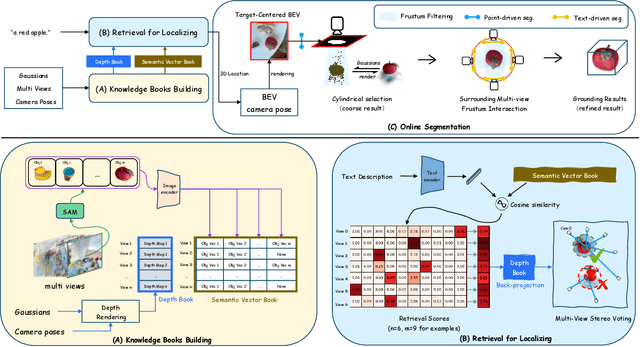
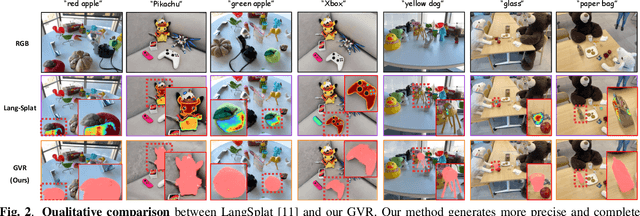
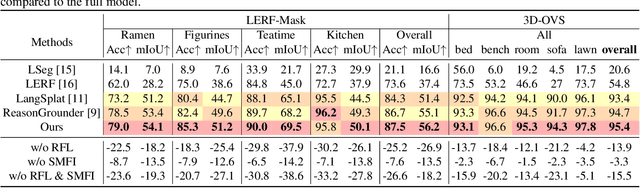
3D Visual Grounding (3DVG) aims to locate objects in 3D scenes based on text prompts, which is essential for applications such as robotics. However, existing 3DVG methods encounter two main challenges: first, they struggle to handle the implicit representation of spatial textures in 3D Gaussian Splatting (3DGS), making per-scene training indispensable; second, they typically require larges amounts of labeled data for effective training. To this end, we propose \underline{G}rounding via \underline{V}iew \underline{R}etrieval (GVR), a novel zero-shot visual grounding framework for 3DGS to transform 3DVG as a 2D retrieval task that leverages object-level view retrieval to collect grounding clues from multiple views, which not only avoids the costly process of 3D annotation, but also eliminates the need for per-scene training. Extensive experiments demonstrate that our method achieves state-of-the-art visual grounding performance while avoiding per-scene training, providing a solid foundation for zero-shot 3DVG research. Video demos can be found in https://github.com/leviome/GVR_demos.
Surface-SOS: Self-Supervised Object Segmentation via Neural Surface Representation
Jan 17, 2025


Self-supervised Object Segmentation (SOS) aims to segment objects without any annotations. Under conditions of multi-camera inputs, the structural, textural and geometrical consistency among each view can be leveraged to achieve fine-grained object segmentation. To make better use of the above information, we propose Surface representation based Self-supervised Object Segmentation (Surface-SOS), a new framework to segment objects for each view by 3D surface representation from multi-view images of a scene. To model high-quality geometry surfaces for complex scenes, we design a novel scene representation scheme, which decomposes the scene into two complementary neural representation modules respectively with a Signed Distance Function (SDF). Moreover, Surface-SOS is able to refine single-view segmentation with multi-view unlabeled images, by introducing coarse segmentation masks as additional input. To the best of our knowledge, Surface-SOS is the first self-supervised approach that leverages neural surface representation to break the dependence on large amounts of annotated data and strong constraints. These constraints typically involve observing target objects against a static background or relying on temporal supervision in videos. Extensive experiments on standard benchmarks including LLFF, CO3D, BlendedMVS, TUM and several real-world scenes show that Surface-SOS always yields finer object masks than its NeRF-based counterparts and surpasses supervised single-view baselines remarkably. Code is available at: https://github.com/zhengxyun/Surface-SOS.
PKU-DyMVHumans: A Multi-View Video Benchmark for High-Fidelity Dynamic Human Modeling
Apr 02, 2024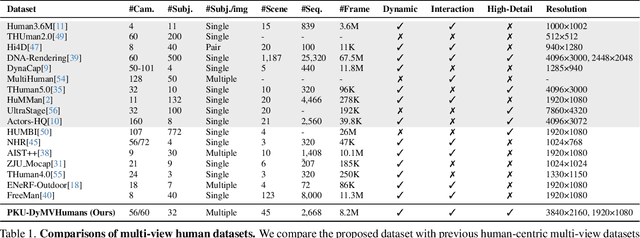
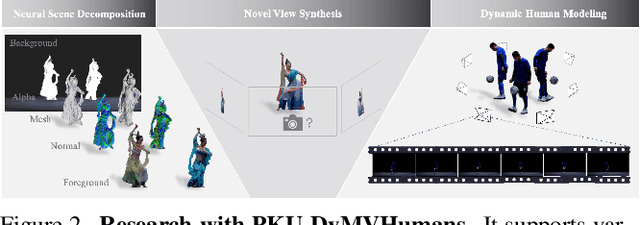
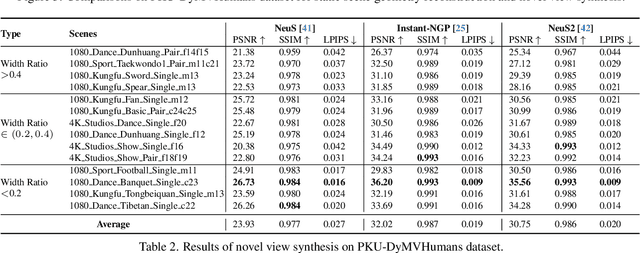
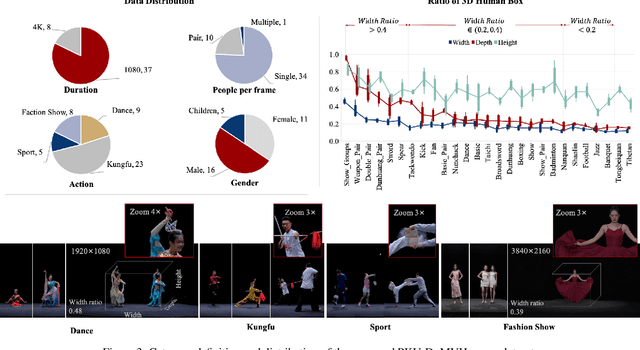
High-quality human reconstruction and photo-realistic rendering of a dynamic scene is a long-standing problem in computer vision and graphics. Despite considerable efforts invested in developing various capture systems and reconstruction algorithms, recent advancements still struggle with loose or oversized clothing and overly complex poses. In part, this is due to the challenges of acquiring high-quality human datasets. To facilitate the development of these fields, in this paper, we present PKU-DyMVHumans, a versatile human-centric dataset for high-fidelity reconstruction and rendering of dynamic human scenarios from dense multi-view videos. It comprises 8.2 million frames captured by more than 56 synchronized cameras across diverse scenarios. These sequences comprise 32 human subjects across 45 different scenarios, each with a high-detailed appearance and realistic human motion. Inspired by recent advancements in neural radiance field (NeRF)-based scene representations, we carefully set up an off-the-shelf framework that is easy to provide those state-of-the-art NeRF-based implementations and benchmark on PKU-DyMVHumans dataset. It is paving the way for various applications like fine-grained foreground/background decomposition, high-quality human reconstruction and photo-realistic novel view synthesis of a dynamic scene. Extensive studies are performed on the benchmark, demonstrating new observations and challenges that emerge from using such high-fidelity dynamic data.