 Add to Chrome
 Add to Firefox
 Add to Edge
FDM-MFVT: Few-step Sampling Diffusion Model for Mask-Free Virtual Try-On
Jun 28, 2026
Image-based Virtual Try-On (IVTON) has greatly advanced through diffusion models, yet existing methods require many sampling steps and depend on masks with costly auxiliary networks. In addition, the absence of large-scale mask-free paired datasets further limits the development of mask-free IVTON. We propose FDM-MFVT, a few-step diffusion model for mask-free IVTON, integrating an Outfit-aware Noise Optimization Module (OANO) and an Instruction-driven Try-on Module (IDT) to enhance efficiency and flexibility.The OANO module initializes the alignment space with noise using the input image and only needs 6 steps to generate a higher-fidelity try-on image compared to 30 steps.The IDT module uses virtual try-on prompts and efficient adaptation to generate high-quality results from garment and person images alone. We further introduce MFVT, a 30,000-pair mask-free IVTON dataset. Experiments show that FDM-MFVT achieves superior quantitative and qualitative results with fewer inference steps than mask-based and mask-free baseline methods.

VTEdit-Bench: A Comprehensive Benchmark for Multi-Reference Image Editing Models in Virtual Try-On
Mar 12, 2026As virtual try-on (VTON) continues to advance, a growing number of real-world scenarios have emerged, pushing beyond the ability of the existing specialized VTON models. Meanwhile, universal multi-reference image editing models have progressed rapidly and exhibit strong generalization in visual editing, suggesting a promising route toward more flexible VTON systems. However, despite their strong capabilities, the strengths and limitations of universal editors for VTON remain insufficiently explored due to the lack of systematic evaluation benchmarks. To address this gap, we introduce VTEdit-Bench, a comprehensive benchmark designed to evaluate universal multi-reference image editing models across various realistic VTON scenarios. VTEdit-Bench contains 24,220 test image pairs spanning five representative VTON tasks with progressively increasing complexity, enabling systematic analysis of robustness and generalization. We further propose VTEdit-QA, a reference-aware VLM-based evaluator that assesses VTON performance from three key aspects: model consistency, cloth consistency, and overall image quality. Through this framework, we systematically evaluate eight universal editing models and compare them with seven specialized VTON models. Results show that top universal editors are competitive on conventional tasks and generalize more stably to harder scenarios, but remain challenged by complex reference configurations, particularly multi-cloth conditioning.
Burst Image Quality Assessment: A New Benchmark and Unified Framework for Multiple Downstream Tasks
Nov 11, 2025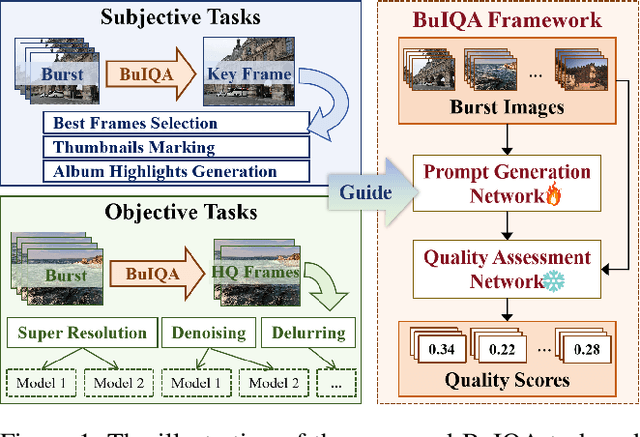
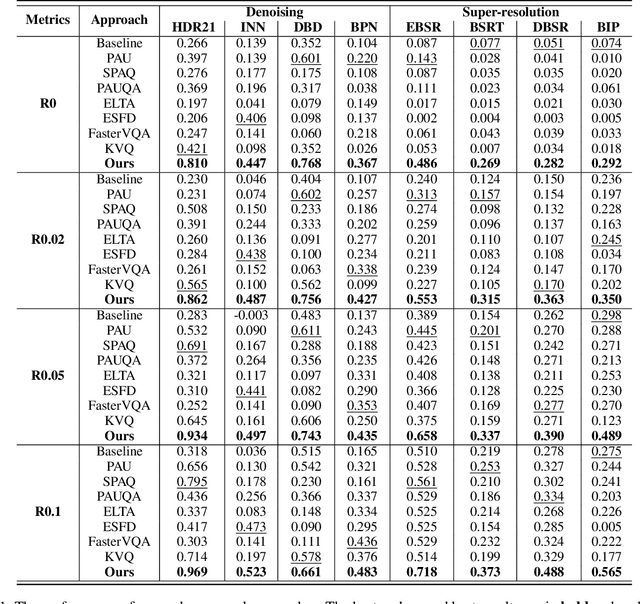

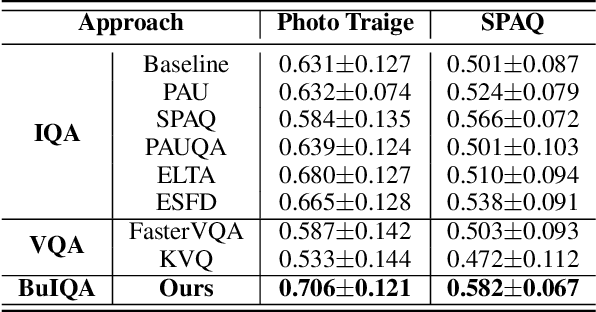
In recent years, the development of burst imaging technology has improved the capture and processing capabilities of visual data, enabling a wide range of applications. However, the redundancy in burst images leads to the increased storage and transmission demands, as well as reduced efficiency of downstream tasks. To address this, we propose a new task of Burst Image Quality Assessment (BuIQA), to evaluate the task-driven quality of each frame within a burst sequence, providing reasonable cues for burst image selection. Specifically, we establish the first benchmark dataset for BuIQA, consisting of $7,346$ burst sequences with $45,827$ images and $191,572$ annotated quality scores for multiple downstream scenarios. Inspired by the data analysis, a unified BuIQA framework is proposed to achieve an efficient adaption for BuIQA under diverse downstream scenarios. Specifically, a task-driven prompt generation network is developed with heterogeneous knowledge distillation, to learn the priors of the downstream task. Then, the task-aware quality assessment network is introduced to assess the burst image quality based on the task prompt. Extensive experiments across 10 downstream scenarios demonstrate the impressive BuIQA performance of the proposed approach, outperforming the state-of-the-art. Furthermore, it can achieve $0.33$ dB PSNR improvement in the downstream tasks of denoising and super-resolution, by applying our approach to select the high-quality burst frames.