 Add to Chrome
 Add to Firefox
 Add to Edge
CLASP: Closed-loop Asynchronous Spatial Perception for Open-vocabulary Desktop Object Grasping
Apr 13, 2026
Robot grasping of desktop object is widely used in intelligent manufacturing, logistics, and agriculture.Although vision-language models (VLMs) show strong potential for robotic manipulation, their deployment in low-level grasping faces key challenges: scarce high-quality multimodal demonstrations, spatial hallucination caused by weak geometric grounding, and the fragility of open-loop execution in dynamic environments. To address these challenges, we propose Closed-Loop Asynchronous Spatial Perception(CLASP), a novel asynchronous closed-loop framework that integrates multimodal perception, logical reasoning, and state-reflective feedback. First, we design a Dual-Pathway Hierarchical Perception module that decouples high-level semantic intent from geometric grounding. The design guides the output of the inference model and the definite action tuples, reducing spatial illusions. Second, an Asynchronous Closed-Loop Evaluator is implemented to compare pre- and post-execution states, providing text-based diagnostic feedback to establish a robust error-correction loop and improving the vulnerability of traditional open-loop execution in dynamic environments. Finally, we design a scalable multi-modal data engine that automatically synthesizes high-quality spatial annotations and reasoning templates from real and synthetic scenes without human teleoperation. Extensive experiments demonstrate that our approach significantly outperforms existing baselines, achieving an 87.0% overall success rate. Notably, the proposed framework exhibits remarkable generalization across diverse objects, bridging the sim-to-real gap and providing exceptional robustness in geometrically challenging categories and cluttered scenarios.

Efficient Distributed Retrieval-Augmented Generation for Enhancing Language Model Performance
Apr 16, 2025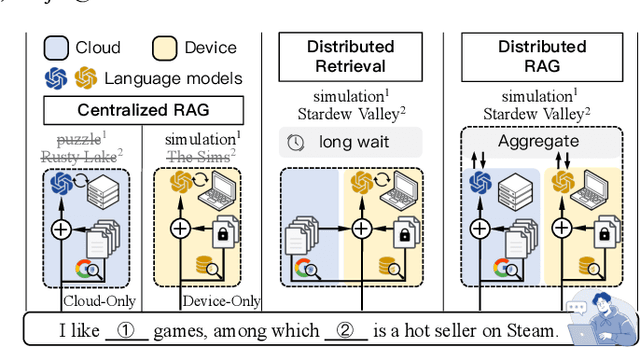
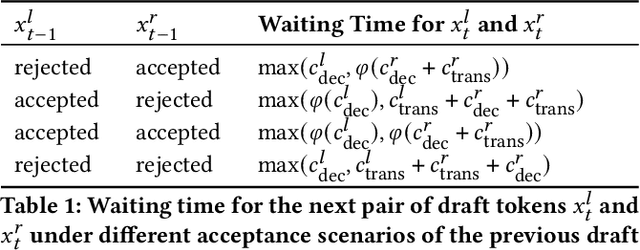
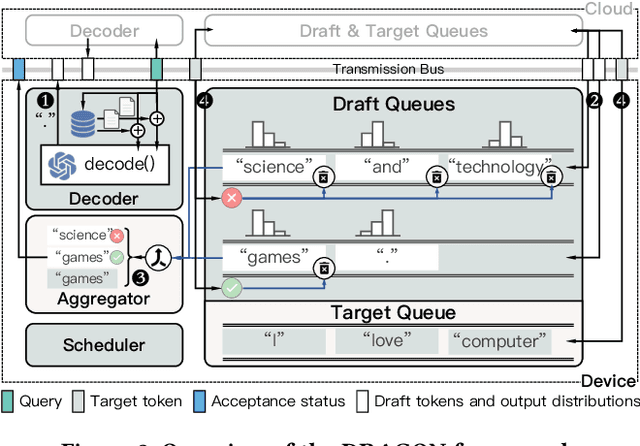
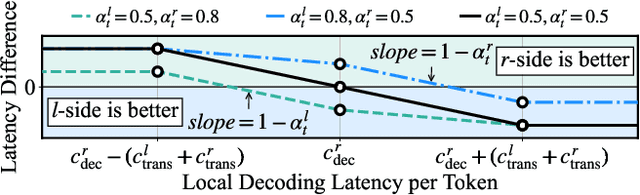
Small language models (SLMs) support efficient deployments on resource-constrained edge devices, but their limited capacity compromises inference performance. Retrieval-augmented generation (RAG) is a promising solution to enhance model performance by integrating external databases, without requiring intensive on-device model retraining. However, large-scale public databases and user-specific private contextual documents are typically located on the cloud and the device separately, while existing RAG implementations are primarily centralized. To bridge this gap, we propose DRAGON, a distributed RAG framework to enhance on-device SLMs through both general and personal knowledge without the risk of leaking document privacy. Specifically, DRAGON decomposes multi-document RAG into multiple parallel token generation processes performed independently and locally on the cloud and the device, and employs a newly designed Speculative Aggregation, a dual-side speculative algorithm to avoid frequent output synchronization between the cloud and device. A new scheduling algorithm is further introduced to identify the optimal aggregation side based on real-time network conditions. Evaluations on real-world hardware testbed demonstrate a significant performance improvement of DRAGON-up to 1.9x greater gains over standalone SLM compared to the centralized RAG, substantial reduction in per-token latency, and negligible Time to First Token (TTFT) overhead.