 Add to Chrome
 Add to Firefox
 Add to Edge
CAER: Conflict-Aware Evidence Routing with Dual Prefix Experts for Multimodal Large Language Models
Jul 31, 2026
Multimodal Large Language Models (MLLMs) have demonstrated remarkable capabilities in multimodal understanding and generation. However, when textual inputs conflict with visual evidence, they still suffer from hallucinations and produce responses inconsistent with visual content. Existing approaches mainly rely on decoding strategies, additional training, verification methods, or prompting techniques, but often lack fine-grained conflict localization and conflict-aware generation. In this work, we propose CAER, a backbone-agnostic framework for visual-language conflict detection and conflict-aware generation. CAER introduces a span-grounded evidence router that transforms claim representations into soft textual queries and retrieves corresponding evidence from frozen visual tokens, enabling fine-grained conflict estimation. Furthermore, we design a dual-prefix expert routing mechanism that learns separate experts for visually supported and contradicted inputs, enabling conflict-aware generation through explicit expert selection. Experiments on the public MMMC benchmark and our newly curated AgriConflict dataset demonstrate that CAER effectively detects visual-language conflicts and improves the reliability of open-source MLLMs without updating their backbone parameters.

Morphology-Aware Multimodal Representation Learning for Insect Phylogenetic Reconstruction
Jun 20, 2026Morphological traits provide important evidence for phylogenetic reconstruction and evolutionary relationship analysis. Recent image-based approaches have introduced deep learning, particularly convolutional models, to derive morphological features from specimen images, but these methods generally rely on single-modality visual representations and do not explicitly incorporate morphological semantics. This study proposes a morphology-aware multimodal alignment framework for insect phylogenetic reconstruction. The framework combines specimen images with curated morphological descriptions by adapting a vision transformer through parameter-efficient fine-tuning and supervised contrastive learning, followed by image-text alignment in a shared latent space. The learned image embeddings are then used as continuous traits for Bayesian phylogenetic reconstruction. On the public Rove-Tree-11 dataset, comparative and ablation experiments across multiple visual backbones and feature adaptation strategies demonstrate that multimodal alignment improves topological agreement with the reference phylogeny. The results indicate that the proposed framework can derive morphology-aware visual traits for computational phylogenetic reconstruction.
Attention Beats Linear for Fast Implicit Neural Representation Generation
Jul 22, 2024

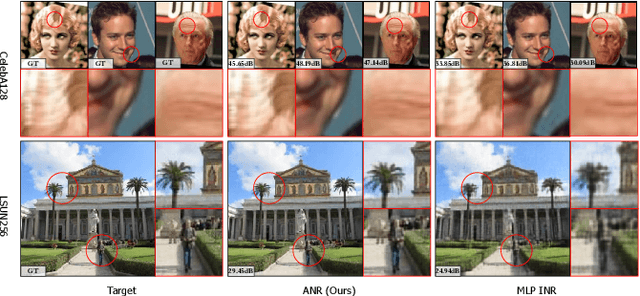
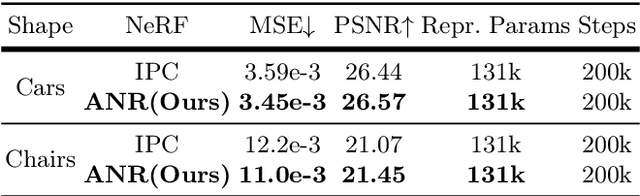
Implicit Neural Representation (INR) has gained increasing popularity as a data representation method, serving as a prerequisite for innovative generation models. Unlike gradient-based methods, which exhibit lower efficiency in inference, the adoption of hyper-network for generating parameters in Multi-Layer Perceptrons (MLP), responsible for executing INR functions, has surfaced as a promising and efficient alternative. However, as a global continuous function, MLP is challenging in modeling highly discontinuous signals, resulting in slow convergence during the training phase and inaccurate reconstruction performance. Moreover, MLP requires massive representation parameters, which implies inefficiencies in data representation. In this paper, we propose a novel Attention-based Localized INR (ANR) composed of a localized attention layer (LAL) and a global MLP that integrates coordinate features with data features and converts them to meaningful outputs. Subsequently, we design an instance representation framework that delivers a transformer-like hyper-network to represent data instances as a compact representation vector. With instance-specific representation vector and instance-agnostic ANR parameters, the target signals are well reconstructed as a continuous function. We further address aliasing artifacts with variational coordinates when obtaining the super-resolution inference results. Extensive experimentation across four datasets showcases the notable efficacy of our ANR method, e.g. enhancing the PSNR value from 37.95dB to 47.25dB on the CelebA dataset. Code is released at https://github.com/Roninton/ANR.
3D Facial Geometry Recovery from a Depth View with Attention Guided Generative Adversarial Network
Sep 02, 2020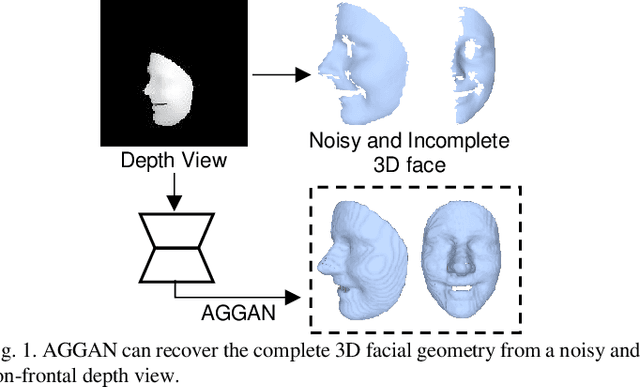
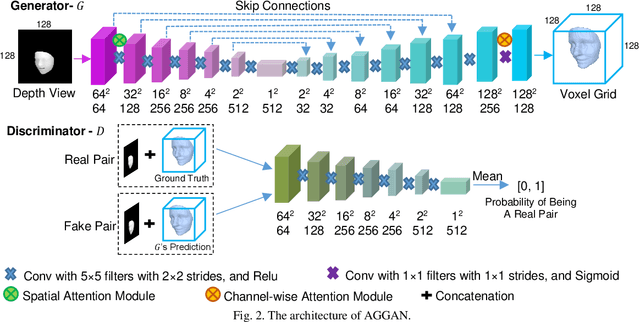
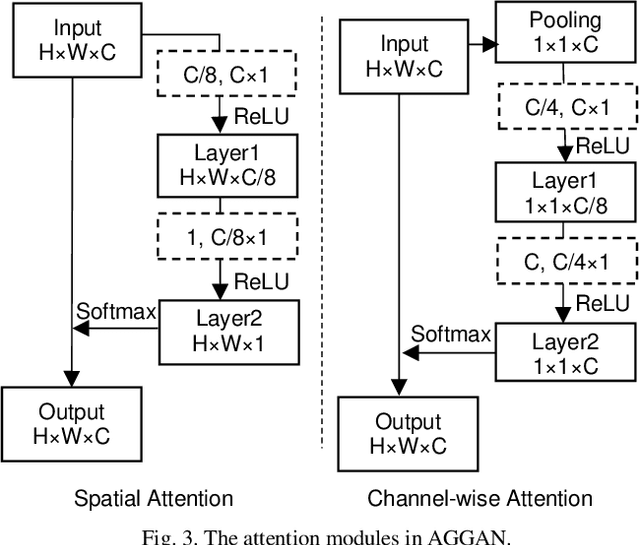
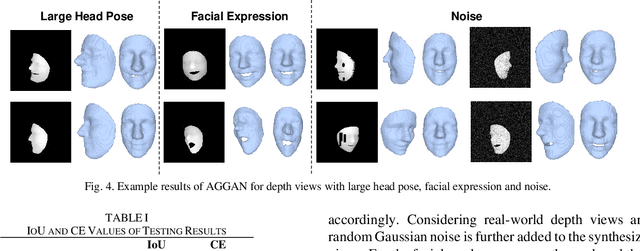
We present to recover the complete 3D facial geometry from a single depth view by proposing an Attention Guided Generative Adversarial Networks (AGGAN). In contrast to existing work which normally requires two or more depth views to recover a full 3D facial geometry, the proposed AGGAN is able to generate a dense 3D voxel grid of the face from a single unconstrained depth view. Specifically, AGGAN encodes the 3D facial geometry within a voxel space and utilizes an attention-guided GAN to model the illposed 2.5D depth-3D mapping. Multiple loss functions, which enforce the 3D facial geometry consistency, together with a prior distribution of facial surface points in voxel space are incorporated to guide the training process. Both qualitative and quantitative comparisons show that AGGAN recovers a more complete and smoother 3D facial shape, with the capability to handle a much wider range of view angles and resist to noise in the depth view than conventional methods
Real-time 3D Facial Tracking via Cascaded Compositional Learning
Sep 02, 2020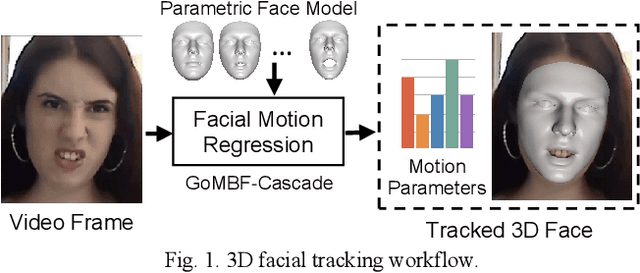
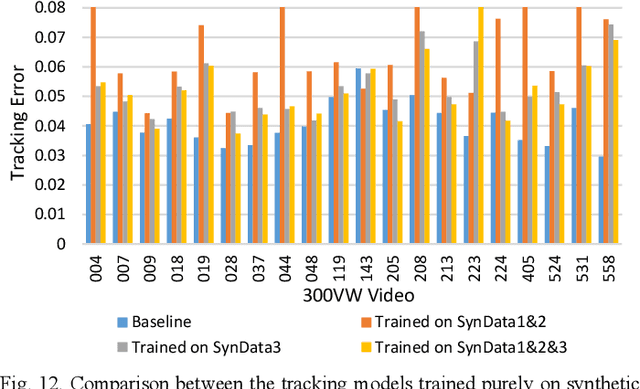
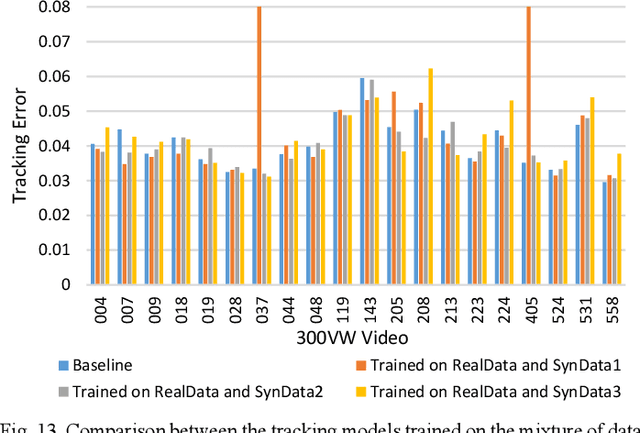
We propose to learn a cascade of globally-optimized modular boosted ferns (GoMBF) to solve multi-modal facial motion regression for real-time 3D facial tracking from a monocular RGB camera. GoMBF is a deep composition of multiple regression models with each is a boosted ferns initially trained to predict partial motion parameters of the same modality, and then concatenated together via a global optimization step to form a singular strong boosted ferns that can effectively handle the whole regression target. It can explicitly cope with the modality variety in output variables, while manifesting increased fitting power and a faster learning speed comparing against the conventional boosted ferns. By further cascading a sequence of GoMBFs (GoMBF-Cascade) to regress facial motion parameters, we achieve competitive tracking performance on a variety of in-the-wild videos comparing to the state-of-the-art methods, which require much more training data or have higher computational complexity. It provides a robust and highly elegant solution to real-time 3D facial tracking using a small set of training data and hence makes it more practical in real-world applications.