 Add to Chrome
 Add to Firefox
 Add to Edge
Interpretable Relational Inference with LLM-Guided Symbolic Dynamics Modeling
Apr 14, 2026
Inferring latent interaction structures from observed dynamics is a fundamental inverse problem in many-body interacting systems. Most neural approaches rely on black-box surrogates over trainable graphs, achieving accuracy at the expense of mechanistic interpretability. Symbolic regression offers explicit dynamical equations and stronger inductive biases, but typically assumes known topology and a fixed function library. We propose \textbf{COSINE} (\textbf{C}o-\textbf{O}ptimization of \textbf{S}ymbolic \textbf{I}nteractions and \textbf{N}etwork \textbf{E}dges), a differentiable framework that jointly discovers interaction graphs and sparse symbolic dynamics. To overcome the limitations of fixed symbolic libraries, COSINE further incorporates an outer-loop large language model that adaptively prunes and expands the hypothesis space using feedback from the inner optimization loop. Experiments on synthetic systems and large-scale real-world epidemic data demonstrate robust structural recovery and compact, mechanism-aligned dynamical expressions. Code: https://anonymous.4open.science/r/COSINE-6D43.

CAMO: Correlation-Aware Mask Optimization with Modulated Reinforcement Learning
Apr 01, 2024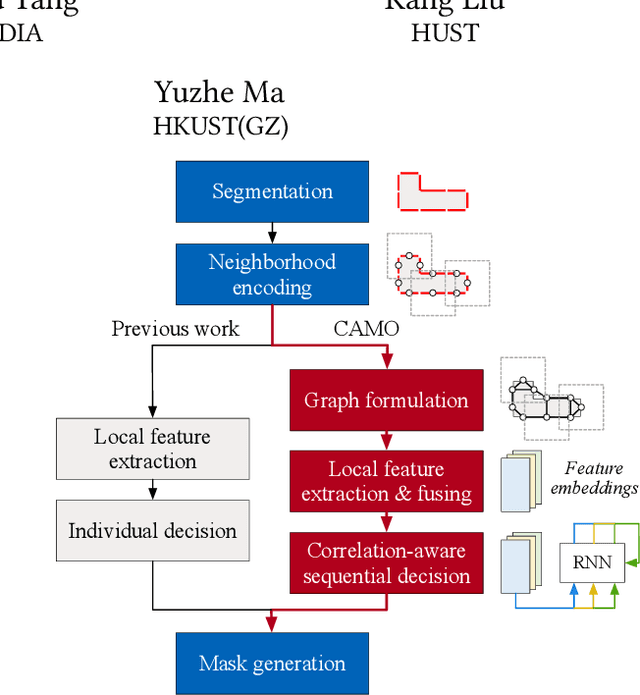
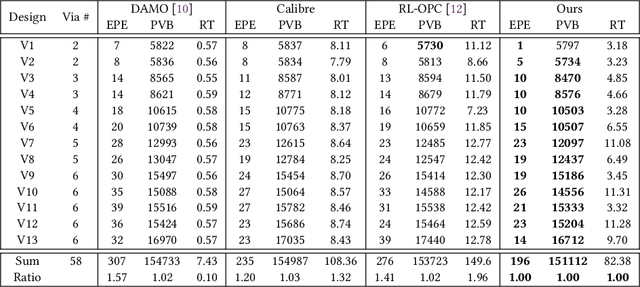

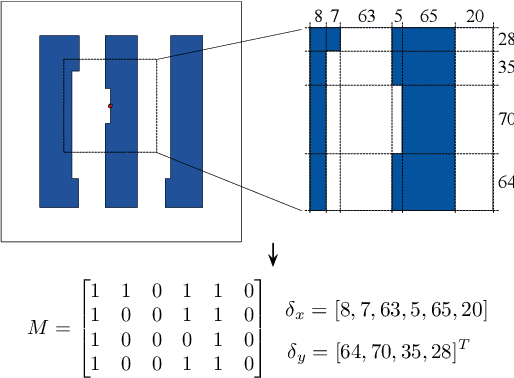
Optical proximity correction (OPC) is a vital step to ensure printability in modern VLSI manufacturing. Various OPC approaches based on machine learning have been proposed to pursue performance and efficiency, which are typically data-driven and hardly involve any particular considerations of the OPC problem, leading to potential performance or efficiency bottlenecks. In this paper, we propose CAMO, a reinforcement learning-based OPC system that specifically integrates important principles of the OPC problem. CAMO explicitly involves the spatial correlation among the movements of neighboring segments and an OPC-inspired modulation for movement action selection. Experiments are conducted on both via layer patterns and metal layer patterns. The results demonstrate that CAMO outperforms state-of-the-art OPC engines from both academia and industry.
RSCFed: Random Sampling Consensus Federated Semi-supervised Learning
Mar 26, 2022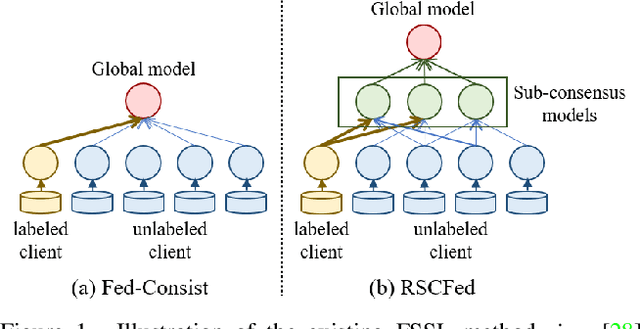
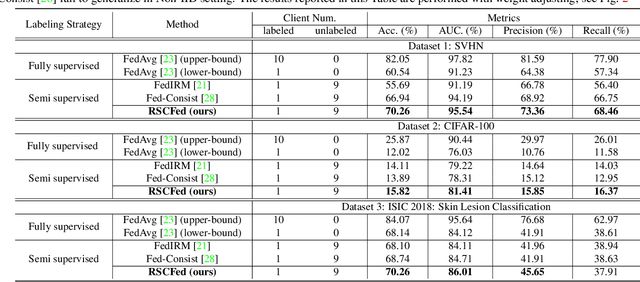
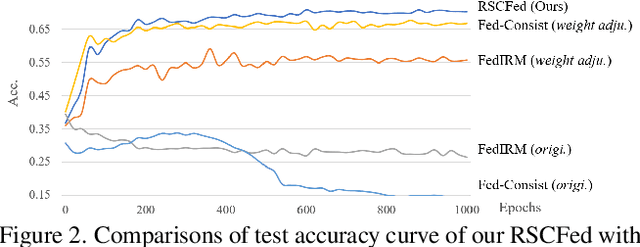
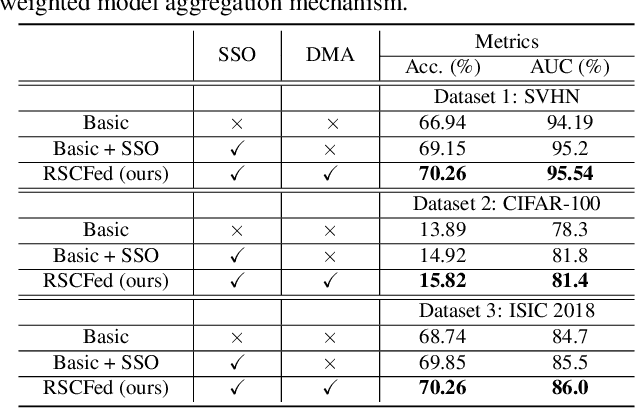
Federated semi-supervised learning (FSSL) aims to derive a global model by training fully-labeled and fully-unlabeled clients or training partially labeled clients. The existing approaches work well when local clients have independent and identically distributed (IID) data but fail to generalize to a more practical FSSL setting, i.e., Non-IID setting. In this paper, we present a Random Sampling Consensus Federated learning, namely RSCFed, by considering the uneven reliability among models from fully-labeled clients, fully-unlabeled clients or partially labeled clients. Our key motivation is that given models with large deviations from either labeled clients or unlabeled clients, the consensus could be reached by performing random sub-sampling over clients. To achieve it, instead of directly aggregating local models, we first distill several sub-consensus models by random sub-sampling over clients and then aggregating the sub-consensus models to the global model. To enhance the robustness of sub-consensus models, we also develop a novel distance-reweighted model aggregation method. Experimental results show that our method outperforms state-of-the-art methods on three benchmarked datasets, including both natural and medical images. The code is available at https://github.com/XMed-Lab/RSCFed.