 Add to Chrome
 Add to Firefox
 Add to Edge
RadDiff: Describing Differences in Radiology Image Sets with Natural Language
Jan 07, 2026
Understanding how two radiology image sets differ is critical for generating clinical insights and for interpreting medical AI systems. We introduce RadDiff, a multimodal agentic system that performs radiologist-style comparative reasoning to describe clinically meaningful differences between paired radiology studies. RadDiff builds on a proposer-ranker framework from VisDiff, and incorporates four innovations inspired by real diagnostic workflows: (1) medical knowledge injection through domain-adapted vision-language models; (2) multimodal reasoning that integrates images with their clinical reports; (3) iterative hypothesis refinement across multiple reasoning rounds; and (4) targeted visual search that localizes and zooms in on salient regions to capture subtle findings. To evaluate RadDiff, we construct RadDiffBench, a challenging benchmark comprising 57 expert-validated radiology study pairs with ground-truth difference descriptions. On RadDiffBench, RadDiff achieves 47% accuracy, and 50% accuracy when guided by ground-truth reports, significantly outperforming the general-domain VisDiff baseline. We further demonstrate RadDiff's versatility across diverse clinical tasks, including COVID-19 phenotype comparison, racial subgroup analysis, and discovery of survival-related imaging features. Together, RadDiff and RadDiffBench provide the first method-and-benchmark foundation for systematically uncovering meaningful differences in radiological data.

MetaKP: On-Demand Keyphrase Generation
Jun 28, 2024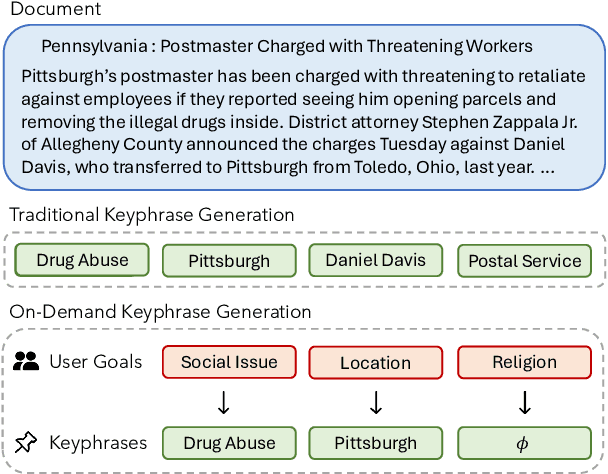
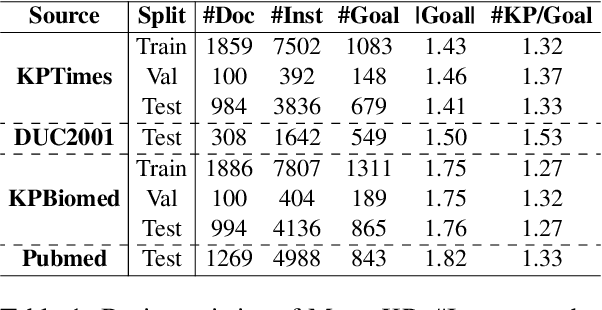
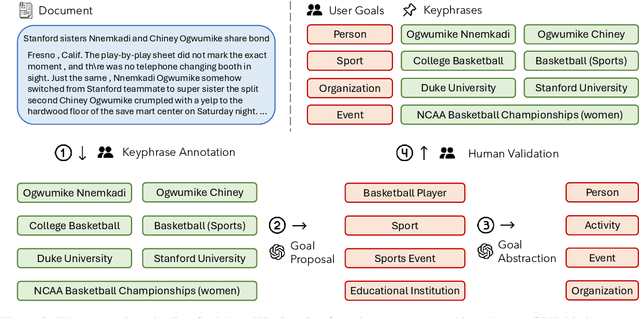
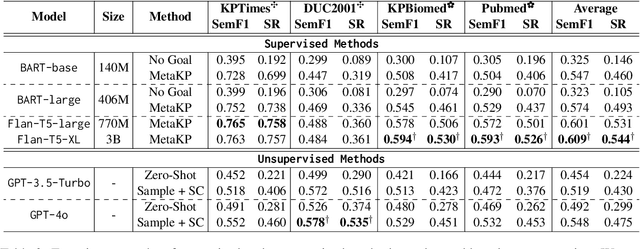
Traditional keyphrase prediction methods predict a single set of keyphrases per document, failing to cater to the diverse needs of users and downstream applications. To bridge the gap, we introduce on-demand keyphrase generation, a novel paradigm that requires keyphrases that conform to specific high-level goals or intents. For this task, we present MetaKP, a large-scale benchmark comprising four datasets, 7500 documents, and 3760 goals across news and biomedical domains with human-annotated keyphrases. Leveraging MetaKP, we design both supervised and unsupervised methods, including a multi-task fine-tuning approach and a self-consistency prompting method with large language models. The results highlight the challenges of supervised fine-tuning, whose performance is not robust to distribution shifts. By contrast, the proposed self-consistency prompting approach greatly improves the performance of large language models, enabling GPT-4o to achieve 0.548 SemF1, surpassing the performance of a fully fine-tuned BART-base model. Finally, we demonstrate the potential of our method to serve as a general NLP infrastructure, exemplified by its application in epidemic event detection from social media.