 Add to Chrome
 Add to Firefox
 Add to Edge
SSKG Hub: An Expert-Guided Platform for LLM-Empowered Sustainability Standards Knowledge Graphs
Feb 28, 2026
Sustainability disclosure standards (e.g., GRI, SASB, TCFD, IFRS S2) are comprehensive yet lengthy, terminology-dense, and highly cross-referential, hindering structured analysis and downstream use. We present SSKG Hub (Sustainability Standards Knowledge Graph Hub), a research prototype and interactive web platform that transforms standards into auditable knowledge graphs (KGs) through an LLM-centered, expert-guided pipeline. The system integrates automatic standard identification, configurable chunking, standard-specific prompting, robust triple parsing, and provenance-aware Neo4j storage with fine-grained audit metadata. LLM extraction produces a provenance-linked Draft KG, which is reviewed, curated, and formally promoted to a Certified KG through meta-expert adjudication. A role-based governance framework covering read-only guest access, expert review and CRUD operations, meta-expert certification, and administrative oversight ensures traceability and accountability across draft and certified states. Beyond graph exploration and triple-level evidence tracing, SSKG Hub supports cross-KG fusion, KG-driven tasks, and dedicated modules for insights and curated resources. We validate the platform through a comprehensive expert-led KG review case study that demonstrates end-to-end curation and quality assurance. The web application is publicly available at www.sskg-hub.com.

Human-machine knowledge hybrid augmentation method for surface defect detection based few-data learning
May 02, 2023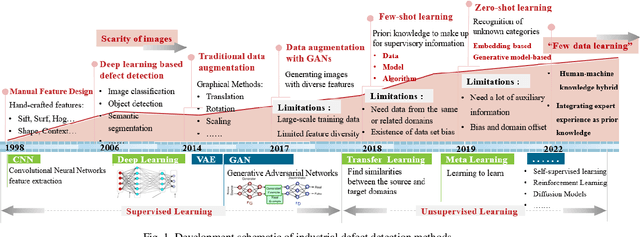
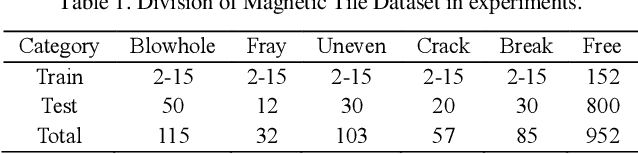


Visual-based defect detection is a crucial but challenging task in industrial quality control. Most mainstream methods rely on large amounts of existing or related domain data as auxiliary information. However, in actual industrial production, there are often multi-batch, low-volume manufacturing scenarios with rapidly changing task demands, making it difficult to obtain sufficient and diverse defect data. This paper proposes a parallel solution that uses a human-machine knowledge hybrid augmentation method to help the model extract unknown important features. Specifically, by incorporating experts' knowledge of abnormality to create data with rich features, positions, sizes, and backgrounds, we can quickly accumulate an amount of data from scratch and provide it to the model as prior knowledge for few-data learning. The proposed method was evaluated on the magnetic tile dataset and achieved F1-scores of 60.73%, 70.82%, 77.09%, and 82.81% when using 2, 5, 10, and 15 training images, respectively. Compared to the traditional augmentation method's F1-score of 64.59%, the proposed method achieved an 18.22% increase in the best result, demonstrating its feasibility and effectiveness in few-data industrial defect detection.