 Add to Chrome
 Add to Firefox
 Add to Edge
PosterText: Towards Unified Visual Text Generation and Editing for E-commerce Poster
Aug 18, 2026
Automated e-commerce poster design requires both high-quality poster generation and flexible editing of existing designs. However, most existing methods either target end-to-end poster generation or follow multi-stage design pipelines, with limited capability for flexible and precise editing of existing posters. To enable unified generation and editing of e-commerce posters, we introduce Text Patch Generation and Editing, a unified task formulation that treats text patches as atomic units and covers four operations: poster generation, patch addition, patch deletion, and patch modification, with optional reference-guided style control. Based on this, we propose PosterText, a unified model trained with a four-stage curriculum, including text rendering pretraining, instruction-following training, reinforcement learning for preference alignment, and spatial guidance self-distillation for execution refinement. We further construct a large-scale dataset with patch-level annotations and a comprehensive benchmark for evaluation. Extensive experiments demonstrate that PosterText achieves competitive performance against existing generation and editing approaches, validating the effectiveness of the proposed framework.

TransAnyText: Translating Arbitrary Text in E-commerce Images via Structured Visual Generation
Aug 17, 2026Cross-border e-commerce image translation is essential for global retail, where product images, banners, and detail pages need to be produced in different languages. Existing methods struggle to achieve accurate translation, faithful visual identity preservation, and easy-to-edit outputs, simultaneously. To address these challenges, we introduce TransAnyText, a structured visual code framework that reformulates image text translation as generating renderable HTML patches from source images and target languages. Our framework decouples semantic generation from pixel rendering: a vision-language model (VLM) handles visual understanding, cross-lingual translation, and structured visual generation, while a diffusion model performs background inpainting and pixel-level refinement, followed by deterministic rendering to synthesize the final image. Based on this formulation, we develop a three-stage post-training framework, where supervised fine-tuning (SFT) establishes the image-to-code mapping, privilege-gap weighted self-distillation (PWSD) improves the learning of style and layout tokens, and reinforcement learning with verifiable rewards (RLVR) further optimizes task-level performance. We further introduce TransAnyDataset and TransAnyBench, a multilingual dataset and benchmark for e-commerce image translation. Extensive experiments demonstrate competitive performance against cascaded pipelines, open-source end-to-end models, and closed-source image editing systems, providing an effective, controllable, and editable solution for cross-border e-commerce image translation.
GMO-E$^2$DIT: Grounded Multi-Operation Editing for E-Commerce Images
Jul 01, 2026Real-world e-commerce image editing often requires multiple, localized, and auditable operations rather than global restyling. This compositional nature poses a dual challenge: models must precisely apply all requested edits to the correct regions while preserving unmodified content, even under ambiguous instructions. Existing one-shot editors conflate intent resolution, spatial grounding, and synthesis into a single step, frequently resulting in partial execution failures, which is unacceptable for commercial scenarios. To address this, we introduce GMO-E$^2$DIT, an agentic editing framework that couples a Vision-Language Model (VLM) with a mask-conditioned image editor to tackle structured multi-turn task completion. Given an underspecified instruction, the VLM agent constructs a region-grounded edit agenda, effectively decoupling cognitive reasoning from generative rendering. The framework then executes sub-programs via operation-aware masks and references, utilizing a reflection-driven loop to inspect intermediate results and determine the subsequent state. This iterative mechanism reliably preserves safe partial progress, retries unfinished operations, and recovers from errors. Furthermore, we develop a unified data pipeline providing aligned supervision for planning, execution, and reflection, alongside EComEditBench, a comprehensive benchmark for instruction-driven evaluation. Extensive experiments demonstrate that GMO-E$^2$DIT achieves competitive performance compared to strong closed-source models, yielding superior instruction accuracy and edit fidelity over existing baselines.
VisionClaw: Always-On AI Agents through Smart Glasses
Apr 03, 2026We present VisionClaw, an always-on wearable AI agent that integrates live egocentric perception with agentic task execution. Running on Meta Ray-Ban smart glasses, VisionClaw continuously perceives real-world context and enables in-situ, speech-driven action initiation and delegation via OpenClaw AI agents. Therefore, users can directly execute tasks through the smart glasses, such as adding real-world objects to an Amazon cart, generating notes from physical documents, receiving meeting briefings on the go, creating events from posters, or controlling IoT devices. We evaluate VisionClaw through a controlled laboratory study (N=12) and a longitudinal deployment study (N=5). Results show that integrating perception and execution enables faster task completion and reduces interaction overhead compared to non-always-on and non-agent baselines. Beyond performance gains, deployment findings reveal a shift in interaction: tasks are initiated opportunistically during ongoing activities, and execution is increasingly delegated rather than manually controlled. These results suggest a new paradigm for wearable AI agents, where perception and action are continuously coupled to support situated, hands-free interaction.
Reality Proxy: Fluid Interactions with Real-World Objects in MR via Abstract Representations
Jul 24, 2025

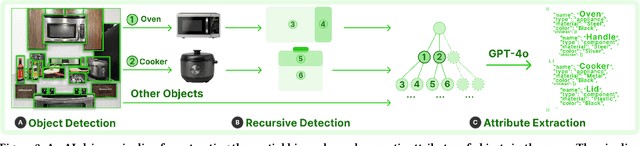
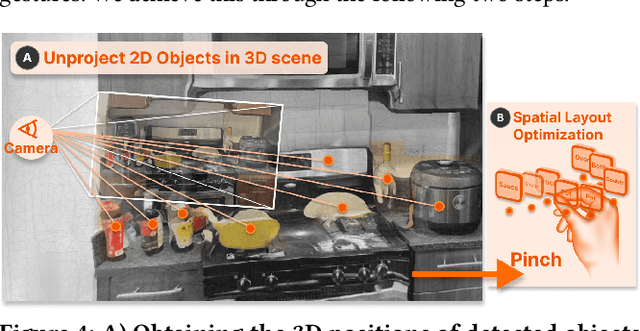
Interacting with real-world objects in Mixed Reality (MR) often proves difficult when they are crowded, distant, or partially occluded, hindering straightforward selection and manipulation. We observe that these difficulties stem from performing interaction directly on physical objects, where input is tightly coupled to their physical constraints. Our key insight is to decouple interaction from these constraints by introducing proxies-abstract representations of real-world objects. We embody this concept in Reality Proxy, a system that seamlessly shifts interaction targets from physical objects to their proxies during selection. Beyond facilitating basic selection, Reality Proxy uses AI to enrich proxies with semantic attributes and hierarchical spatial relationships of their corresponding physical objects, enabling novel and previously cumbersome interactions in MR - such as skimming, attribute-based filtering, navigating nested groups, and complex multi object selections - all without requiring new gestures or menu systems. We demonstrate Reality Proxy's versatility across diverse scenarios, including office information retrieval, large-scale spatial navigation, and multi-drone control. An expert evaluation suggests the system's utility and usability, suggesting that proxy-based abstractions offer a powerful and generalizable interaction paradigm for future MR systems.
Augmenting Human Cognition through Everyday AR
May 06, 2025As spatial computing and multimodal LLMs mature, AR is tending to become an intuitive "thinking tool," embedding semantic and context-aware intelligence directly into everyday environments. This paper explores how always-on AR can seamlessly bridge digital cognition and physical affordances, enabling proactive, context-sensitive interactions that enhance human task performance and understanding.