 Add to Chrome
 Add to Firefox
 Add to Edge
PosterText: Towards Unified Visual Text Generation and Editing for E-commerce Poster
Aug 18, 2026
Automated e-commerce poster design requires both high-quality poster generation and flexible editing of existing designs. However, most existing methods either target end-to-end poster generation or follow multi-stage design pipelines, with limited capability for flexible and precise editing of existing posters. To enable unified generation and editing of e-commerce posters, we introduce Text Patch Generation and Editing, a unified task formulation that treats text patches as atomic units and covers four operations: poster generation, patch addition, patch deletion, and patch modification, with optional reference-guided style control. Based on this, we propose PosterText, a unified model trained with a four-stage curriculum, including text rendering pretraining, instruction-following training, reinforcement learning for preference alignment, and spatial guidance self-distillation for execution refinement. We further construct a large-scale dataset with patch-level annotations and a comprehensive benchmark for evaluation. Extensive experiments demonstrate that PosterText achieves competitive performance against existing generation and editing approaches, validating the effectiveness of the proposed framework.

TransAnyText: Translating Arbitrary Text in E-commerce Images via Structured Visual Generation
Aug 17, 2026Cross-border e-commerce image translation is essential for global retail, where product images, banners, and detail pages need to be produced in different languages. Existing methods struggle to achieve accurate translation, faithful visual identity preservation, and easy-to-edit outputs, simultaneously. To address these challenges, we introduce TransAnyText, a structured visual code framework that reformulates image text translation as generating renderable HTML patches from source images and target languages. Our framework decouples semantic generation from pixel rendering: a vision-language model (VLM) handles visual understanding, cross-lingual translation, and structured visual generation, while a diffusion model performs background inpainting and pixel-level refinement, followed by deterministic rendering to synthesize the final image. Based on this formulation, we develop a three-stage post-training framework, where supervised fine-tuning (SFT) establishes the image-to-code mapping, privilege-gap weighted self-distillation (PWSD) improves the learning of style and layout tokens, and reinforcement learning with verifiable rewards (RLVR) further optimizes task-level performance. We further introduce TransAnyDataset and TransAnyBench, a multilingual dataset and benchmark for e-commerce image translation. Extensive experiments demonstrate competitive performance against cascaded pipelines, open-source end-to-end models, and closed-source image editing systems, providing an effective, controllable, and editable solution for cross-border e-commerce image translation.
Your Network May Need to Be Rewritten: Network Adversarial Based on High-Dimensional Function Graph Decomposition
May 04, 2024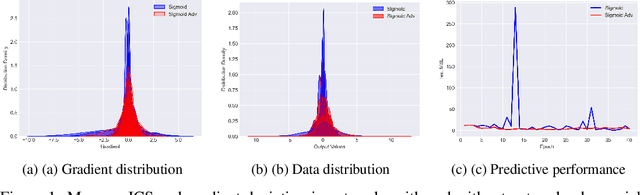
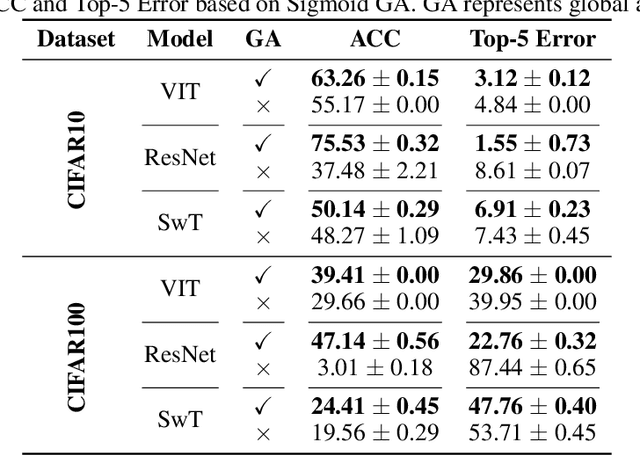
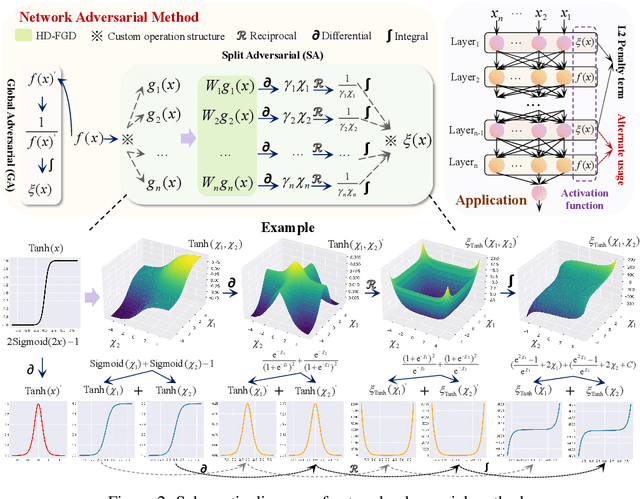
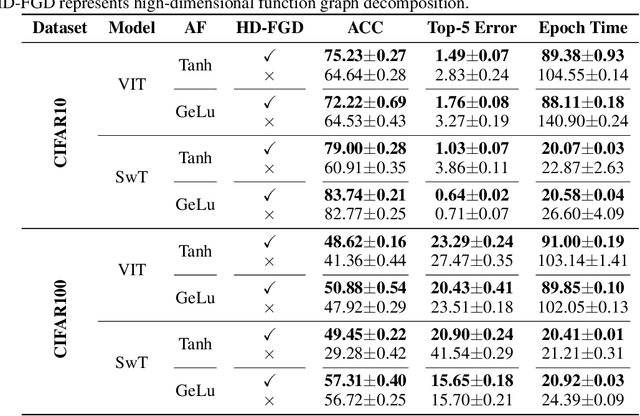
In the past, research on a single low dimensional activation function in networks has led to internal covariate shift and gradient deviation problems. A relatively small research area is how to use function combinations to provide property completion for a single activation function application. We propose a network adversarial method to address the aforementioned challenges. This is the first method to use different activation functions in a network. Based on the existing activation functions in the current network, an adversarial function with opposite derivative image properties is constructed, and the two are alternately used as activation functions for different network layers. For complex situations, we propose a method of high-dimensional function graph decomposition(HD-FGD), which divides it into different parts and then passes through a linear layer. After integrating the inverse of the partial derivatives of each decomposed term, we obtain its adversarial function by referring to the computational rules of the decomposition process. The use of network adversarial methods or the use of HD-FGD alone can effectively replace the traditional MLP+activation function mode. Through the above methods, we have achieved a substantial improvement over standard activation functions regarding both training efficiency and predictive accuracy. The article addresses the adversarial issues associated with several prevalent activation functions, presenting alternatives that can be seamlessly integrated into existing models without any adverse effects. We will release the code as open source after the conference review process is completed.
A generalized evidence distance
Nov 16, 2013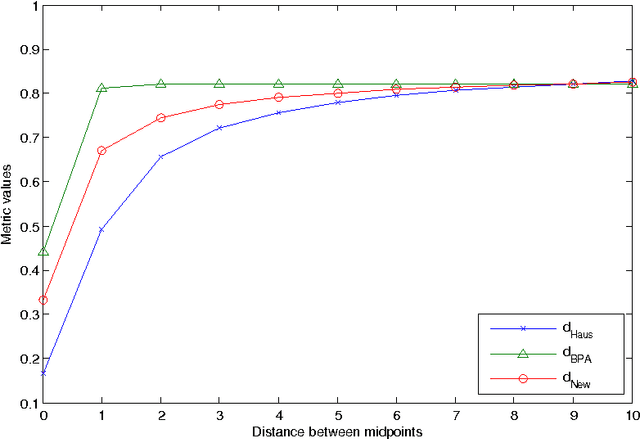
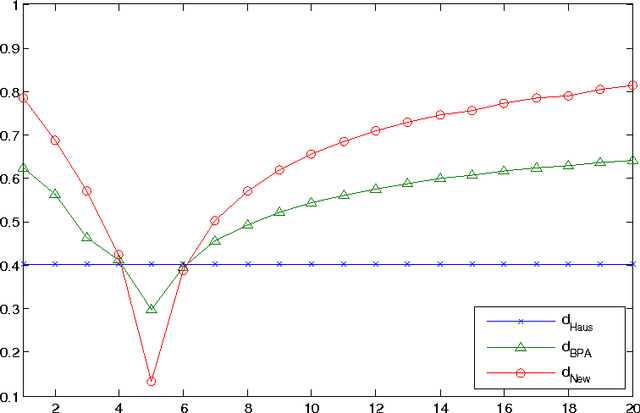
Dempster-Shafer theory of evidence (D-S theory) is widely used in uncertain information process. The basic probability assignment(BPA) is a key element in D-S theory. How to measure the distance between two BPAs is an open issue. In this paper, a new method to measure the distance of two BPAs is proposed. The proposed method is a generalized of existing evidence distance. Numerical examples are illustrated that the proposed method can overcome the shortcomings of existing methods.