 Add to Chrome
 Add to Firefox
 Add to Edge
SCOUT: Unlocking Enhanced Spatial Reasoning via Structured Chain-of-Thought and Multi-Objective Process Reward
Aug 12, 2026
Existing Vision-Language Models (VLMs) exhibits a critical bottleneck in robust spatial reasoning. Recent reinforcement learning (RL) methods aim to close this gap with verifiable outcomes, yet they suffer from poor credit assignment across intermediate reasoning steps. Concurrently, structured reasoning approaches overlook the critical depth perception necessary for comprehensive 3D understanding. To address these challenges, we propose SCOUT (Structured Chain-Of-Thought Utilizing Process-Supervised RL Training). Specifically, we design a structured Chain-of-Thought (CoT) framework that explicitly models 3D environmental perception to ensure robust spatial understanding and reasoning. Furthermore, we introduce a novel RL algorithm featuring multi-objective process rewards and a tailored advantage estimation method, facilitating fine-grained credit assignment across distinct segments of the reasoning trajectory. To support our framework, we develop SCOUT-24k, a structured spatial reasoning CoT dataset synthesized through a customized pipeline. Extensive evaluations demonstrate that SCOUT-3B improves upon baseline models by 16.85% and 6.3% on general spatial benchmarks and complex spatial reasoning tasks respectively. Notably, our larger SCOUT-7B even outperforms GPT-4o by a margin of 4.28%. Moreover, despite being trained exclusively on single image, SCOUT-7B exhibits robust out-of-domain generalization to multi-image and video scenarios. These empirical results render SCOUT as a critical step towards next generation of spatially-aware VLMs.

AVR: Active Vision-Driven Robotic Precision Manipulation with Viewpoint and Focal Length Optimization
Mar 03, 2025Robotic manipulation within dynamic environments presents challenges to precise control and adaptability. Traditional fixed-view camera systems face challenges adapting to change viewpoints and scale variations, limiting perception and manipulation precision. To tackle these issues, we propose the Active Vision-driven Robotic (AVR) framework, a teleoperation hardware solution that supports dynamic viewpoint and dynamic focal length adjustments to continuously center targets and maintain optimal scale, accompanied by a corresponding algorithm that effectively enhances the success rates of various operational tasks. Using the RoboTwin platform with a real-time image processing plugin, AVR framework improves task success rates by 5%-16% on five manipulation tasks. Physical deployment on a dual-arm system demonstrates in collaborative tasks and 36% precision in screwdriver insertion, outperforming baselines by over 25%. Experimental results confirm that AVR framework enhances environmental perception, manipulation repeatability (40% $\le $1 cm error), and robustness in complex scenarios, paving the way for future robotic precision manipulation methods in the pursuit of human-level robot dexterity and precision.
Bayesian Nonparametric Dictionary Learning for Compressed Sensing MRI
Jul 26, 2014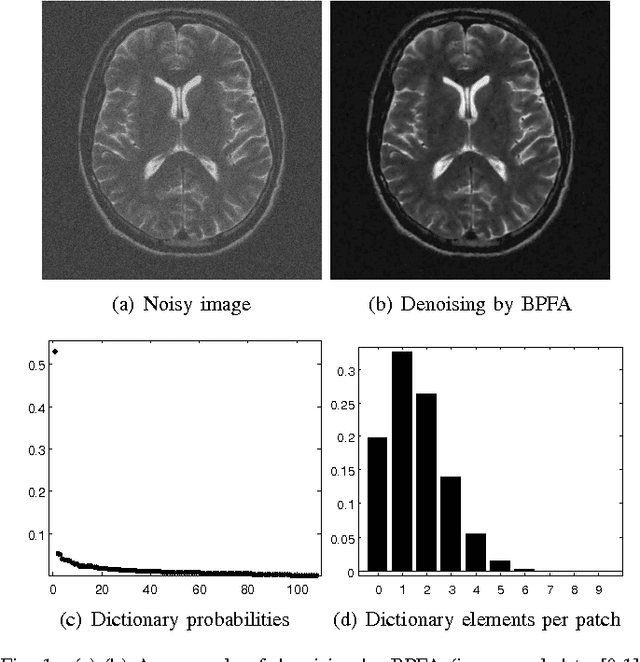
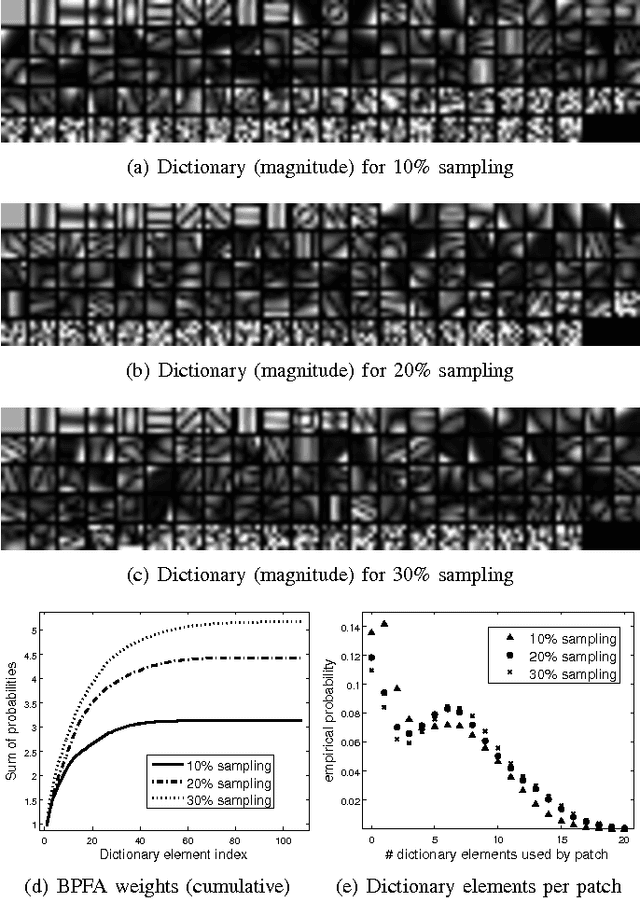
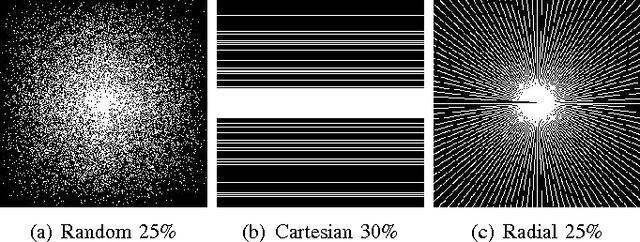
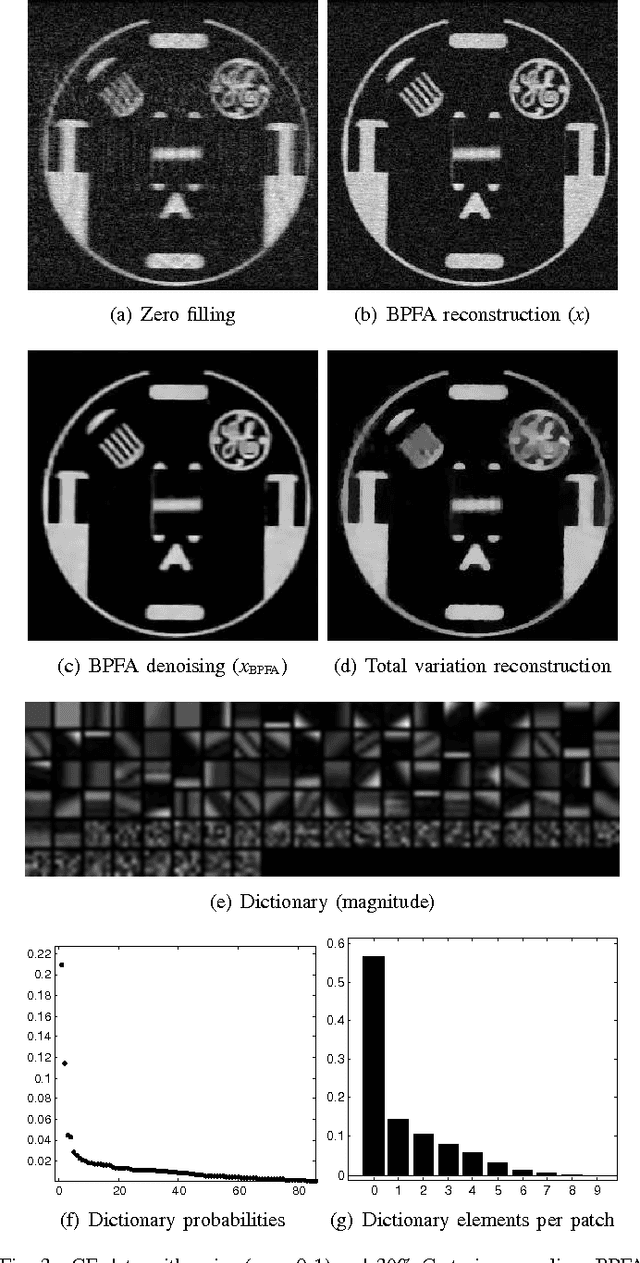
We develop a Bayesian nonparametric model for reconstructing magnetic resonance images (MRI) from highly undersampled k-space data. We perform dictionary learning as part of the image reconstruction process. To this end, we use the beta process as a nonparametric dictionary learning prior for representing an image patch as a sparse combination of dictionary elements. The size of the dictionary and the patch-specific sparsity pattern are inferred from the data, in addition to other dictionary learning variables. Dictionary learning is performed directly on the compressed image, and so is tailored to the MRI being considered. In addition, we investigate a total variation penalty term in combination with the dictionary learning model, and show how the denoising property of dictionary learning removes dependence on regularization parameters in the noisy setting. We derive a stochastic optimization algorithm based on Markov Chain Monte Carlo (MCMC) for the Bayesian model, and use the alternating direction method of multipliers (ADMM) for efficiently performing total variation minimization. We present empirical results on several MRI, which show that the proposed regularization framework can improve reconstruction accuracy over other methods.