 Add to Chrome
 Add to Firefox
 Add to Edge
Towards Expressive and Faithful Audio-to-Image Generation: A Unified Multimodal Dataset and Synthesis Framework
Aug 10, 2026
As an important subfield of cross-modal generation, synthesizing static visual content in the form of images from audio, namely audio-to-image (A2I) generation, has attracted increasing research attention in recent years. Nevertheless, despite the remarkable visual quality of modern text-to-image (T2I) models, the performance of A2I remains fundamentally limited by traditional datasets, which often lack both high-fidelity images and precise cross-modal alignment. As a result, existing methods still struggle to achieve high-quality audio-to-image generation through finetuning strong T2I models, thereby constraining practical applications in this area. Motivated by this gap, we introduce A2I-Set, a unified, high-quality tri-modal dataset consisting of 323K paired audio, images, and detailed text captions, specifically designed for audio-visual research, including audio-conditioned image generation. Besides, we developed a new mixed-source test set for the A2I task through human supervision. We further propose an A2I model, AudioCanvas, fine-tuned on our A2I-Set. Experiments show that AudioCanvas achieves more visually expressive as well as cross-modal alignment results that generally outperforming existing approaches. Our dataset and source code are available at https://github.com/gdx012/A2I-Generation.

Positive-Incentive Noise Predictor for Adversarial Purification in Speaker Verification
Jul 01, 2026Modern automatic speaker verification (ASV) systems are vulnerable to adversarial perturbations. Diffusion-based purification has recently shown strong effectiveness against such perturbations, but its reverse denoising process requires iterative sampling and leads to high inference latency. We find that the forward noising process provides most of the robustness gain. Motivated by this observation, we reformulate adversarial purification as a learnable noising problem, and propose the Positive-Incentive Noise Predictor (PnP), the first framework that explicitly introduces positive-incentive noise (π-noise) into the purification task. PnP learns input-adaptive π-noise and mixes it with the input to improve the robustness of downstream ASV systems. Experiments on four advanced ASV backbones show that PnP effectively defends against adversarial attacks while preserving performance on natural speech. Compared with representative purification baselines, the proposed framework provides a competitive balance among defense effectiveness, impact on genuine utterances, and inference efficiency under white-box, black-box, and defender-aware adaptive attacks, with a real-time factor as low as 0.014. Moreover, PnP can be cascaded with a diffusion denoiser to further improve the perceptual quality of purified utterances. Code and purified audio examples are available at https://eurecom-asp.github.io/pnp/
Unified Audio Generation and Editing via Joint Condition Modeling and Progressive Training
Jun 15, 2026With the growing focus on audio in multimedia applications, numerous advanced works on audio generation have emerged. Existing studies typically treat text-to-audio (TTA) and other related audio generation tasks, such as instruction-based audio editing, as independent challenges, adopting task-specific architectures or modules. This absence of a unified modeling paradigm substantially increases the overhead and complexity of building a system for both audio generation and editing, while also leading to limited scalability. To address this issue, we introduce AudioWeave, a unified model for TTA and audio editing without additional task-specific components. Specifically, we propose a joint condition modeling approach with a factorized position embedding, enabling the diffusion transformer backbone to operate under heterogeneous inputs of TTA and audio editing. We further propose a progressive multistage training strategy to mitigate task competition and catastrophic forgetting caused by interference among multiple tasks. This in turn helps maintain the performance of each individual task and may even lead to improvements in certain aspects. Experimental results on TTA task and six audio editing tasks show that our unified model achieves competitive performance with task-specific models, laying a groundwork for further exploration of unified audio generation models.
High-Fidelity Generative Audio Compression at 0.275kbps
Jan 31, 2026High-fidelity general audio compression at ultra-low bitrates is crucial for applications ranging from low-bandwidth communication to generative audio-language modeling. Traditional audio compression methods and contemporary neural codecs are fundamentally designed for waveform reconstruction. As a result, when operating at ultra-low bitrates, these methods degrade rapidly and often fail to preserve essential information, leading to severe acoustic artifacts and pronounced semantic distortion. To overcome these limitations, we introduce Generative Audio Compression (GAC), a novel paradigm shift from signal fidelity to task-oriented effectiveness. Implemented within the AI Flow framework, GAC is theoretically grounded in the Law of Information Capacity. These foundations posit that abundant computational power can be leveraged at the receiver to offset extreme communication bottlenecks--exemplifying the More Computation, Less Bandwidth philosophy. By integrating semantic understanding at the transmitter with scalable generative synthesis at the receiver, GAC offloads the information burden to powerful model priors. Our 1.8B-parameter model achieves high-fidelity reconstruction of 32kHz general audio at an unprecedented bitrate of 0.275kbps. Even at 0.175kbps, it still preserves a strong intelligible audio transmission capability, which represents an about 3000x compression ratio, significantly outperforming current state-of-the-art neural codecs in maintaining both perceptual quality and semantic consistency.
Rare Word Recognition and Translation Without Fine-Tuning via Task Vector in Speech Models
Dec 26, 2025Rare words remain a critical bottleneck for speech-to-text systems. While direct fine-tuning improves recognition of target words, it often incurs high cost, catastrophic forgetting, and limited scalability. To address these challenges, we propose a training-free paradigm based on task vectors for rare word recognition and translation. By defining task vectors as parameter differences and introducing word-level task vector arithmetic, our approach enables flexible composition of rare-word capabilities, greatly enhancing scalability and reusability. Extensive experiments across multiple domains show that the proposed method matches or surpasses fine-tuned models on target words, improves general performance by about 5 BLEU, and mitigates catastrophic forgetting.
MDD: a Mask Diffusion Detector to Protect Speaker Verification Systems from Adversarial Perturbations
Aug 26, 2025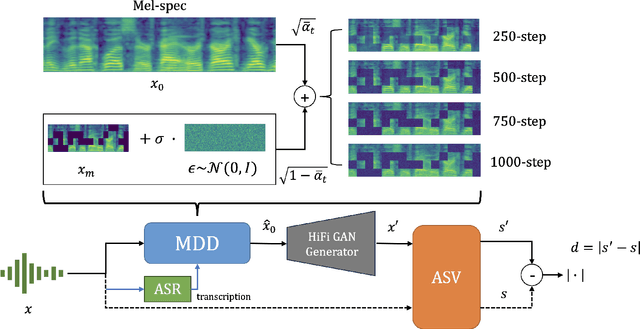
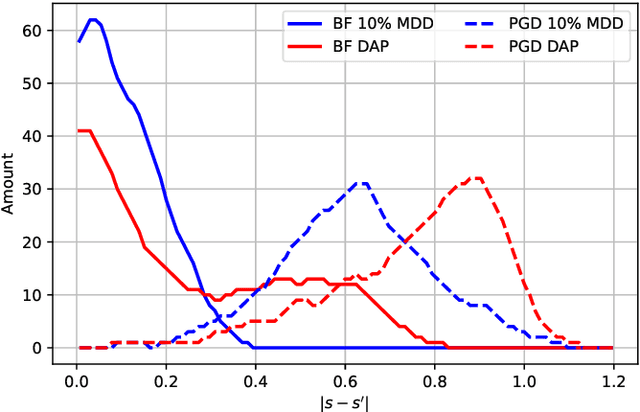
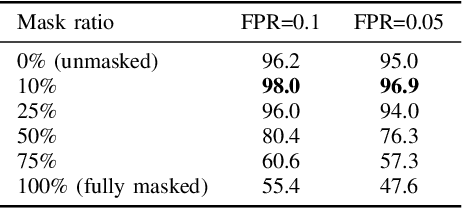
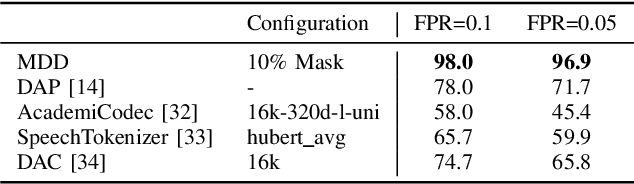
Speaker verification systems are increasingly deployed in security-sensitive applications but remain highly vulnerable to adversarial perturbations. In this work, we propose the Mask Diffusion Detector (MDD), a novel adversarial detection and purification framework based on a \textit{text-conditioned masked diffusion model}. During training, MDD applies partial masking to Mel-spectrograms and progressively adds noise through a forward diffusion process, simulating the degradation of clean speech features. A reverse process then reconstructs the clean representation conditioned on the input transcription. Unlike prior approaches, MDD does not require adversarial examples or large-scale pretraining. Experimental results show that MDD achieves strong adversarial detection performance and outperforms prior state-of-the-art methods, including both diffusion-based and neural codec-based approaches. Furthermore, MDD effectively purifies adversarially-manipulated speech, restoring speaker verification performance to levels close to those observed under clean conditions. These findings demonstrate the potential of diffusion-based masking strategies for secure and reliable speaker verification systems.
PadAug: Robust Speaker Verification with Simple Waveform-Level Silence Padding
Aug 20, 2025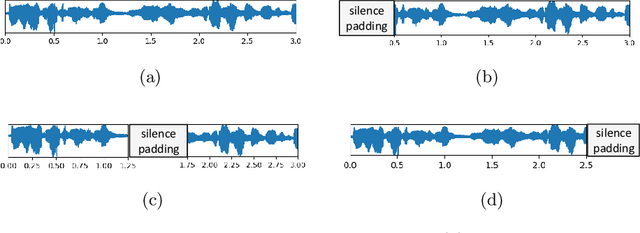
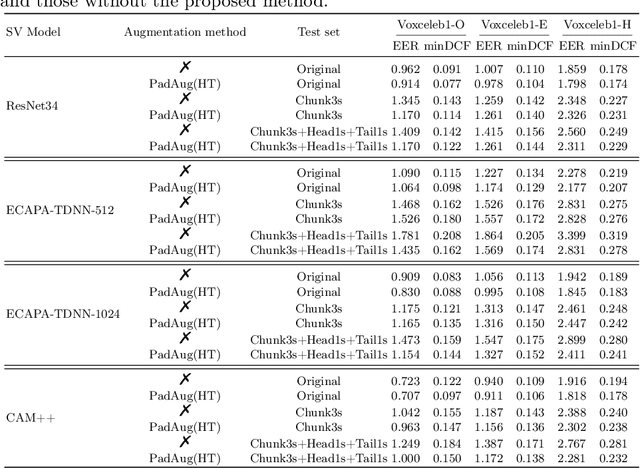
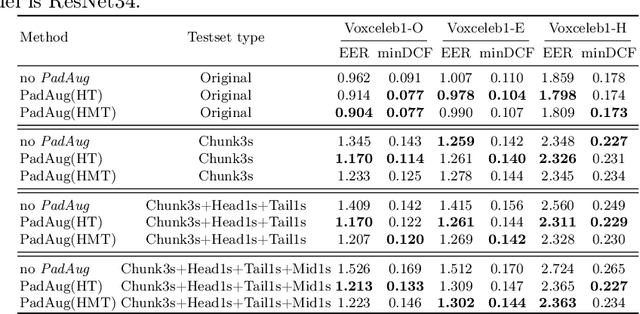
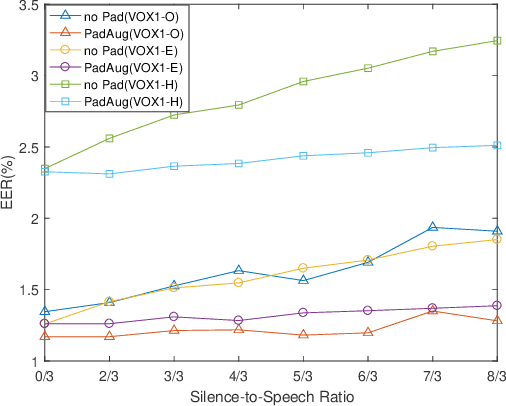
The presence of non-speech segments in utterances often leads to the performance degradation of speaker verification. Existing systems usually use voice activation detection as a preprocessing step to cut off long silence segments. However, short silence segments, particularly those between speech segments, still remain a problem for speaker verification. To address this issue, in this paper, we propose a simple wave-level data augmentation method, \textit{PadAug}, which aims to enhance the system's robustness to silence segments. The core idea of \textit{PadAug} is to concatenate silence segments with speech segments at the waveform level for model training. Due to its simplicity, it can be directly applied to the current state-of-the art architectures. Experimental results demonstrate the effectiveness of the proposed \textit{PadAug}. For example, applying \textit{PadAug} to ResNet34 achieves a relative equal error rate reduction of 5.0\% on the voxceleb dataset. Moreover, the \textit{PadAug} based systems are robust to different lengths and proportions of silence segments in the test data.
Angle-distance decomposition based on deep learning for active sonar detection
Jul 28, 2025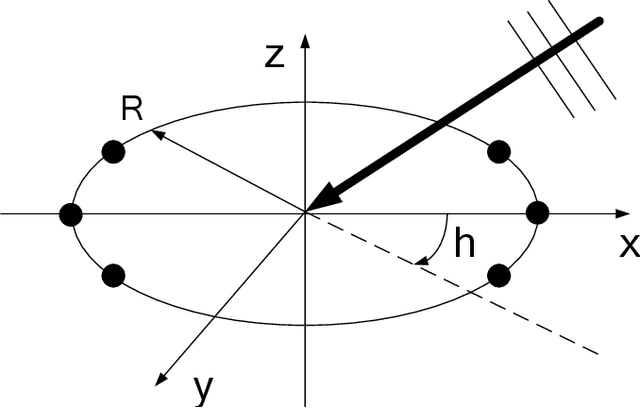
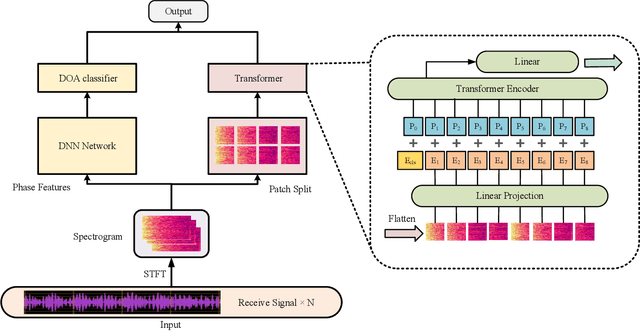
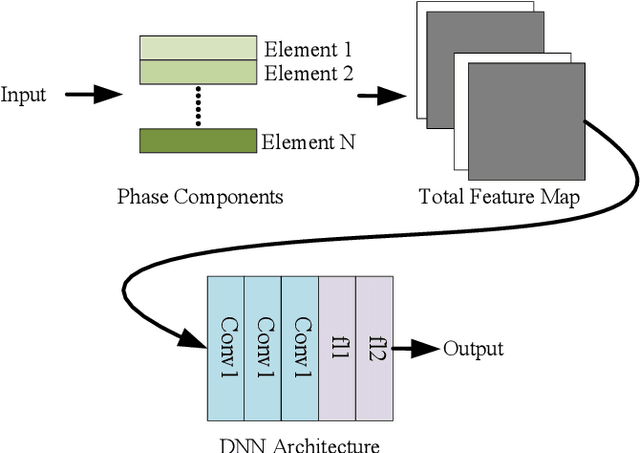
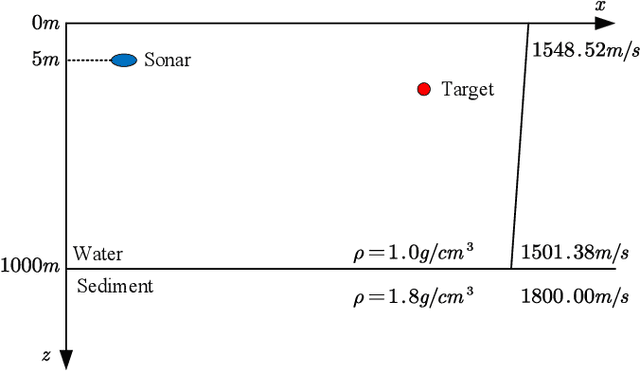
Underwater target detection using active sonar constitutes a critical research area in marine sciences and engineering. However, traditional signal processing methods face significant challenges in complex underwater environments due to noise, reverberation, and interference. To address these issues, this paper presents a deep learning-based active sonar target detection method that decomposes the detection process into separate angle and distance estimation tasks. Active sonar target detection employs deep learning models to predict target distance and angle, with the final target position determined by integrating these estimates. Limited underwater acoustic data hinders effective model training, but transfer learning and simulation offer practical solutions to this challenge. Experimental results verify that the method achieves effective and robust performance under challenging conditions.
Bridging the Gap between Continuous and Informative Discrete Representations by Random Product Quantization
Apr 07, 2025Self-supervised learning has become a core technique in speech processing, but the high dimensionality of its representations makes discretization essential for improving efficiency. However, existing discretization methods still suffer from significant information loss, resulting in a notable performance gap compared to continuous representations. To overcome these limitations, we propose two quantization-based discretization methods: Product Quantization (PQ) and Random Product Quantization (RPQ). PQ partitions the original feature space into multiple subspaces and independently quantizes each sub-vector, producing a fused set of discrete units that retain diverse information from different subspaces, thus mitigating the loss associated with single-cluster quantization. RPQ further enhances representation diversity by randomly sampling a fixed proportion of feature dimensions multiple times to construct sub-vectors, thereby better capturing the variability in the data distribution. Theoretical analysis shows that RPQ reduces the correlation coefficient rho (where 0 <= rho <= 1) between sub-quantizers. Its quantization error is lower-bounded by the product of rho and epsilon-kms, where epsilon-kms denotes the quantization error of a single K-means quantizer. Experimental results on a combined dataset built from LibriSpeech and ML-SUPERB show that PQ and RPQ outperform standard K-means discretization, achieving relative improvements of 21.8 percent and 20.0 percent in WER on LibriSpeech, and 24.1 percent and 19.6 percent in CER on ML-SUPERB, respectively. Moreover, their performance is competitive with, and in some cases even surpasses, that of continuous SSL representations.
DualSpec: Text-to-spatial-audio Generation via Dual-Spectrogram Guided Diffusion Model
Feb 26, 2025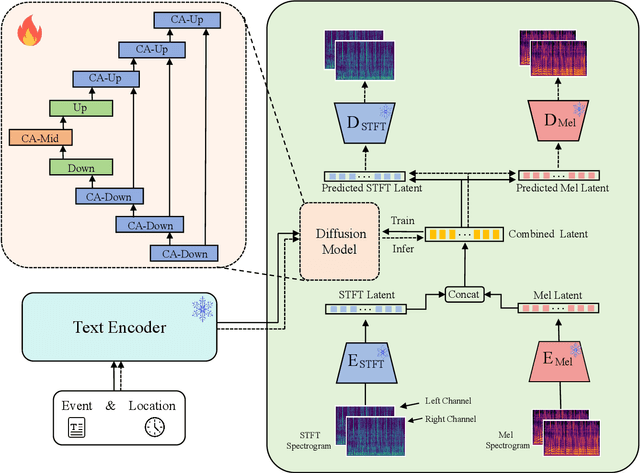
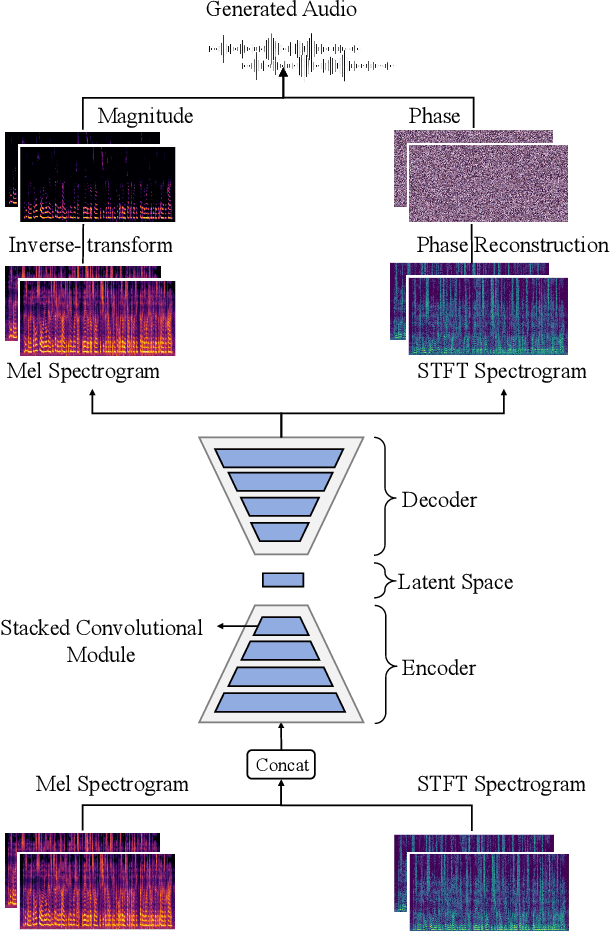
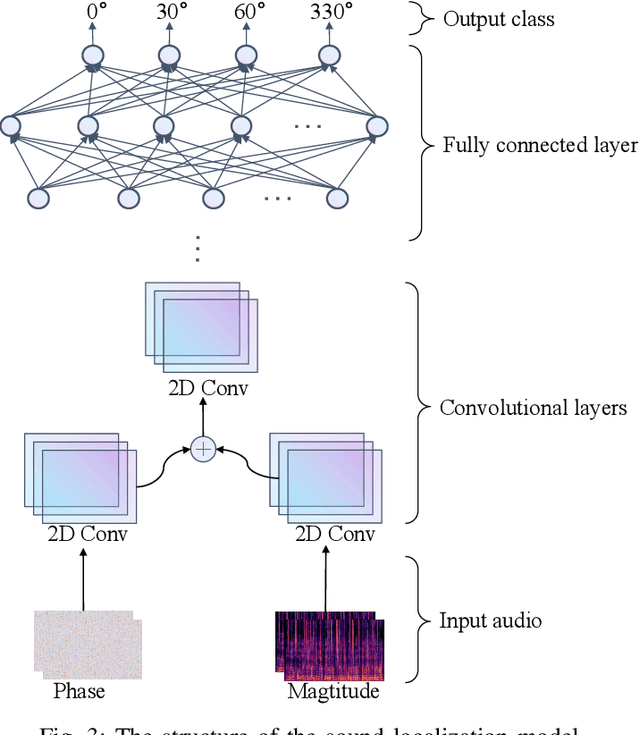
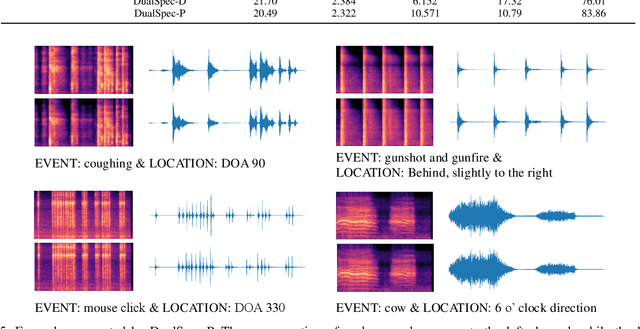
Text-to-audio (TTA), which generates audio signals from textual descriptions, has received huge attention in recent years. However, recent works focused on text to monaural audio only. As we know, spatial audio provides more immersive auditory experience than monaural audio, e.g. in virtual reality. To address this issue, we propose a text-to-spatial-audio (TTSA) generation framework named DualSpec.Specifically, it first trains variational autoencoders (VAEs) for extracting the latent acoustic representations from sound event audio. Then, given text that describes sound events and event directions, the proposed method uses the encoder of a pretrained large language model to transform the text into text features. Finally, it trains a diffusion model from the latent acoustic representations and text features for the spatial audio generation. In the inference stage, only the text description is needed to generate spatial audio. Particularly, to improve the synthesis quality and azimuth accuracy of the spatial sound events simultaneously, we propose to use two kinds of acoustic features. One is the Mel spectrograms which is good for improving the synthesis quality, and the other is the short-time Fourier transform spectrograms which is good at improving the azimuth accuracy. We provide a pipeline of constructing spatial audio dataset with text prompts, for the training of the VAEs and diffusion model. We also introduce new spatial-aware evaluation metrics to quantify the azimuth errors of the generated spatial audio recordings. Experimental results demonstrate that the proposed method can generate spatial audio with high directional and event consistency.