 Add to Chrome
 Add to Firefox
 Add to Edge
Frequency-Decorrelated Temporal Ensembles for EEG--fNIRS Imagined-Handwriting Decoding
Aug 04, 2026
Imagined handwriting offers a temporally rich paradigm for non-invasive neural decoding, yet reliable recognition across unseen participants remains difficult because scalp EEG is noisy and internally generated stroke sequences vary across individuals. The Multimodal Brain-Computer Interface Grand Challenge provides synchronized EEG and fNIRS for four-class subject-independent handwriting-trajectory classification. We propose FRED, a task-adapted system that models imagined handwriting as a multi-second motor sequence and trains a compact multi-scale temporal network on three complementary EEG frequency views. With three seeds per view, cross-band members produce substantially less-correlated errors than same-band replicas, yielding a clean nine-member ensemble accuracy of 0.8076/0.7242/0.7492 on the public/private/overall test partitions without test-set adaptation or output constraints. The submitted pipeline further incorporates transductive pseudo-label training, three EEG-Conformer members, posterior aggregation, and a paradigm-aware decoder. Because every 12-trial randomization block contains three instances of each class, the final predictions are obtained by Hungarian assignment under the known block quota. On one fixed posterior pool, independent, session-constrained, and block-constrained decoding achieve 0.7600, 0.7758, and 0.7952 overall accuracy, respectively. The complete system reaches 0.8498/0.7718/0.7952, ranking fourth on the private split. A modality audit finds fNIRS-only decoding at chance (0.2511 overall), while adding fNIRS to EEG changes accuracy by only +0.0025. These results identify frequency-diverse temporal EEG modeling and protocol-matched structured inference as the principal sources of performance in this sparse-montage EEG--fNIRS setting. The source code is available at https://github.com/XiuFan719/EEG-fNIRS-fuse-method-for-MM-challenge.

MoETTA: Test-Time Adaptation Under Mixed Distribution Shifts with MoE-LayerNorm
Nov 14, 2025Test-Time adaptation (TTA) has proven effective in mitigating performance drops under single-domain distribution shifts by updating model parameters during inference. However, real-world deployments often involve mixed distribution shifts, where test samples are affected by diverse and potentially conflicting domain factors, posing significant challenges even for SOTA TTA methods. A key limitation in existing approaches is their reliance on a unified adaptation path, which fails to account for the fact that optimal gradient directions can vary significantly across different domains. Moreover, current benchmarks focus only on synthetic or homogeneous shifts, failing to capture the complexity of real-world heterogeneous mixed distribution shifts. To address this, we propose MoETTA, a novel entropy-based TTA framework that integrates the Mixture-of-Experts (MoE) architecture. Rather than enforcing a single parameter update rule for all test samples, MoETTA introduces a set of structurally decoupled experts, enabling adaptation along diverse gradient directions. This design allows the model to better accommodate heterogeneous shifts through flexible and disentangled parameter updates. To simulate realistic deployment conditions, we introduce two new benchmarks: potpourri and potpourri+. While classical settings focus solely on synthetic corruptions, potpourri encompasses a broader range of domain shifts--including natural, artistic, and adversarial distortions--capturing more realistic deployment challenges. Additionally, potpourri+ further includes source-domain samples to evaluate robustness against catastrophic forgetting. Extensive experiments across three mixed distribution shifts settings show that MoETTA consistently outperforms strong baselines, establishing SOTA performance and highlighting the benefit of modeling multiple adaptation directions via expert-level diversity.
The Devil is in the Details: Boosting Guided Depth Super-Resolution via Rethinking Cross-Modal Alignment and Aggregation
Jan 16, 2024Guided depth super-resolution (GDSR) involves restoring missing depth details using the high-resolution RGB image of the same scene. Previous approaches have struggled with the heterogeneity and complementarity of the multi-modal inputs, and neglected the issues of modal misalignment, geometrical misalignment, and feature selection. In this study, we rethink some essential components in GDSR networks and propose a simple yet effective Dynamic Dual Alignment and Aggregation network (D2A2). D2A2 mainly consists of 1) a dynamic dual alignment module that adapts to alleviate the modal misalignment via a learnable domain alignment block and geometrically align cross-modal features by learning the offset; and 2) a mask-to-pixel feature aggregate module that uses the gated mechanism and pixel attention to filter out irrelevant texture noise from RGB features and combine the useful features with depth features. By combining the strengths of RGB and depth features while minimizing disturbance introduced by the RGB image, our method with simple reuse and redesign of basic components achieves state-of-the-art performance on multiple benchmark datasets. The code is available at https://github.com/JiangXinni/D2A2.
Air-to-Ground Communications Beyond 5G: UAV Swarm Formation Control and Tracking
Dec 25, 2023


Unmanned aerial vehicle (UAV) communications have been widely accepted as promising technologies to support air-to-ground communications in the forthcoming sixth-generation (6G) wireless networks. This paper proposes a novel air-to-ground communication model consisting of aerial base stations served by UAVs and terrestrial user equipments (UEs) by integrating the technique of coordinated multi-point (CoMP) transmission with the theory of stochastic geometry. In particular, a CoMP set consisting of multiple UAVs is developed based on the theory of Poisson-Delaunay tetrahedralization. Effective UAV formation control and UAV swarm tracking schemes for two typical scenarios, including static and mobile UEs, are also developed using the multi-agent system theory to ensure that collaborative UAVs can efficiently reach target spatial positions for mission execution. Thanks to the ease of mathematical tractability, this model provides explicit performance expressions for a typical UE's coverage probability and achievable ergodic rate. Extensive simulation and numerical results corroborate that the proposed scheme outperforms UAV communications without CoMP transmission and obtains similar performance to the conventional CoMP scheme while avoiding search overhead.
SearchMorph:Multi-scale Correlation Iterative Network for Deformable Registration
Jul 04, 2022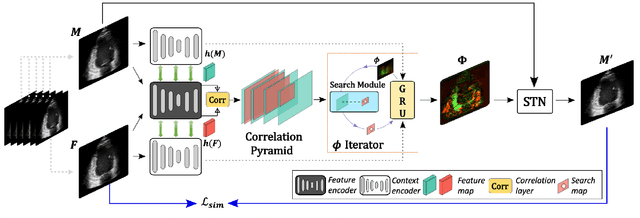
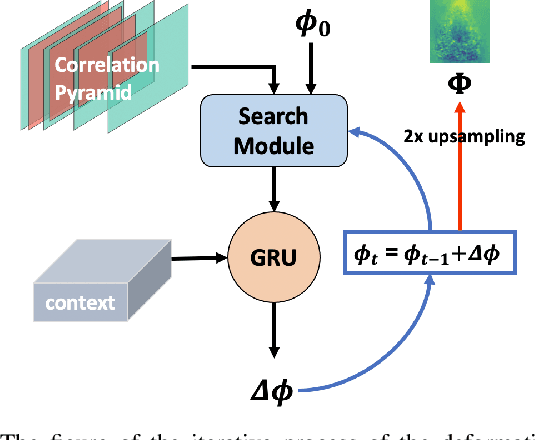
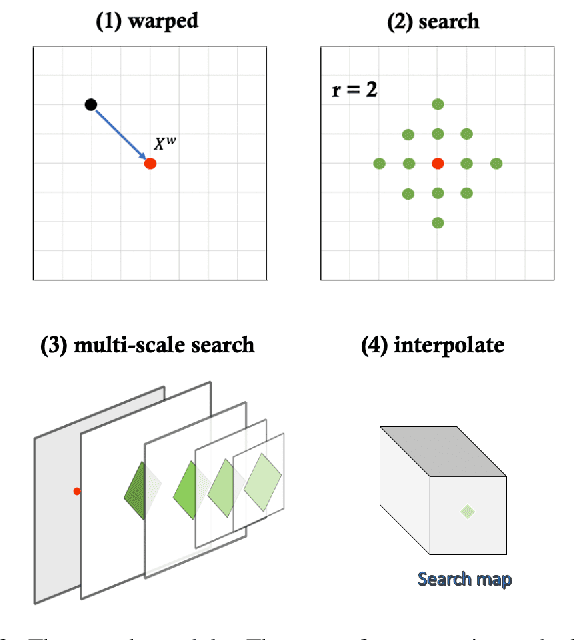
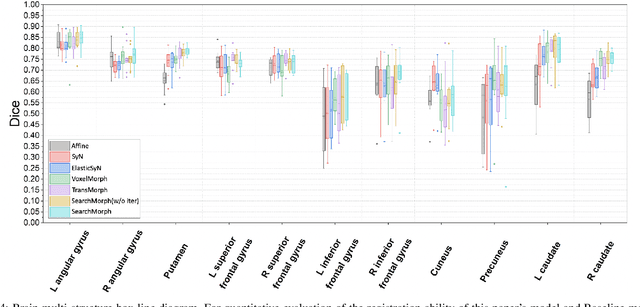
Deformable image registration provides dynamic information about the image and is essential in medical image analysis. However, due to the different characteristics of single-temporal brain MR images and multi-temporal echocardiograms, it is difficult to accurately register them using the same algorithm or model. We propose an unsupervised multi-scale correlation iterative registration network (SearchMorph), and the model has three highlights. (1)We introduced cost volumes to strengthen feature correlations and constructed correlation pyramids to complement multi-scale correlation information. (2) We designed the search module to search for the registration of features in multi-scale pyramids. (3) We use the GRU module for iterative refinement of the deformation field. The proposed network in this paper shows leadership in common single-temporal registration tasks and solves multi-temporal motion estimation tasks. The experimental results show that our proposed method achieves higher registration accuracy and a lower folding point ratio than the state-of-the-art methods.