 Add to Chrome
 Add to Firefox
 Add to Edge
SUGAR: A Scalable Human-Video-Driven Generalizable Humanoid Loco-Manipulation Learning Framework
May 19, 2026
Building humanoid robots capable of generalizable whole-body loco-manipulation in the real world remains a fundamental challenge. Existing methods either rely on laborious task-specific reward engineering, rigidly replay reference motions that fail to generalize, or depend on costly teleoperation that limits scalability. While human videos capture diverse human behaviors, motion priors inferred from them are inherently imperfect, suffering from occlusion, contact artifacts, and retargeting errors that render them unsuitable for direct policy learning. To address this, we present SUGAR, a scalable data-driven framework that converts diverse human videos into deployable humanoid loco-manipulation skills, without any task-specific reward engineering or reference-motion conditioning at inference. SUGAR proceeds in three stages. First, a fully automated pipeline extracts kinematic interaction priors including human-object motion trajectories and contact labels from unstructured human videos. Second, a privileged physics-based refiner uses a unified mimic reward and progressive state pool to transform imperfect priors into physically feasible, high-fidelity skills. Third, refined skills are distilled into a hierarchical autonomous policy consisting of a command generator and a command tracker. We evaluate SUGAR on six representative loco-manipulation tasks in simulation and real-world humanoid hardware. Our method substantially outperforms reference-tracking baselines, and performance scales clearly with the amount of human video data. It also achieves zero-shot real-world transfer with reliable closed-loop execution, autonomous failure recovery, and stable long-horizon performance under external perturbations. Project Page: https://tianshuwu.github.io/sugar-humanoid/

Explainable Interface for Human-Autonomy Teaming: A Survey
May 04, 2024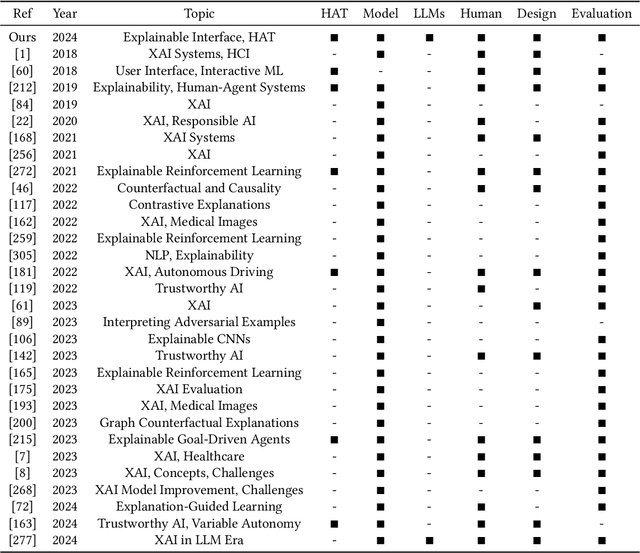
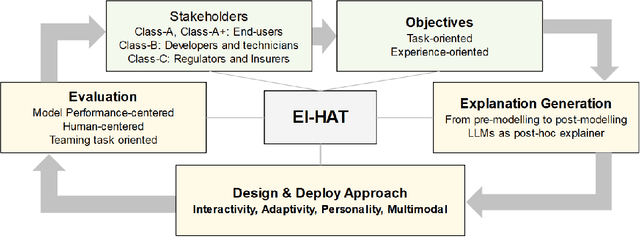
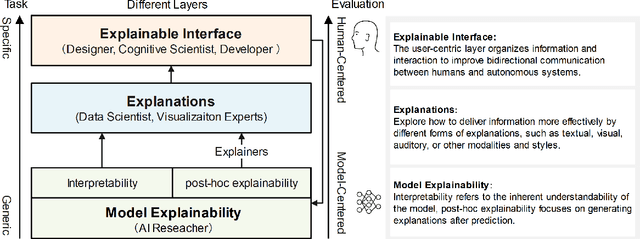
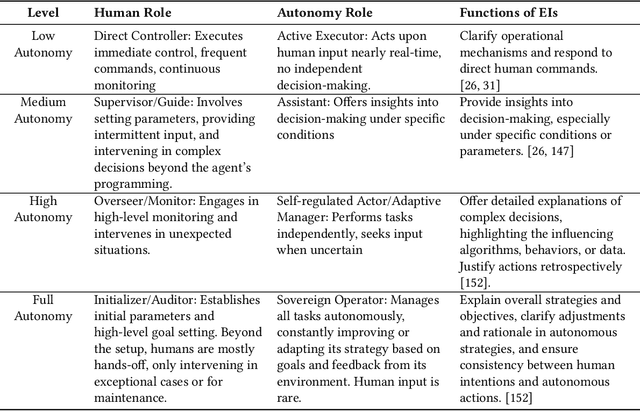
Nowadays, large-scale foundation models are being increasingly integrated into numerous safety-critical applications, including human-autonomy teaming (HAT) within transportation, medical, and defence domains. Consequently, the inherent 'black-box' nature of these sophisticated deep neural networks heightens the significance of fostering mutual understanding and trust between humans and autonomous systems. To tackle the transparency challenges in HAT, this paper conducts a thoughtful study on the underexplored domain of Explainable Interface (EI) in HAT systems from a human-centric perspective, thereby enriching the existing body of research in Explainable Artificial Intelligence (XAI). We explore the design, development, and evaluation of EI within XAI-enhanced HAT systems. To do so, we first clarify the distinctions between these concepts: EI, explanations and model explainability, aiming to provide researchers and practitioners with a structured understanding. Second, we contribute to a novel framework for EI, addressing the unique challenges in HAT. Last, our summarized evaluation framework for ongoing EI offers a holistic perspective, encompassing model performance, human-centered factors, and group task objectives. Based on extensive surveys across XAI, HAT, psychology, and Human-Computer Interaction (HCI), this review offers multiple novel insights into incorporating XAI into HAT systems and outlines future directions.