 Add to Chrome
 Add to Firefox
 Add to Edge
Physics-Informed Sliding-Window Particle Filtering for Tactile-Only In-Hand 6-DoF Object Pose Refinement
Aug 18, 2026
This paper studies tactile-only 6-DoF pose refinement and belief maintenance for grasped objects in static and short quasi-static in-hand configurations where vision is unavailable or heavily occluded. The key difficulty is tactile partial observability: whole-hand taxel contacts are sparse, intermittent, and ambiguous under limited excitation and object symmetries. We propose a physics-informed particle filter on $\mathrm{SE}(3)$ that updates pose beliefs from dense whole-hand tactile measurements. The likelihood combines active-contact signed-distance consistency, force-normal alignment, friction-cone feasibility, zero-force negative evidence, and optional feasibility guards. A sliding-window log-likelihood fuses recent tactile frames to reduce single-frame ambiguity, while a potential-field-guided proposal steers particles away from hand--object penetration. Symmetry-aware resampling preserves multiple plausible modes. Experiments on an Allegro Hand V5 with five objects show lower normalized ADD-S than tactile-only geometric, particle-filter, and learning baselines, and ablations confirm the benefits of temporal fusion, potential guidance, and mode preservation.

Hierarchical Space Partition for Surface Reconstruction
Jun 03, 2026Generating compact polygonal models from point clouds is a key problem in 3D vision and computer graphics. However, due to inherent limitations of LiDAR scanning (e.g. range constraints and occlusions), critical scene information is often missing, leading to degraded reconstruction accuracy. To address this, we propose a plane assembling strategy that effectively recovers missing details while maintaining model compactness. We classify all the planes extracted from the scene into three categories: highly visible, barely visible, and invisible. The invisible planes, which are recovered by scene structure analysis, indicate the missing details. The three types of planes correspond to the three growth priorities. Each plane grows according to the priority level, and the space is partitioned progressively, namely, the hierarchical partition. Subsequently, we generate a watertight polygonal mesh from the partition via a min-cut-based optimization. Finally, comparisons on public datasets show the effectiveness and superiority of our method against mainstream approaches. The project page is available at https://hsr-3dv.github.io/.
* Published in 2026 International Conference on 3D Vision (3DV)
Optimal Uncertainty-Aware Calibration for the AX=YB Problem
May 06, 2026This article proposes a general optimization framework for solving hand-eye calibration problem. Unlike traditional methods, an iterative algorithm based on Lie algebra that achieves approximately global optimal solutions is developed. During the optimization process, the method strictly preserves the structural constraints of the calibration parameters and enables synchronized updates between calibration parameters. Recognizing that data used in real-word hand-eye calibration often contain uncertainty, especially in over-loading and large workspace industrial robot scenarios, which can significantly degrade accuracy, and accurately modeling such uncertainty is inherently difficult, this article avoids explicit uncertainty modeling. Instead, an uncertainty metric to evaluate the relative uncertainty between data sources is introduced and used to dynamically refine the iterative process. To further enhance convergence efficiency, an effective initial solution generation method that improves overall stability and accuracy is designed. Numerical simulations and real-world experiments validate the effectiveness of the proposed approach, and in synthetic datasets, the proposed approach improves the estimation accuracy by at least 67\% under high-uncertainty conditions compared with the existing methods.
Robotic Grinding Skills Learning Based on Geodesic Length Dynamic Motion Primitives
Apr 24, 2025
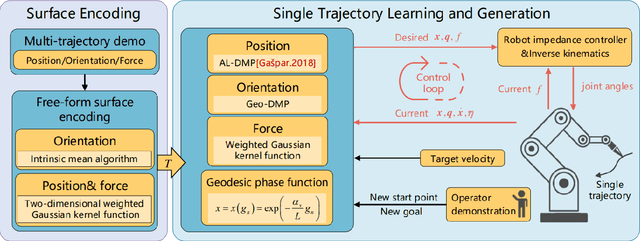
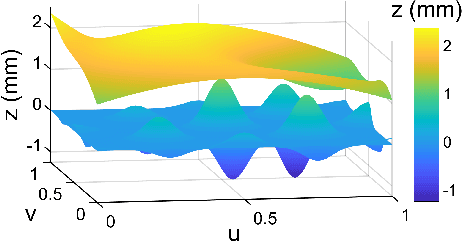
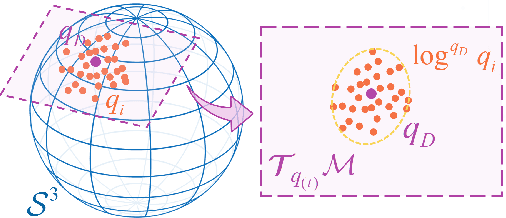
Learning grinding skills from human craftsmen via imitation learning has become a key research topic in robotic machining. Due to their strong generalization and robustness to external disturbances, Dynamical Movement Primitives (DMPs) offer a promising approach for robotic grinding skill learning. However, directly applying DMPs to grinding tasks faces challenges, such as low orientation accuracy, unsynchronized position-orientation-force, and limited generalization for surface trajectories. To address these issues, this paper proposes a robotic grinding skill learning method based on geodesic length DMPs (Geo-DMPs). First, a normalized 2D weighted Gaussian kernel and intrinsic mean clustering algorithm are developed to extract geometric features from multiple demonstrations. Then, an orientation manifold distance metric removes the time dependency in traditional orientation DMPs, enabling accurate orientation learning via Geo-DMPs. A synchronization encoding framework is further proposed to jointly model position, orientation, and force using a geodesic length-based phase function. This framework enables robotic grinding actions to be generated between any two surface points. Experiments on robotic chamfer grinding and free-form surface grinding validate that the proposed method achieves high geometric accuracy and generalization in skill encoding and generation. To our knowledge, this is the first attempt to use DMPs for jointly learning and generating grinding skills in position, orientation, and force on model-free surfaces, offering a novel path for robotic grinding.