 Add to Chrome
 Add to Firefox
 Add to Edge
Surface Constraint Policy for Learning Surface-Constrained and Dynamically Feasible Robot Skills
May 29, 2026
Diffusion-based imitation learning methods have driven rapid progress in robot dexterous manipulation tasks. However, they have limitations when applied to tasks that involve complex free-form surface constraints because of their lack of explicit surface geometry constraint modeling and the dynamic feasibility issue, resulting in stochastic action generation that fails to achieve reliable surface alignment and maintain stable contact. To address these limitations, we propose a novel surface constraint policy (SCP) for generating robot actions that satisfy free-form surface constraints on the basis of human demonstrations and real-time visual observations. First, the surface geometry constraint is encoded using a two-dimensional weighted Gaussian kernel function that is derived from demonstrations. Building on the encoded surface geometry constraints, the diffusion-based policy is used to infer task-level action intentions from multimodal sensory inputs, including visual observations and robot state feedback. These intentions are further transformed into surface-constrained dynamic movement primitives (DMPs) through a similarity-based action mapping method, thereby enabling smooth and compliant motion execution. The SCP achieves generation of structured surface geometric intent and dynamically admissible actions. The proposed method is validated on multiple surface manipulation tasks and compared with existing techniques. The experimental results demonstrate superior task success rates and contact stability under surface constraints.

Robotic Grinding Skills Learning Based on Geodesic Length Dynamic Motion Primitives
Apr 24, 2025
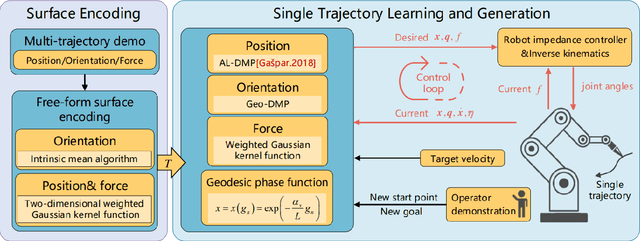
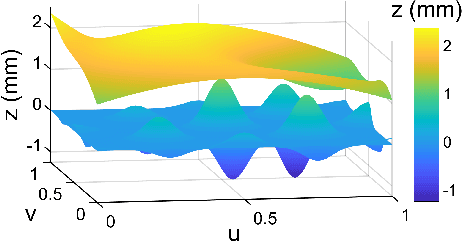
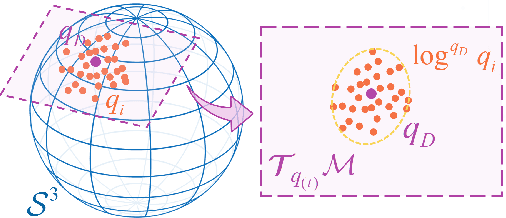
Learning grinding skills from human craftsmen via imitation learning has become a key research topic in robotic machining. Due to their strong generalization and robustness to external disturbances, Dynamical Movement Primitives (DMPs) offer a promising approach for robotic grinding skill learning. However, directly applying DMPs to grinding tasks faces challenges, such as low orientation accuracy, unsynchronized position-orientation-force, and limited generalization for surface trajectories. To address these issues, this paper proposes a robotic grinding skill learning method based on geodesic length DMPs (Geo-DMPs). First, a normalized 2D weighted Gaussian kernel and intrinsic mean clustering algorithm are developed to extract geometric features from multiple demonstrations. Then, an orientation manifold distance metric removes the time dependency in traditional orientation DMPs, enabling accurate orientation learning via Geo-DMPs. A synchronization encoding framework is further proposed to jointly model position, orientation, and force using a geodesic length-based phase function. This framework enables robotic grinding actions to be generated between any two surface points. Experiments on robotic chamfer grinding and free-form surface grinding validate that the proposed method achieves high geometric accuracy and generalization in skill encoding and generation. To our knowledge, this is the first attempt to use DMPs for jointly learning and generating grinding skills in position, orientation, and force on model-free surfaces, offering a novel path for robotic grinding.