 Add to Chrome
 Add to Firefox
 Add to Edge
Optimal Uncertainty-Aware Calibration for the AX=YB Problem
May 06, 2026
This article proposes a general optimization framework for solving hand-eye calibration problem. Unlike traditional methods, an iterative algorithm based on Lie algebra that achieves approximately global optimal solutions is developed. During the optimization process, the method strictly preserves the structural constraints of the calibration parameters and enables synchronized updates between calibration parameters. Recognizing that data used in real-word hand-eye calibration often contain uncertainty, especially in over-loading and large workspace industrial robot scenarios, which can significantly degrade accuracy, and accurately modeling such uncertainty is inherently difficult, this article avoids explicit uncertainty modeling. Instead, an uncertainty metric to evaluate the relative uncertainty between data sources is introduced and used to dynamically refine the iterative process. To further enhance convergence efficiency, an effective initial solution generation method that improves overall stability and accuracy is designed. Numerical simulations and real-world experiments validate the effectiveness of the proposed approach, and in synthetic datasets, the proposed approach improves the estimation accuracy by at least 67\% under high-uncertainty conditions compared with the existing methods.

A Multi-Scale Spatial Attention Network for Near-field MIMO Channel Estimation
Jul 30, 2025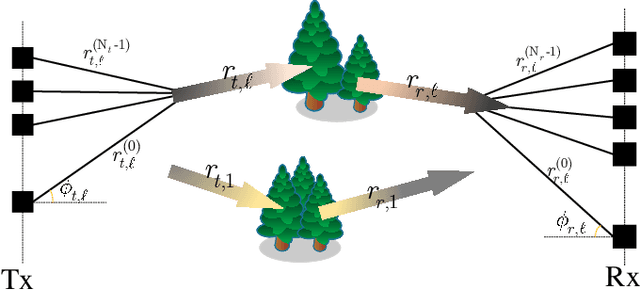
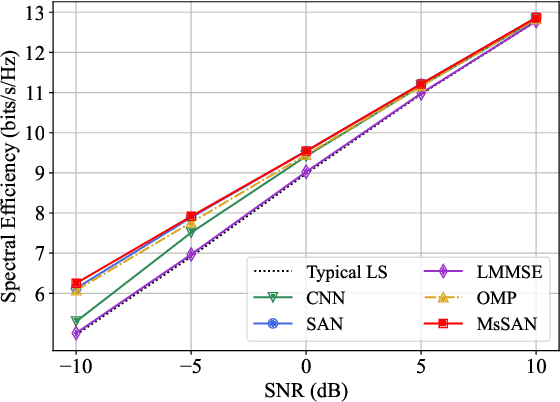
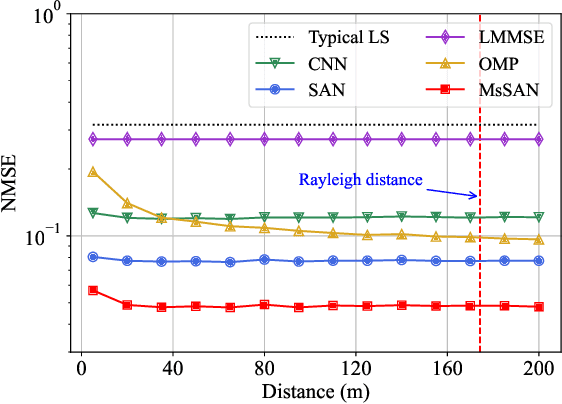
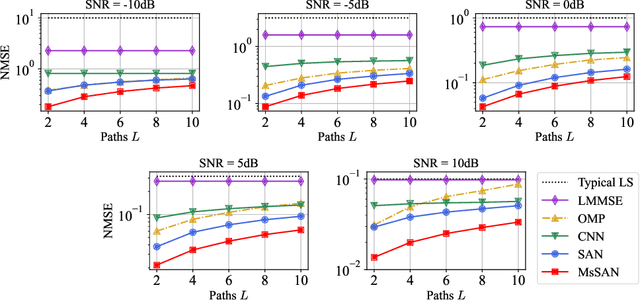
The deployment of extremely large-scale array (ELAA) brings higher spectral efficiency and spatial degree of freedom, but triggers issues on near-field channel estimation. Existing near-field channel estimation schemes primarily exploit sparsity in the transform domain. However, these schemes are sensitive to the transform matrix selection and the stopping criteria. Inspired by the success of deep learning (DL) in far-field channel estimation, this paper proposes a novel spatial-attention-based method for reconstructing extremely large-scale MIMO (XL-MIMO) channel. Initially, the spatial antenna correlations of near-field channels are analyzed as an expectation over the angle-distance space, which demonstrate correlation range of an antenna element varies with its position. Due to the strong correlation between adjacent antenna elements, interactions of inter-subchannel are applied to describe inherent correlation of near-field channels instead of inter-element. Subsequently, a multi-scale spatial attention network (MsSAN) with the inter-subchannel correlation learning capabilities is proposed tailed to near-field MIMO channel estimation. We employ the multi-scale architecture to refine the subchannel size in MsSAN. Specially, we inventively introduce the sum of dot products as spatial attention (SA) instead of cross-covariance to weight subchannel features at different scales in the SA module. Simulation results are presented to validate the proposed MsSAN achieves remarkable the inter-subchannel correlation learning capabilities and outperforms others in terms of near-field channel reconstruction.