 Add to Chrome
 Add to Firefox
 Add to Edge
Low Complexity Kolmogorov-Arnold Network-based DPD for Analog RoF Fronthaul
Jun 25, 2026
This paper proposes and demonstrates experimentally for the first time a Kolmogorov-Arnold Network (KAN)-based digital predistortion (DPD) model, named envelope time-delay KAN (ETDKAN), for mitigating nonlinear distortions in analog radio-over-fiber (A-RoF) systems. The ETDKAN model incorporates physical constraints of radio-frequency (RF) nonlinear devices and, through KAN symbolization, achieves a significant reduction in computational complexity while improving interpretability. The proposed model is numerically implemented and optimized alongside multilayer perceptron (MLP) and memory-polynomial-based DPDs. Results show that the resulting symbolic ETDKAN (symbETDKAN) attains ACLR and EVM performance comparable to neural network-based models, while maintaining a computational complexity close to that of memory polynomials. Experimental validation using an A-RoF system confirms the practical feasibility of the proposed approach, which resulted in a 4-5 dB reduction in ACLR in the analyzed scenario.

Integrated Computation and Communication with Fiber-optic Transmissions
Mar 04, 2025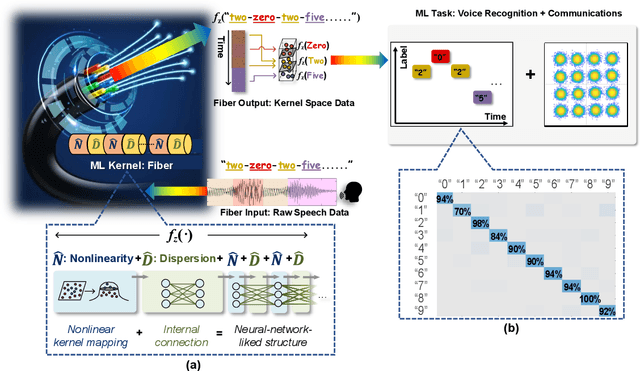
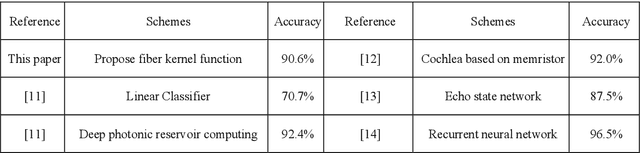
Fiber-optic transmission systems are leveraged not only as high-speed communication channels but also as nonlinear kernel functions for machine learning computations, enabling the seamless integration of computational intelligence and communication.
NR Conformance Testing of Analog Radio-over-LWIR FSO Fronthaul link for 6G Distributed MIMO Networks
Feb 09, 2023
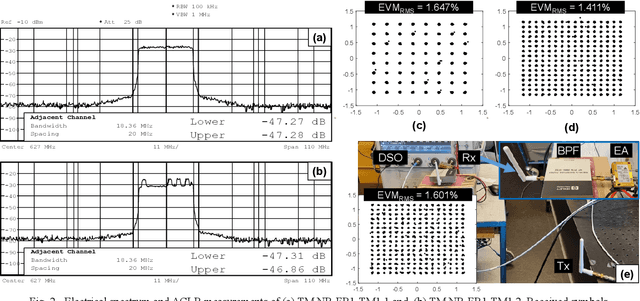
We experimentally test the compliance with 5G/NR 3GPP technical specifications of an analog radio-over-FSO link at 9 {\mu}m. The ACLR and EVM transmitter requirements are fulfilled validating the suitability of LWIR FSO for 6G fronthaul.
Plane Spiral OAM Mode-Group Based MIMO Communications: An Experimental Study
Mar 11, 2021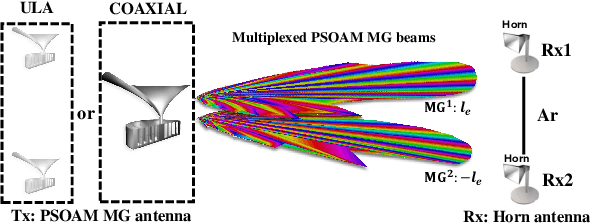
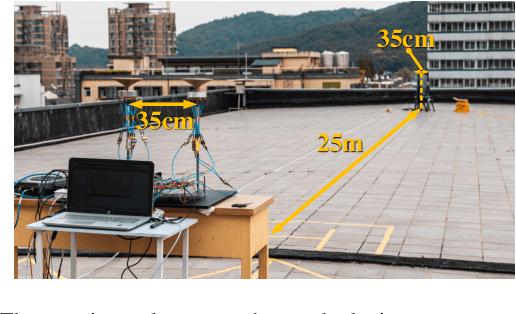
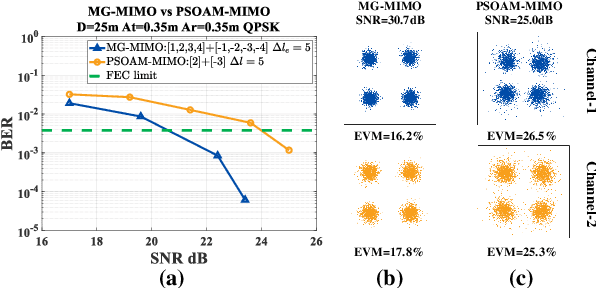
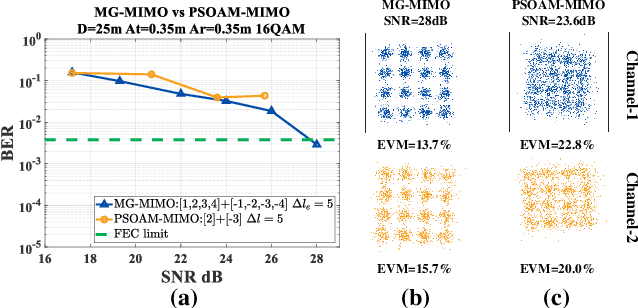
Spatial division multiplexing using conventional orbital angular momentum (OAM) has become a well-known physical layer transmission method over the past decade. The mode-group (MG) superposed by specific single mode plane spiral OAM (PSOAM) waves has been proved to be a flexible beamforming method to achieve the azimuthal pattern diversity, which inherits the spiral phase distribution of conventional OAM wave. Thus, it possesses both the beam directionality and vorticity. In this paper, it's the first time to show and verify novel PSOAM MG based multiple-in-multiple-out (MIMO) communication link (MG-MIMO) experimentally in a line-of-sight (LoS) scenario. A compact multi-mode PSOAM antenna is demonstrated experimentally to generate multiple independent controllable PSOAM waves, which can be used for constructing MGs. After several proof-of-principle tests, it has been verified that the beam directionality gain of MG can improve the receiving signal-to-noise (SNR) level in an actual system, meanwhile, the vorticity can provide another degree of freedom (DoF) to reduce the spatial correlation of MIMO system. Furthermore, a tentative long-distance transmission experiment operated at 10.2 GHz has been performed successfully at a distance of 50 m with a single-way spectrum efficiency of 3.7 bits/s/Hz/stream. The proposed MG-MIMO may have potential in the long-distance LoS back-haul scenario.