 Add to Chrome
 Add to Firefox
 Add to Edge
Low Complexity Kolmogorov-Arnold Network-based DPD for Analog RoF Fronthaul
Jun 25, 2026
This paper proposes and demonstrates experimentally for the first time a Kolmogorov-Arnold Network (KAN)-based digital predistortion (DPD) model, named envelope time-delay KAN (ETDKAN), for mitigating nonlinear distortions in analog radio-over-fiber (A-RoF) systems. The ETDKAN model incorporates physical constraints of radio-frequency (RF) nonlinear devices and, through KAN symbolization, achieves a significant reduction in computational complexity while improving interpretability. The proposed model is numerically implemented and optimized alongside multilayer perceptron (MLP) and memory-polynomial-based DPDs. Results show that the resulting symbolic ETDKAN (symbETDKAN) attains ACLR and EVM performance comparable to neural network-based models, while maintaining a computational complexity close to that of memory polynomials. Experimental validation using an A-RoF system confirms the practical feasibility of the proposed approach, which resulted in a 4-5 dB reduction in ACLR in the analyzed scenario.

Integrated Computation and Communication with Fiber-optic Transmissions
Mar 04, 2025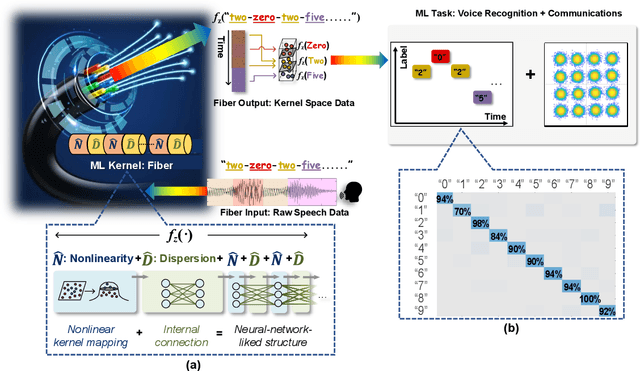
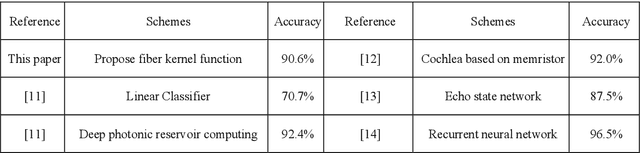
Fiber-optic transmission systems are leveraged not only as high-speed communication channels but also as nonlinear kernel functions for machine learning computations, enabling the seamless integration of computational intelligence and communication.
Experimental Validation of Coherent Joint Transmission in a Distributed-MIMO System with Analog Fronthaul for 6G
May 04, 2023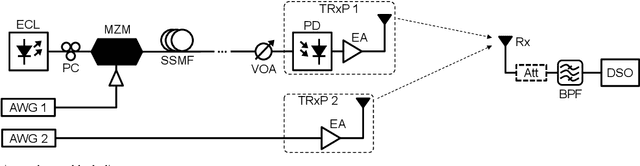
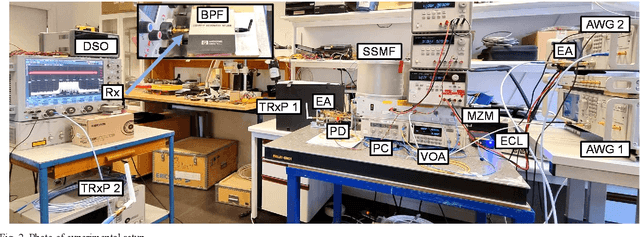
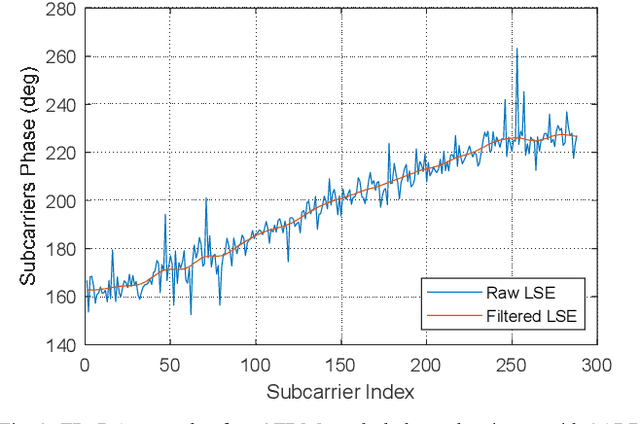
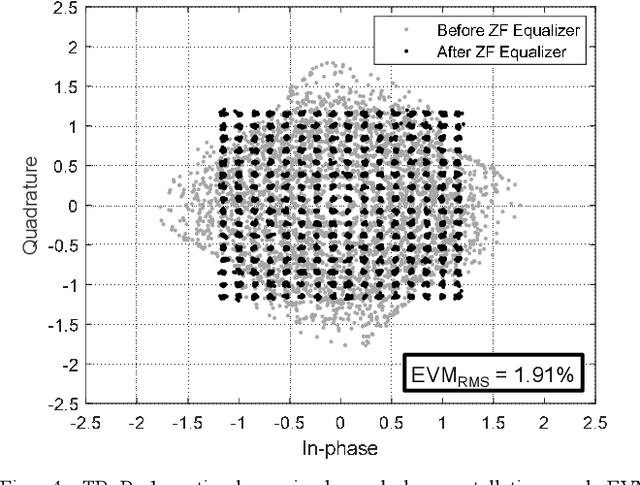
The sixth-generation (6G) mobile networks must increase coverage and improve spectral efficiency, especially for cell-edge users. Distributed multiple-input multiple-output (D-MIMO) networks can fulfill these requirements provided that transmission/reception points (TRxPs) of the network can be synchronized with sub nanosecond precision, however, synchronization with current backhaul and fronthaul digital interfaces is challenging. For 6G new services and scenarios, analog radio-over-fiber (ARoF) is a prospective alternative for future mobile fronthaul where current solutions fall short to fulfill future demands on bandwidth, synchronization, and/or power consumption. This paper presents an experimental validation of coherent joint transmissions (CJTs) in a two TRxPs D-MIMO network where ARoF fronthaul links allow to meet the required level of synchronization. Results show that by means of CJT a combined diversity and power gain of +5 dB is realized in comparison with a single TRxP transmission.
NR Conformance Testing of Analog Radio-over-LWIR FSO Fronthaul link for 6G Distributed MIMO Networks
Feb 09, 2023
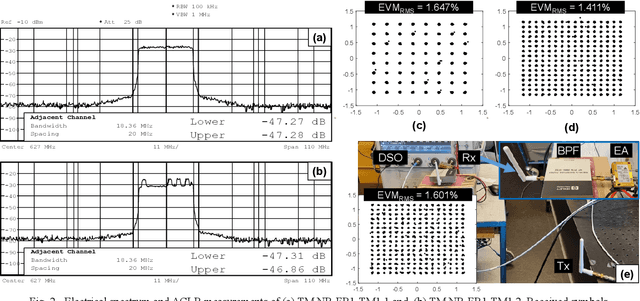
We experimentally test the compliance with 5G/NR 3GPP technical specifications of an analog radio-over-FSO link at 9 {\mu}m. The ACLR and EVM transmitter requirements are fulfilled validating the suitability of LWIR FSO for 6G fronthaul.
Self-Evolutionary Reservoir Computer Based on Kuramoto Model
Jan 25, 2023The human brain's synapses have remarkable activity-dependent plasticity, where the connectivity patterns of neurons change dramatically, relying on neuronal activities. As a biologically inspired neural network, reservoir computing (RC) has unique advantages in processing spatiotemporal information. However, typical reservoir architectures only take static random networks into account or consider the dynamics of neurons and connectivity separately. In this paper, we propose a structural autonomous development reservoir computing model (sad-RC), which structure can adapt to the specific problem at hand without any human expert knowledge. Specifically, we implement the reservoir by adaptive networks of phase oscillators, a commonly used model for synaptic plasticity in biological neural networks. In this co-evolving dynamic system, the dynamics of nodes and coupling weights in the reservoir constantly interact and evolve together when disturbed by external inputs.