 Add to Chrome
 Add to Firefox
 Add to Edge
Low Complexity Kolmogorov-Arnold Network-based DPD for Analog RoF Fronthaul
Jun 25, 2026
This paper proposes and demonstrates experimentally for the first time a Kolmogorov-Arnold Network (KAN)-based digital predistortion (DPD) model, named envelope time-delay KAN (ETDKAN), for mitigating nonlinear distortions in analog radio-over-fiber (A-RoF) systems. The ETDKAN model incorporates physical constraints of radio-frequency (RF) nonlinear devices and, through KAN symbolization, achieves a significant reduction in computational complexity while improving interpretability. The proposed model is numerically implemented and optimized alongside multilayer perceptron (MLP) and memory-polynomial-based DPDs. Results show that the resulting symbolic ETDKAN (symbETDKAN) attains ACLR and EVM performance comparable to neural network-based models, while maintaining a computational complexity close to that of memory polynomials. Experimental validation using an A-RoF system confirms the practical feasibility of the proposed approach, which resulted in a 4-5 dB reduction in ACLR in the analyzed scenario.

Adaptive Turbo Equalization of Probabilistically Shaped Constellations
Feb 24, 2023
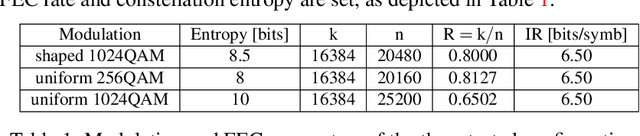
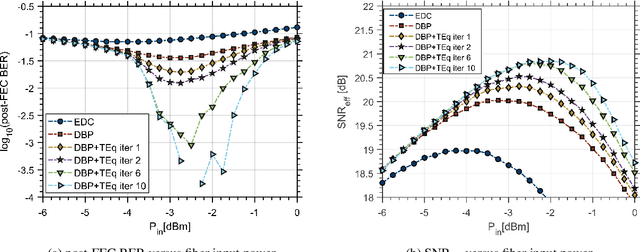

Fiber nonlinearity compensation of probabilistically shaped constellations with adaptive turbo equalization is investigated for the first time. Potential for more than 100% transmission reach extension is demonstrated by combining probabilistic shaping, single-channel digital backpropagation, and adaptive turbo equalization.
Adaptive Turbo Equalization for Nonlinearity Compensation in WDM Systems
Sep 05, 2021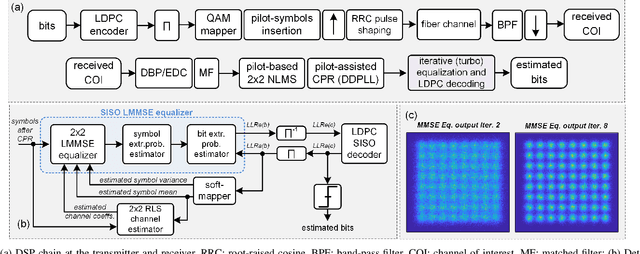
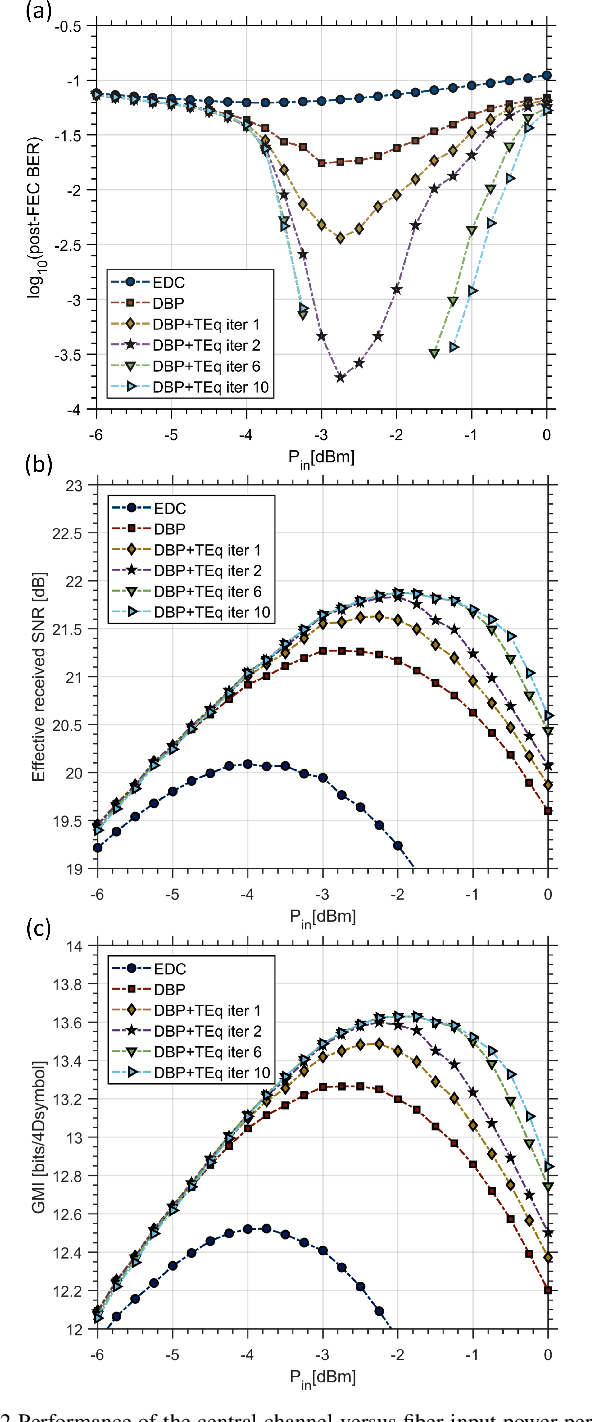
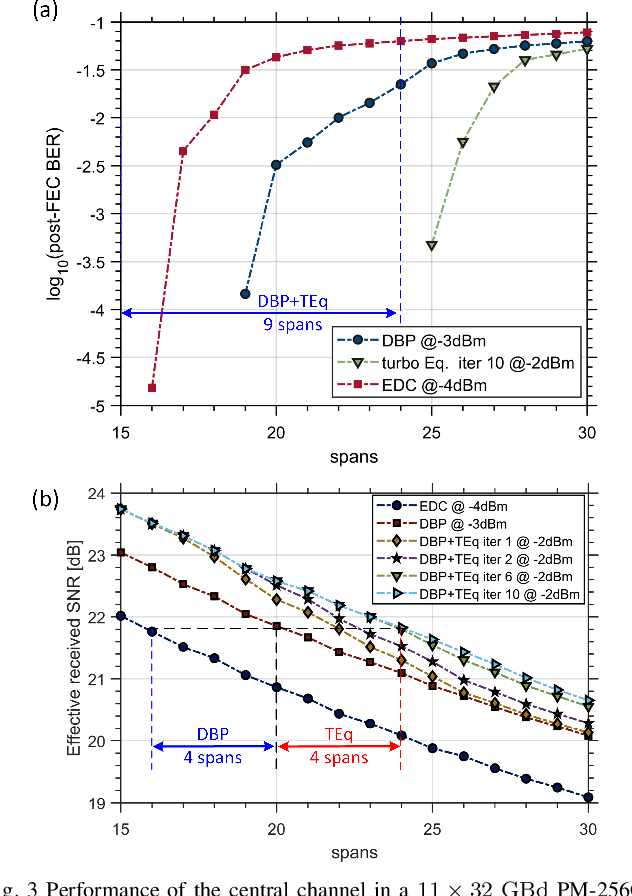
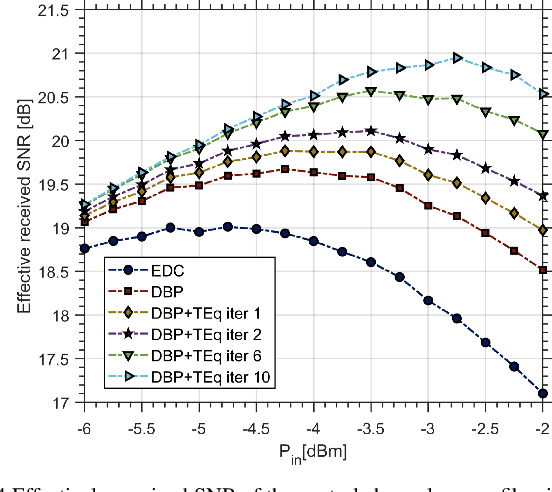
In this paper, the performance of adaptive turbo equalization for nonlinearity compensation (NLC) is investigated. A turbo equalization scheme is proposed where a recursive least-squares (RLS) algorithm is used as an adaptive channel estimator to track the time-varying intersymbol interference (ISI) coefficients associated with inter-channel nonlinear interference (NLI) model. The estimated channel coefficients are used by a MIMO 2x2 soft-input soft-output (SISO) linear minimum mean square error (LMMSE) equalizer to compensate for the time-varying ISI. The SISO LMMSE equalizer and the SISO forward error correction (FEC) decoder exchange extrinsic information in every turbo iteration, allowing the receiver to improve the performance of the channel estimation and the equalization, achieving lower bit-error-rate (BER) values. The proposed scheme is investigated for polarization multiplexed 64QAM and 256QAM, although it applies to any proper modulation format. Extensive numerical results are presented. It is shown that the scheme allows up to 0.7 dB extra gain in effectively received signal-to-noise ratio (SNR) and up to 0.2 bits/symbol/pol in generalized mutual information (GMI), on top of the gain provided by single-channel digital backpropagation.