 Add to Chrome
 Add to Firefox
 Add to Edge
3DTCR: A Physics-Based Generative Framework for Vortex-Following 3D Reconstruction to Improve Tropical Cyclone Intensity Forecasting
Mar 16, 2026
Tropical cyclone (TC) intensity forecasting remains challenging as current numerical and AI-based weather models fail to satisfactorily represent extreme TC structure and intensity. Although intensity time-series forecasting has achieved significant advances, it outputs intensity sequences rather than the three-dimensional inner-core fine-scale structure and physical mechanisms governing TC evolution. High-resolution numerical simulations can capture these features but remain computationally expensive and inefficient for large-scale operational applications. Here we present 3DTCR, a physics-based generative framework combining physical constraints with generative AI efficiency for 3D TC structure reconstruction. Trained on a six-year, 3-km-resolution moving-domain WRF dataset, 3DTCR enables region-adaptive vortex-following reconstruction using conditional Flow Matching(CFM), optimized via latent domain adaptation and two-stage transfer learning. The framework mitigates limitations imposed by low-resolution targets and over-smoothed forecasts, improving the representation of TC inner-core structure and intensity while maintaining track stability. Results demonstrate that 3DTCR outperforms the ECMWF high-resolution forecasting system (ECMWF-HRES) in TC intensity prediction at nearly all lead times up to 5 days and reduces the RMSE of maximum WS10M by 36.5% relative to its FuXi inputs. These findings highlight 3DTCR as a physics-based generative framework that efficiently resolves fine-scale structures at lower computational cost, which may offer a promising avenue for improving TC intensity forecasting.

FuXi-2.0: Advancing machine learning weather forecasting model for practical applications
Sep 11, 2024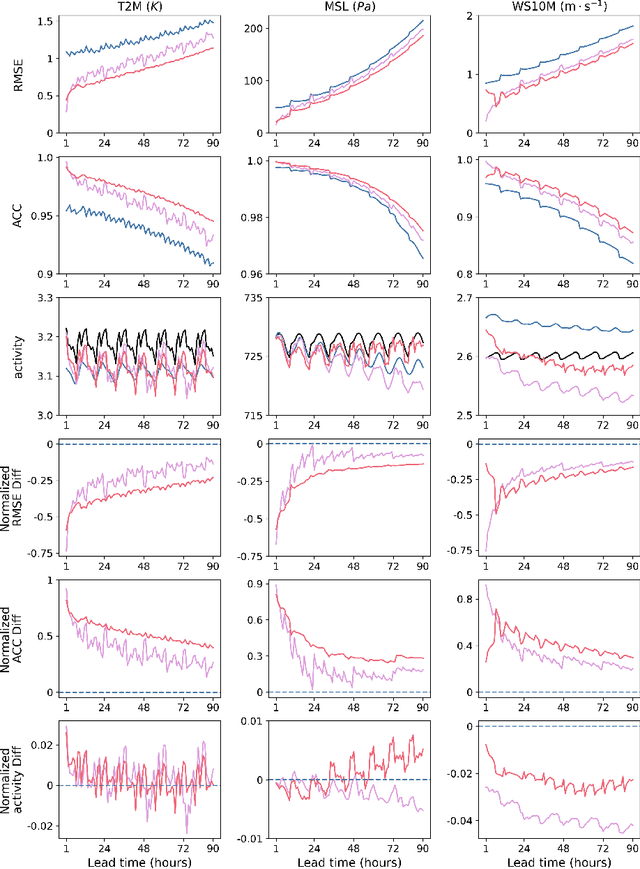
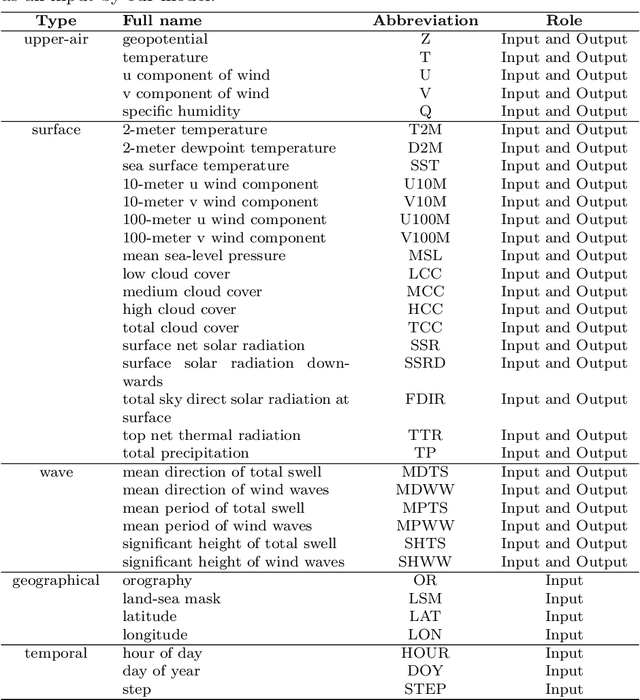
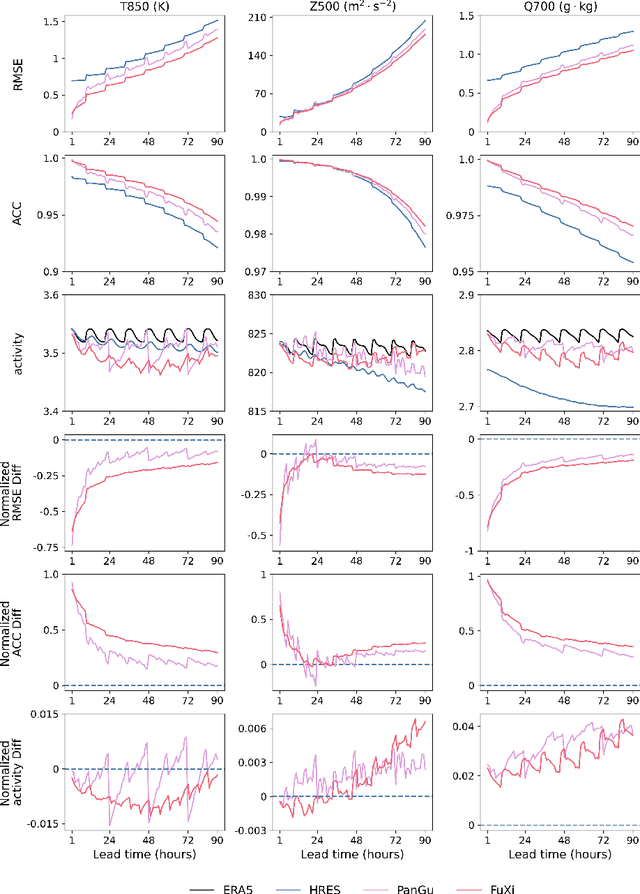
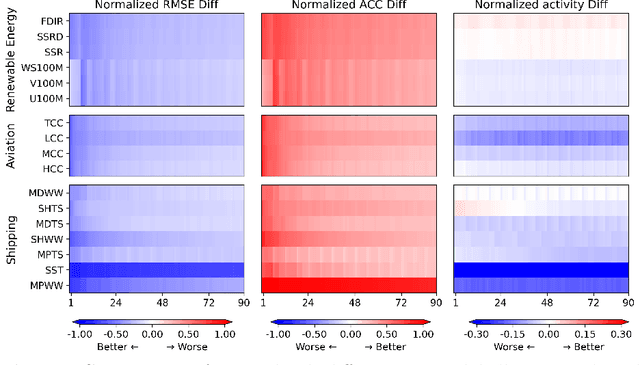
Machine learning (ML) models have become increasingly valuable in weather forecasting, providing forecasts that not only lower computational costs but often match or exceed the accuracy of traditional numerical weather prediction (NWP) models. Despite their potential, ML models typically suffer from limitations such as coarse temporal resolution, typically 6 hours, and a limited set of meteorological variables, limiting their practical applicability. To overcome these challenges, we introduce FuXi-2.0, an advanced ML model that delivers 1-hourly global weather forecasts and includes a comprehensive set of essential meteorological variables, thereby expanding its utility across various sectors like wind and solar energy, aviation, and marine shipping. Our study conducts comparative analyses between ML-based 1-hourly forecasts and those from the high-resolution forecast (HRES) of the European Centre for Medium-Range Weather Forecasts (ECMWF) for various practical scenarios. The results demonstrate that FuXi-2.0 consistently outperforms ECMWF HRES in forecasting key meteorological variables relevant to these sectors. In particular, FuXi-2.0 shows superior performance in wind power forecasting compared to ECMWF HRES, further validating its efficacy as a reliable tool for scenarios demanding precise weather forecasts. Additionally, FuXi-2.0 also integrates both atmospheric and oceanic components, representing a significant step forward in the development of coupled atmospheric-ocean models. Further comparative analyses reveal that FuXi-2.0 provides more accurate forecasts of tropical cyclone intensity than its predecessor, FuXi-1.0, suggesting that there are benefits of an atmosphere-ocean coupled model over atmosphere-only models.