 Add to Chrome
 Add to Firefox
 Add to Edge
3DTCR: A Physics-Based Generative Framework for Vortex-Following 3D Reconstruction to Improve Tropical Cyclone Intensity Forecasting
Mar 16, 2026
Tropical cyclone (TC) intensity forecasting remains challenging as current numerical and AI-based weather models fail to satisfactorily represent extreme TC structure and intensity. Although intensity time-series forecasting has achieved significant advances, it outputs intensity sequences rather than the three-dimensional inner-core fine-scale structure and physical mechanisms governing TC evolution. High-resolution numerical simulations can capture these features but remain computationally expensive and inefficient for large-scale operational applications. Here we present 3DTCR, a physics-based generative framework combining physical constraints with generative AI efficiency for 3D TC structure reconstruction. Trained on a six-year, 3-km-resolution moving-domain WRF dataset, 3DTCR enables region-adaptive vortex-following reconstruction using conditional Flow Matching(CFM), optimized via latent domain adaptation and two-stage transfer learning. The framework mitigates limitations imposed by low-resolution targets and over-smoothed forecasts, improving the representation of TC inner-core structure and intensity while maintaining track stability. Results demonstrate that 3DTCR outperforms the ECMWF high-resolution forecasting system (ECMWF-HRES) in TC intensity prediction at nearly all lead times up to 5 days and reduces the RMSE of maximum WS10M by 36.5% relative to its FuXi inputs. These findings highlight 3DTCR as a physics-based generative framework that efficiently resolves fine-scale structures at lower computational cost, which may offer a promising avenue for improving TC intensity forecasting.

FreDFT: Frequency Domain Fusion Transformer for Visible-Infrared Object Detection
Nov 14, 2025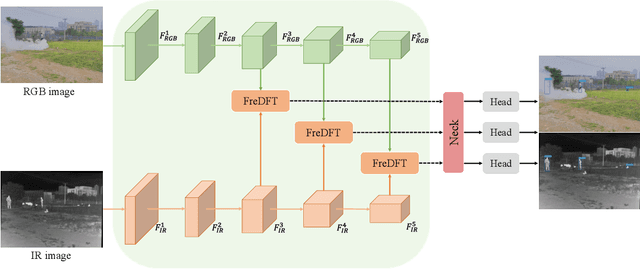
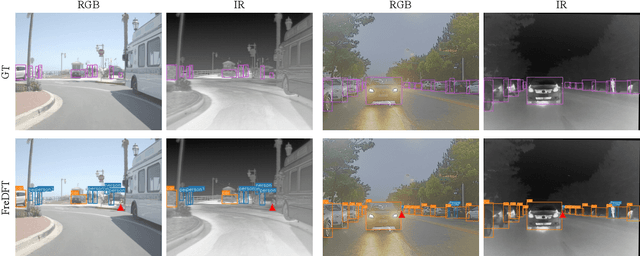
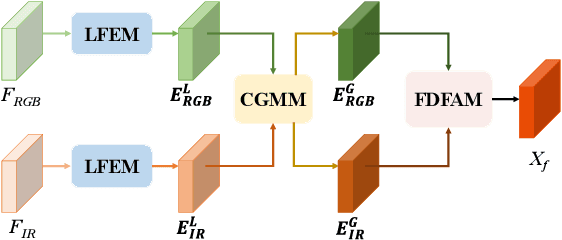
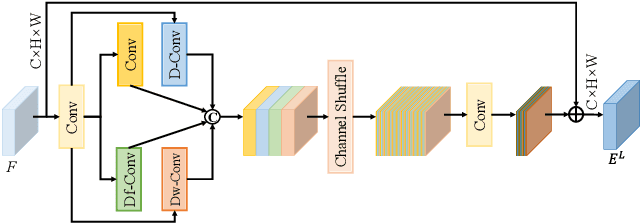
Visible-infrared object detection has gained sufficient attention due to its detection performance in low light, fog, and rain conditions. However, visible and infrared modalities captured by different sensors exist the information imbalance problem in complex scenarios, which can cause inadequate cross-modal fusion, resulting in degraded detection performance. \textcolor{red}{Furthermore, most existing methods use transformers in the spatial domain to capture complementary features, ignoring the advantages of developing frequency domain transformers to mine complementary information.} To solve these weaknesses, we propose a frequency domain fusion transformer, called FreDFT, for visible-infrared object detection. The proposed approach employs a novel multimodal frequency domain attention (MFDA) to mine complementary information between modalities and a frequency domain feed-forward layer (FDFFL) via a mixed-scale frequency feature fusion strategy is designed to better enhance multimodal features. To eliminate the imbalance of multimodal information, a cross-modal global modeling module (CGMM) is constructed to perform pixel-wise inter-modal feature interaction in a spatial and channel manner. Moreover, a local feature enhancement module (LFEM) is developed to strengthen multimodal local feature representation and promote multimodal feature fusion by using various convolution layers and applying a channel shuffle. Extensive experimental results have verified that our proposed FreDFT achieves excellent performance on multiple public datasets compared with other state-of-the-art methods. The code of our FreDFT is linked at https://github.com/WenCongWu/FreDFT.
RGB-T Object Detection via Group Shuffled Multi-receptive Attention and Multi-modal Supervision
May 29, 2024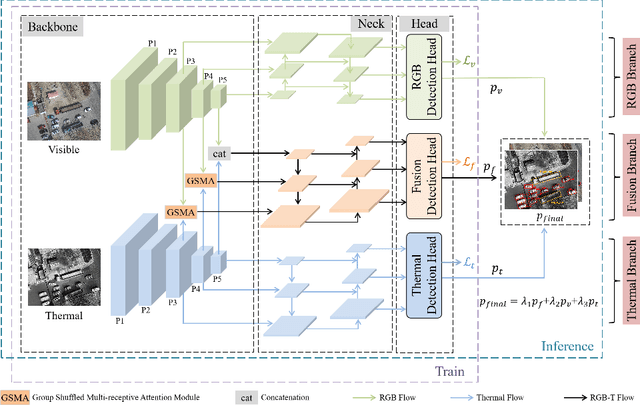


Multispectral object detection, utilizing both visible (RGB) and thermal infrared (T) modals, has garnered significant attention for its robust performance across diverse weather and lighting conditions. However, effectively exploiting the complementarity between RGB-T modals while maintaining efficiency remains a critical challenge. In this paper, a very simple Group Shuffled Multi-receptive Attention (GSMA) module is proposed to extract and combine multi-scale RGB and thermal features. Then, the extracted multi-modal features are directly integrated with a multi-level path aggregation neck, which significantly improves the fusion effect and efficiency. Meanwhile, multi-modal object detection often adopts union annotations for both modals. This kind of supervision is not sufficient and unfair, since objects observed in one modal may not be seen in the other modal. To solve this issue, Multi-modal Supervision (MS) is proposed to sufficiently supervise RGB-T object detection. Comprehensive experiments on two challenging benchmarks, KAIST and DroneVehicle, demonstrate the proposed model achieves the state-of-the-art accuracy while maintaining competitive efficiency.