 Add to Chrome
 Add to Firefox
 Add to Edge
TimeLAVA: Learning-Agnostic Data Valuation for Time Series
Jun 17, 2026
Data valuation quantifies the intrinsic quality of individual samples to enable principled data curation, quality control, and robust learning. For time series in critical domains such as healthcare, finance, and industrial monitoring, effective valuation methods are essential yet fundamentally lacking. Existing approaches are either model-dependent, limiting their generalizability, or designed for i.i.d. data and thus fail to capture temporal dependencies, multi-scale patterns, and non-stationary dynamics inherent to sequential data. We introduce TimeLAVA, a learning-agnostic framework that values temporal segments by their marginal contribution to minimizing distributional discrepancy between evaluated and reference data. At its core is a novel Selective Wavelet-based Wasserstein discrepancy combining multi-scale wavelet transforms for temporal localization with unbalanced optimal transport for robustness to distributional shifts. Segment values are efficiently computed via sensitivity analysis without requiring model training and aggregated into point-wise scores. We provide theoretical guarantees linking valuation to model-agnostic generalization and prove bounded sensitivity to outlier contamination. Extensive experiments across anomaly detection, data pruning, and label noise detection demonstrate that TimeLAVA produces significantly more informative value scores than existing methods on diverse real-world datasets.
* 34pages

Multi-Turn Reasoning When Context Arrives in Pieces: Scalable Sharding and Memory-Augmented RL
Jun 11, 2026When a user reveals task-critical information across several conversation turns, LLM accuracy drops by up to 65% despite full context availability. We show that this Lost in Conversation degradation can be substantially mitigated by training models to maintain a compact rolling memory instead of attending to a growing history. To make such training scalable, we introduce a low-cost sharding pipeline that converts single-turn QA datasets into multi-turn fragmented-information episodes, eliminating the need for hours of manual annotation. Training only on sharded GSM8K, our memory-augmented policy significantly improves multi-turn accuracy and generalises zero-shot to harder math and out-of-domain long-context QA. Moreover, memory-trained models outperform full-history baselines even when given the full history at test time, suggesting that learning to compress induces more robust incremental reasoning than full-context exposure alone.
Observationally Informed Adaptive Causal Experimental Design
Mar 04, 2026Randomized Controlled Trials (RCTs) represent the gold standard for causal inference yet remain a scarce resource. While large-scale observational data is often available, it is utilized only for retrospective fusion, and remains discarded in prospective trial design due to bias concerns. We argue this "tabula rasa" data acquisition strategy is fundamentally inefficient. In this work, we propose Active Residual Learning, a new paradigm that leverages the observational model as a foundational prior. This approach shifts the experimental focus from learning target causal quantities from scratch to efficiently estimating the residuals required to correct observational bias. To operationalize this, we introduce the R-Design framework. Theoretically, we establish two key advantages: (1) a structural efficiency gap, proving that estimating smooth residual contrasts admits strictly faster convergence rates than reconstructing full outcomes; and (2) information efficiency, where we quantify the redundancy in standard parameter-based acquisition (e.g., BALD), demonstrating that such baselines waste budget on task-irrelevant nuisance uncertainty. We propose R-EPIG (Residual Expected Predictive Information Gain), a unified criterion that directly targets the causal estimand, minimizing residual uncertainty for estimation or clarifying decision boundaries for policy. Experiments on synthetic and semi-synthetic benchmarks demonstrate that R-Design significantly outperforms baselines, confirming that repairing a biased model is far more efficient than learning one from scratch.
A Skewness-Based Criterion for Addressing Heteroscedastic Noise in Causal Discovery
Oct 08, 2024

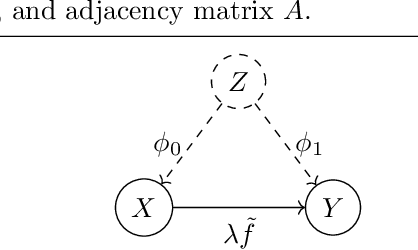

Real-world data often violates the equal-variance assumption (homoscedasticity), making it essential to account for heteroscedastic noise in causal discovery. In this work, we explore heteroscedastic symmetric noise models (HSNMs), where the effect $Y$ is modeled as $Y = f(X) + \sigma(X)N$, with $X$ as the cause and $N$ as independent noise following a symmetric distribution. We introduce a novel criterion for identifying HSNMs based on the skewness of the score (i.e., the gradient of the log density) of the data distribution. This criterion establishes a computationally tractable measurement that is zero in the causal direction but nonzero in the anticausal direction, enabling the causal direction discovery. We extend this skewness-based criterion to the multivariate setting and propose SkewScore, an algorithm that handles heteroscedastic noise without requiring the extraction of exogenous noise. We also conduct a case study on the robustness of SkewScore in a bivariate model with a latent confounder, providing theoretical insights into its performance. Empirical studies further validate the effectiveness of the proposed method.