 Add to Chrome
 Add to Firefox
 Add to Edge
Interdomain Attention: Beyond Token-Level Key-Value Memory
May 23, 2026
Transformers and deep state space models (SSMs) sit at opposite ends of a basic design choice: attention routes each query through a growing key-value (KV) cache by content-based matching at quadratic cost, while deep SSMs compress context into a fixed-size recurrent state that is not directly addressed by query-key matching. We propose Interdomain Attention, which integrates an SSM into an attention module through kernel methods: an attention kernel is approximated by a finite feature map, the resulting key features and values are projected onto a shared set of basis functions maintained by a single SSM recurrence, and each query attends to the compressed coefficients through its own feature map, recovering query-conditioned attention over a fixed-size state. The scalable layer is a learned relaxation of this derivation, and we validate its components through ablations. In a 125M to 1.3B autoregressive language-modeling study on FineWeb-Edu at matched recurrent-state budget, Interdomain Attention improves on an SSM token mixer at every scale, surpasses a same-recipe softmax baseline at 1.3B on validation perplexity and on the eight-task commonsense suite, and inherits the length-flat behavior of its fixed-state core out to 3.5x the training context. Ablations indicate that the query-conditioned projection is the main source of the gain.

Saliency-Aware Regularized Quantization Calibration for Large Language Models
May 07, 2026Post-training quantization (PTQ) is an effective approach for deploying large language models (LLMs) under memory and latency constraints. Most existing PTQ methods determine quantization parameters by minimizing a layer-wise reconstruction error on a predetermined calibration dataset, usually optimized via either scale search or Gram-based methods. However, from the perspective of generalization risk, existing calibration objectives of PTQ based only on empirical reconstruction error on limited or unrepresentative calibration data could move the quantized weights away from the original weights. This may cause the generalization risk to diverge, potentially degrading downstream performance. To address this issue, we propose \emph{Saliency-Aware Regularized Quantization Calibration} (SARQC) a unified framework that augments the standard PTQ objective with a saliency-aware regularization term. This term encourages quantized weights to stay close to the original weights during calibration, leading to improved generalization during inference. SARQC integrates seamlessly into existing PTQ pipelines, enhancing both scale search and Gram-based methods under a unified formulation. Extensive experiments on dense and Mixture-of-Experts LLMs demonstrate consistent improvements in perplexity and zero-shot accuracy, without additional computational overhead during inference.
RASLF: Representation-Aware State Space Model for Light Field Super-Resolution
Mar 17, 2026Current SSM-based light field super-resolution (LFSR) methods often fail to fully leverage the complementarity among various LF representations, leading to the loss of fine textures and geometric misalignments across views. To address these issues, we propose RASLF, a representation-aware state-space framework that explicitly models structural correlations across multiple LF representations. Specifically, a Progressive Geometric Refinement (PGR) block is created that uses a panoramic epipolar representation to explicitly encode multi-view parallax differences, thereby enabling integration across different LF representations. Furthermore, we introduce a Representation Aware Asymmetric Scanning (RAAS) mechanism that dynamically adjusts scanning paths based on the physical properties of different representation spaces, optimizing the balance between performance and efficiency through path pruning. Additionally, a Dual-Anchor Aggregation (DAA) module improves hierarchical feature flow, reducing redundant deeplayer features and prioritizing important reconstruction information. Experiments on various public benchmarks show that RASLF achieves the highest reconstruction accuracy while remaining highly computationally efficient.
Probabilistic Learning and Generation in Deep Sequence Models
Mar 01, 2026Despite exceptional predictive performance of Deep sequence models (DSMs), the main concern of their deployment centers around the lack of uncertainty awareness. In contrast, probabilistic models quantify the uncertainty associated with unobserved variables with rules of probability. Notably, Bayesian methods leverage Bayes' rule to express our belief of unobserved variables in a principled way. Since exact Bayesian inference is computationally infeasible at scale, approximate inference is required in practice. Two major bottlenecks of Bayesian methods, especially when applied in deep neural networks, are prior specification and approximation quality. In Chapter 3 & 4, we investigate how the architectures of DSMs themselves can be informative for the design of priors or approximations in probabilistic models. We first develop an approximate Bayesian inference method tailored to the Transformer based on the similarity between attention and sparse Gaussian process. Next, we exploit the long-range memory preservation capability of HiPPOs (High-order Polynomial Projection Operators) to construct an interdomain inducing point for Gaussian process, which successfully memorizes the history in online learning. In addition to the progress of DSMs in predictive tasks, sequential generative models consisting of a sequence of latent variables are popularized in the domain of deep generative models. Inspired by the explicit self-supervised signals for these latent variables in diffusion models, in Chapter 5, we explore the possibility of improving other generative models with self-supervision for their sequential latent states, and investigate desired probabilistic structures over them. Overall, this thesis leverages inductive biases in DSMs to design probabilistic inference or structure, which bridges the gap between DSMs and probabilistic models, leading to mutually reinforced improvement.
AugVLA-3D: Depth-Driven Feature Augmentation for Vision-Language-Action Models
Feb 11, 2026Vision-Language-Action (VLA) models have recently achieved remarkable progress in robotic perception and control, yet most existing approaches primarily rely on VLM trained using 2D images, which limits their spatial understanding and action grounding in complex 3D environments. To address this limitation, we propose a novel framework that integrates depth estimation into VLA models to enrich 3D feature representations. Specifically, we employ a depth estimation baseline called VGGT to extract geometry-aware 3D cues from standard RGB inputs, enabling efficient utilization of existing large-scale 2D datasets while implicitly recovering 3D structural information. To further enhance the reliability of these depth-derived features, we introduce a new module called action assistant, which constrains the learned 3D representations with action priors and ensures their consistency with downstream control tasks. By fusing the enhanced 3D features with conventional 2D visual tokens, our approach significantly improves the generalization ability and robustness of VLA models. Experimental results demonstrate that the proposed method not only strengthens perception in geometrically ambiguous scenarios but also leads to superior action prediction accuracy. This work highlights the potential of depth-driven data augmentation and auxiliary expert supervision for bridging the gap between 2D observations and 3D-aware decision-making in robotic systems.
Compact Memory for Continual Logistic Regression
Nov 12, 2025Despite recent progress, continual learning still does not match the performance of batch training. To avoid catastrophic forgetting, we need to build compact memory of essential past knowledge, but no clear solution has yet emerged, even for shallow neural networks with just one or two layers. In this paper, we present a new method to build compact memory for logistic regression. Our method is based on a result by Khan and Swaroop [2021] who show the existence of optimal memory for such models. We formulate the search for the optimal memory as Hessian-matching and propose a probabilistic PCA method to estimate them. Our approach can drastically improve accuracy compared to Experience Replay. For instance, on Split-ImageNet, we get 60% accuracy compared to 30% obtained by replay with memory-size equivalent to 0.3% of the data size. Increasing the memory size to 2% further boosts the accuracy to 74%, closing the gap to the batch accuracy of 77.6% on this task. Our work opens a new direction for building compact memory that can also be useful in the future for continual deep learning.
Bayesian Computation in Deep Learning
Feb 26, 2025This review paper is intended for the 2nd edition of the Handbook of Markov chain Monte Carlo. We provide an introduction to approximate inference techniques as Bayesian computation methods applied to deep learning models. We organize the chapter by presenting popular computational methods for Bayesian neural networks and deep generative models, explaining their unique challenges in posterior inference as well as the solutions.
Recurrent Memory for Online Interdomain Gaussian Processes
Feb 12, 2025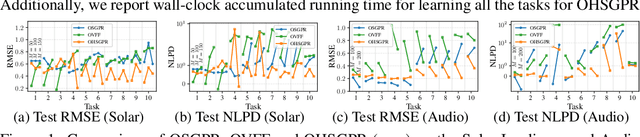
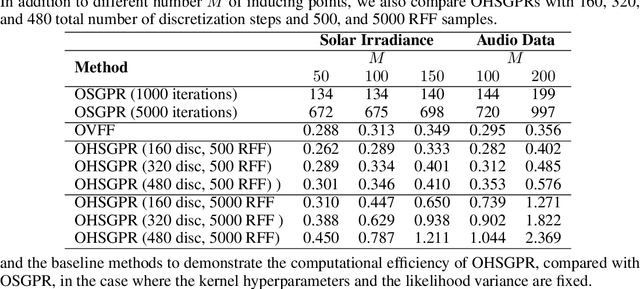
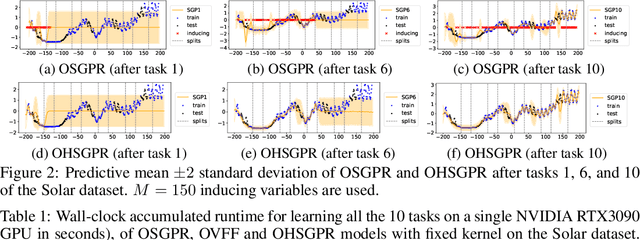
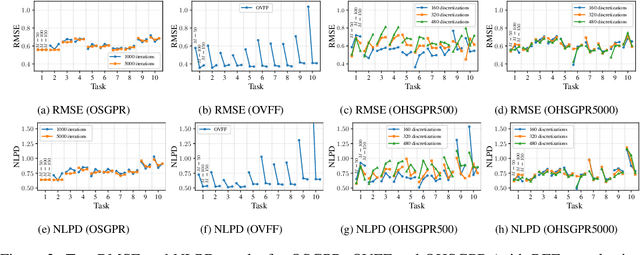
We propose a novel online Gaussian process (GP) model that is capable of capturing long-term memory in sequential data in an online regression setting. Our model, Online HiPPO Sparse Variational Gaussian Process Regression (OHSGPR), leverages the HiPPO (High-order Polynomial Projection Operators) framework, which is popularized in the RNN domain due to its long-range memory modeling capabilities. We interpret the HiPPO time-varying orthogonal projections as inducing variables with time-dependent orthogonal polynomial basis functions, which allows the SGPR inducing points to memorize the process history. We show that the HiPPO framework fits naturally into the interdomain GP framework and demonstrate that the kernel matrices can also be updated online in a recurrence form based on the ODE evolution of HiPPO. We evaluate our method on time series regression tasks, showing that it outperforms the existing online GP method in terms of predictive performance and computational efficiency
Your Image is Secretly the Last Frame of a Pseudo Video
Oct 26, 2024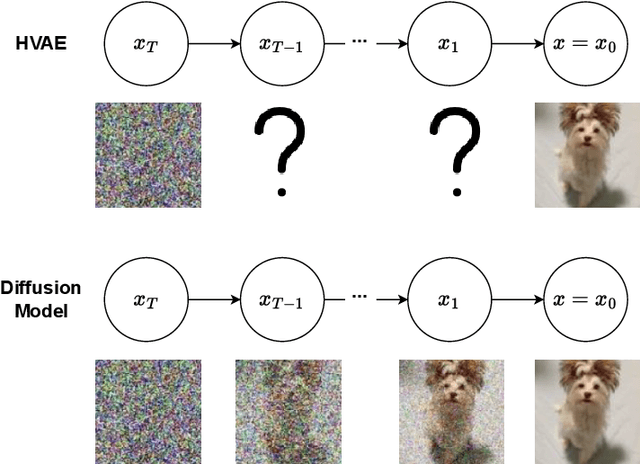
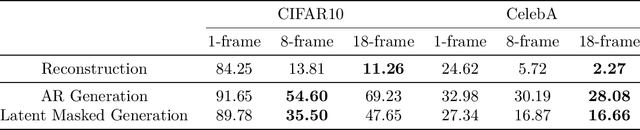


Diffusion models, which can be viewed as a special case of hierarchical variational autoencoders (HVAEs), have shown profound success in generating photo-realistic images. In contrast, standard HVAEs often produce images of inferior quality compared to diffusion models. In this paper, we hypothesize that the success of diffusion models can be partly attributed to the additional self-supervision information for their intermediate latent states provided by corrupted images, which along with the original image form a pseudo video. Based on this hypothesis, we explore the possibility of improving other types of generative models with such pseudo videos. Specifically, we first extend a given image generative model to their video generative model counterpart, and then train the video generative model on pseudo videos constructed by applying data augmentation to the original images. Furthermore, we analyze the potential issues of first-order Markov data augmentation methods, which are typically used in diffusion models, and propose to use more expressive data augmentation to construct more useful information in pseudo videos. Our empirical results on the CIFAR10 and CelebA datasets demonstrate that improved image generation quality can be achieved with additional self-supervised information from pseudo videos.
Prototype-based Optimal Transport for Out-of-Distribution Detection
Oct 10, 2024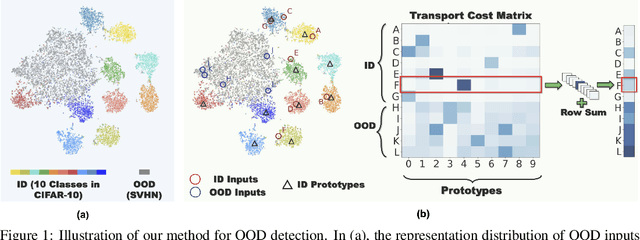
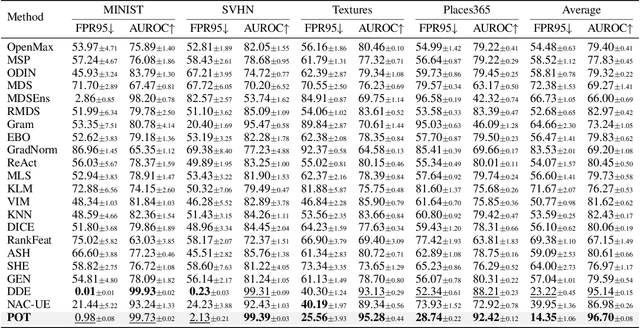

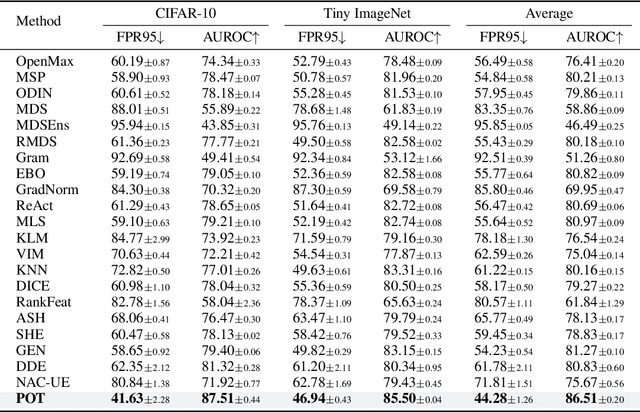
Detecting Out-of-Distribution (OOD) inputs is crucial for improving the reliability of deep neural networks in the real-world deployment. In this paper, inspired by the inherent distribution shift between ID and OOD data, we propose a novel method that leverages optimal transport to measure the distribution discrepancy between test inputs and ID prototypes. The resulting transport costs are used to quantify the individual contribution of each test input to the overall discrepancy, serving as a desirable measure for OOD detection. To address the issue that solely relying on the transport costs to ID prototypes is inadequate for identifying OOD inputs closer to ID data, we generate virtual outliers to approximate the OOD region via linear extrapolation. By combining the transport costs to ID prototypes with the costs to virtual outliers, the detection of OOD data near ID data is emphasized, thereby enhancing the distinction between ID and OOD inputs. Experiments demonstrate the superiority of our method over state-of-the-art methods.