 Add to Chrome
 Add to Firefox
 Add to Edge
When Do Multi-Agent Systems Help? An Information Bottleneck Perspective
Jul 17, 2026
LLM powered multi-agent systems (MAS) have emerged as a promising paradigm for complex tasks. However, their advantages over single-agent systems (SAS) remain unclear, with performance varying inconsistently across settings. Here, we provide an information bottleneck perspective on elucidating the differences between MAS and SAS. Specifically, our key observation is that a SAS accumulates its full reasoning trace in one shared context, while a MAS uses isolated local contexts connected by bounded relay messages. We show that, under infinite relay bandwidth, any SAS can be simulated by a MAS that transmits the full upstream context. Thus, the nontrivial advantage of MAS arises under bounded relays, where compression introduces a fundamental trade-off: reducing redundant context can improve efficiency, but may also incur loss of task-relevant information. We formalize this trade-off as an information bottleneck controlled by an effective parameter $β$, which captures how the balance shifts with model capability, and shows that MAS gains arise when context reduction outweighs relay information loss. We conduct 18 controlled experiments across five benchmarks and three model scales to validate our theoretical studies. We observe that MAS consistently helps when relays are near-sufficient, especially for weaker models. In contrast, MAS gains shrink or reverse when relays incur information loss, especially for stronger models that can already extract useful information from redundant context and thus gain little from compression. Our study shows that multi-agent design is fundamentally an information-bottleneck optimization problem. This perspective explains when bounded inter-agent communication helps or hurts.

Spin-Weighted Spherical Harmonics Enable Complete and Scalable $\mathrm{E}(3)$-Equivariant Networks
Jul 01, 2026$\mathrm{E}(3)$-equivariant networks are promising for 3D atomistic system modeling, yet their scalability is limited by the $O(L^6)$ complexity of the Clebsch-Gordan Tensor Product (CGTP). The recently proposed Gaunt Tensor Product (GTP) reduces the complexity but is unable to capture the antisymmetric paths, resulting in incomplete expressivity. In this work, we present SpinGTP, an approach to overcome the GTP incompleteness by generalizing from scalar functions to Spin-Weighted Spherical Harmonics (SWSH). By relying on the algebraic properties of SWSH, SpinGTP recovers the missing antisymmetric interactions while maintaining the asymptotic efficiency of GTP. It also allows for a more expressive equivariant basis that naturally accounts for the parity-odd components of tensor products. We evaluate SpinGTP across diverse benchmarks, including Tetris, 3BPA, SPICE-MACE-OFF, and OC20. Our results show that SpinGTP achieves accuracies comparable to full CGTP. Notably, by explicitly capturing antisymmetric paths, SpinGTP exhibits superior performance in tasks involving chiral materials and non-centrosymmetric geometries. This work provides a complete, scalable, and mathematically rigorous path toward high-order equivariance in large-scale 3D atomistic system simulations.
Model Developmental Safety: A Safety-Centric Method and Applications in Vision-Language Models
Oct 13, 2024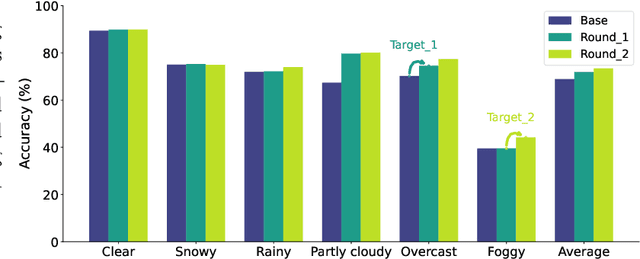
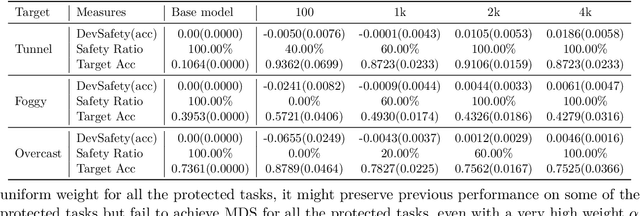
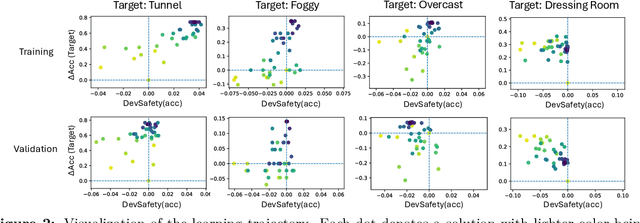
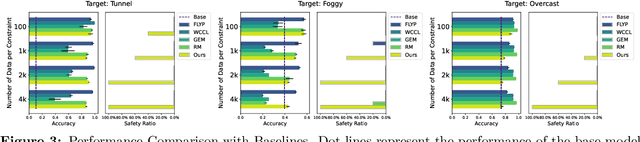
In the real world, a learning-enabled system usually undergoes multiple cycles of model development to enhance the system's ability to handle difficult or emerging tasks. This continual model development process raises a significant issue that the model development for acquiring new or improving existing capabilities may inadvertently lose capabilities of the old model, also known as catastrophic forgetting. Existing continual learning studies focus on mitigating catastrophic forgetting by trading off performance on previous tasks and new tasks to ensure good average performance. However, they are inadequate for many applications especially in safety-critical domains, as failure to strictly preserve the performance of the old model not only introduces safety risks and uncertainties but also imposes substantial expenses in the re-improving and re-validation of existing properties. To address this issue, we introduce model developmental safety as a guarantee of a learning system such that in the model development process the new model should strictly preserve the existing protected capabilities of the old model while improving its performance on target tasks. To ensure the model developmental safety, we present a safety-centric framework by formulating the model developmental safety as data-dependent constraints. Under this framework, we study how to develop a pretrained vision-language model (aka the CLIP model) for acquiring new capabilities or improving existing capabilities of image classification. We propose an efficient constrained optimization algorithm with theoretical guarantee and use its insights to finetune a CLIP model with task-dependent heads for promoting the model developmental safety. Our experiments on improving vision perception capabilities on autonomous driving and scene recognition datasets demonstrate the efficacy of the proposed approach.
Automated Polynomial Filter Learning for Graph Neural Networks
Jul 16, 2023
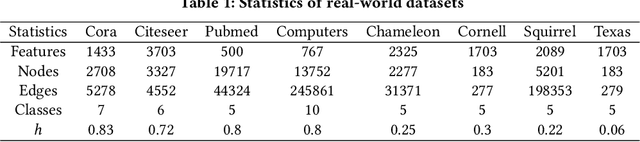
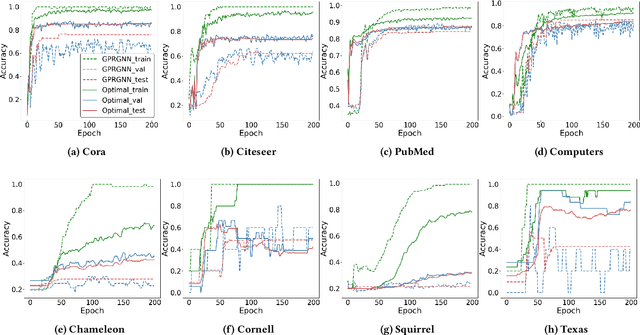
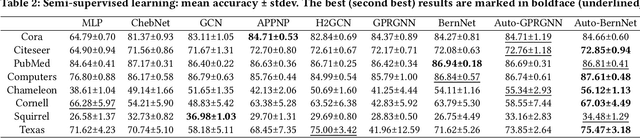
Polynomial graph filters have been widely used as guiding principles in the design of Graph Neural Networks (GNNs). Recently, the adaptive learning of the polynomial graph filters has demonstrated promising performance for modeling graph signals on both homophilic and heterophilic graphs, owning to their flexibility and expressiveness. In this work, we conduct a novel preliminary study to explore the potential and limitations of polynomial graph filter learning approaches, revealing a severe overfitting issue. To improve the effectiveness of polynomial graph filters, we propose Auto-Polynomial, a novel and general automated polynomial graph filter learning framework that efficiently learns better filters capable of adapting to various complex graph signals. Comprehensive experiments and ablation studies demonstrate significant and consistent performance improvements on both homophilic and heterophilic graphs across multiple learning settings considering various labeling ratios, which unleashes the potential of polynomial filter learning.