 Add to Chrome
 Add to Firefox
 Add to Edge
TA-SparseMG: Trend-Aware Sparse Forecasting via Multi-Scale Gating for Long-Term Time Series
Jun 26, 2026
Long-term time series forecasting finds extensive applications in domains such as power demand, traffic flow, meteorological observation, and renewable energy dispatch. Forecasting dynamically varying long-term time series poses inherent challenges, including statistical nonstationarity, local high-frequency disturbances, and coupled cross-period dependencies, which make it difficult for lightweight models to balance parameter efficiency and forecasting performance. To address this issue, this study presents TA-SparseMG, a lightweight cross-period forecasting model built on SparseTSF's sparse cross-period modeling framework. It incorporates three key modules: a trend-aware reversible instance normalization module, a scale-adaptive gated denoising module, and a multiscale gated-attention MLP forecasting module. The trend-aware normalization module captures input-window statistics and calibrates forecast-window distributions, effectively mitigating distribution shift. The scale-adaptive gated denoising module performs feature smoothing and residual suppression before period rearrangement, thereby reducing interference from high-frequency perturbations. The multiscale gated attention prediction module strengthens the prediction head's adaptive representational capacity via conditional gating and feature modulation. Extensive experiments across multiple LTSF benchmarks demonstrate that the proposed TA-SparseMG consistently achieves superior, stable performance. Ablation studies confirm that each module independently improves distribution adaptation, input robustness, and cross-period feature mapping capability.

PaAno+: Multiscale Encoding and Cross-Variable Attention for Time Series Anomaly Detection
Jun 18, 2026Time-series anomaly detection has significant practical value for industrial and medical monitoring, as well as other critical domains. Current Transformer- and large-model-based detection approaches incur excessive computational overhead, while existing lightweight alternatives are constrained by insufficient feature extraction and inadequate modeling of dependencies across multivariate variables. To mitigate the above drawbacks, this study develops a lightweight, efficient anomaly detection model, dubbed PaAno, within the patch-oriented representation learning paradigm. In the encoder module, a multiscale feature-extraction backbone is constructed using convolutional kernels with differentiated receptive fields to capture hierarchical temporal characteristics; subsequent cross-scale adaptive attention aggregation, combined with residual connection optimization, further stabilizes feature representation learning. A cross-variable fusion attention module is embedded to explicitly characterize inter-variable correlations, empowering the model to identify anomalous patterns amid intricate operational conditions. Moreover, a novel pretext task based on temporal patch-window sorting is customized to uncover intrinsic structural properties of time series, and triplet loss is leveraged to optimize the patch embedding space for enhanced feature discrimination. Extensive experiments on the TSB-AD benchmark demonstrate that the proposed PaAno achieves state-of-the-art detection accuracy on both univariate and multivariate tasks, yielding significant performance gains across evaluation metrics, including VUS-PR, relative to the original PaAno. Leveraging a compact network design, the presented model achieves favorable computational efficiency, enabling deployment on resource-limited terminals for real-time anomaly inference.
Movable-Antenna Enabled Robust Vehicular Consumer Networks Under Imperfect CSI
Apr 20, 2026The accelerating advancement of intelligent transportation systems has established consumer-oriented vehicular networks (CVNs) as a critical infrastructure for next-generation connected mobility. However, the high mobility of vehicular users (VUs) introduces significant channel state information (CSI) uncertainty, which severely undermines the performance of conventional fixed-position antenna systems. To address this, this paper explores the deployment of movable-antennas (MAs) to enhance communication robustness in CVNs under imperfect CSI conditions. We develop a joint optimization framework that dynamically coordinates the spatial positioning of MAs and transmit beamforming at the base station, with the objective of maximizing the worst-case sum rate across all VUs. The problem is formulated as a non-convex max-min optimization problem, subject to bounded CSI estimation errors, transmit power limits, and physical constraints on antenna displacement. By adopting an alternating optimization strategy, the original problem is decomposed into tractable subproblems, solved via techniques including the S-Procedure, Schur complement, and successive convex approximation. Numerical evaluations confirm that the proposed approach achieves substantial gains over existing benchmarks in terms of worst-case throughput.
Exact and Asymptotically Complete Robust Verifications of Neural Networks via Quantum Optimization
Feb 28, 2026Deep neural networks (DNNs) enable high performance across domains but remain vulnerable to adversarial perturbations, limiting their use in safety-critical settings. Here, we introduce two quantum-optimization-based models for robust verification that reduce the combinatorial burden of certification under bounded input perturbations. For piecewise-linear activations (e.g., ReLU and hardtanh), our first model yields an exact formulation that is sound and complete, enabling precise identification of adversarial examples. For general activations (including sigmoid and tanh), our second model constructs scalable over-approximations via piecewise-constant bounds and is asymptotically complete, with approximation error vanishing as the segmentation is refined. We further integrate Quantum Benders Decomposition with interval arithmetic to accelerate solving, and propose certificate-transfer bounds that relate robustness guarantees of pruned networks to those of the original model. Finally, a layerwise partitioning strategy supports a quantum--classical hybrid workflow by coupling subproblems across depth. Experiments on robustness benchmarks show high certification accuracy, indicating that quantum optimization can serve as a principled primitive for robustness guarantees in neural networks with complex activations.
UAV-Enabled Fluid Antenna Systems for Multi-Target Wireless Sensing over LAWCNs
Sep 26, 2025Fluid antenna system (FAS) is emerging as a key technology for enhancing spatial flexibility and sensing accuracy in future wireless systems. This paper investigates an unmanned aerial vehicle (UAV)-enabled FAS for multi-target wireless sensing in low-altitude wireless consumer networks (LAWCNs) for achieving the low-altitude economy (LAE) missions. We formulate an optimization problem aimed at minimizing the average Cram\'er-Rao bound (CRB) for multiple target estimations. To tackle this non-convex problem, an efficient alternating optimization (AO) algorithm is proposed, which jointly optimizes the UAV trajectory, the antenna position of the transmit fluid antennas (FAs) and the receive FAs, and the transmit beamforming at the UAV. Simulation results demonstrate significant performance improvements in estimation accuracy and sensing reliability compared to conventional schemes, e.g., the fixed position antenna scheme. The proposed system achieves enhanced sensing performance through adaptive trajectory design and beamforming, alongside effective interference suppression via the flexible FAS antenna repositioning, underscoring its practical potential for precision sensing in the UAV-enabled LAWCNs.
RSMA-Enhanced Data Collection in RIS-Assisted Intelligent Consumer Transportation Systems
Sep 11, 2025This paper investigates the data collection enhancement problem in a reconfigurable intelligent surface (RIS)-empowered intelligent consumer transportation system (ICTS). We propose a novel framework where a data center (DC) provides energy to pre-configured roadside unit (RSU) pairs during the downlink stage. While in the uplink stage, these RSU pairs utilize a hybrid rate-splitting multiple access (RSMA) and time-division multiple access (TDMA) protocol to transmit the processed data to the DC, while simultaneously performing local data processing using the harvested energy. Our objective is to maximize the minimal processed data volume of the RSU pairs by jointly optimizing the RIS downlink and uplink phase shifts, the transmit power of the DC and RSUs, the RSU computation resource allocation, and the time slot allocation. To address the formulated non-convex problem, we develop an efficient iterative algorithm integrating alternating optimization and sequential rank-one constraint relaxation methods. Extensive simulations demonstrate that the proposed algorithm significantly outperforms baseline schemes under diverse scenarios, validating its effectiveness in enhancing the data processing performance for intelligent transportation applications.
Latency Minimization for Multi-AAV-Enabled ISCC Systems with Movable Antenna
Aug 07, 2025This paper investigates an autonomous aerial vehicle (AAV)-enabled integrated sensing, communication, and computation system, with a particular focus on integrating movable antennas (MAs) into the system for enhancing overall system performance. Specifically, multiple MA-enabled AVVs perform sensing tasks and simultaneously transmit the generated computational tasks to the base station for processing. To minimize the maximum latency under the sensing and resource constraints, we formulate an optimization problem that jointly coordinates the position of the MAs, the computation resource allocation, and the transmit beamforming. Due to the non-convexity of the objective function and strong coupling among variables, we propose a two-layer iterative algorithm leveraging particle swarm optimization and convex optimization to address it. The simulation results demonstrate that the proposed scheme achieves significant latency improvements compared to the baseline schemes.
Movable Antennas Meet Low-Altitude Wireless Networks: Fundamentals, Opportunities, and Future Directions
Jun 16, 2025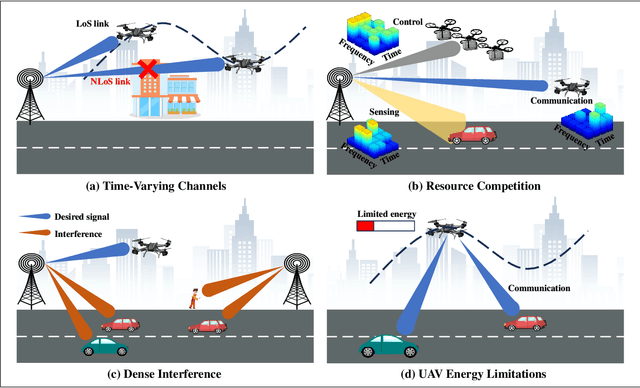
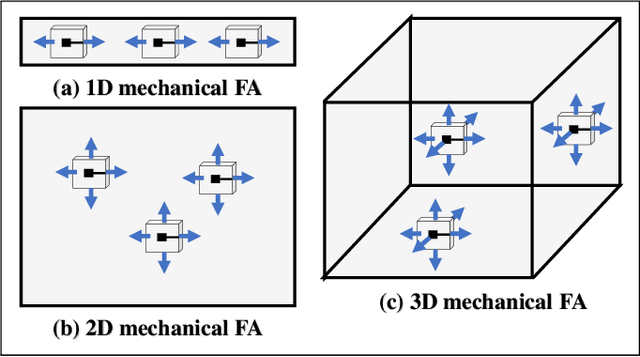
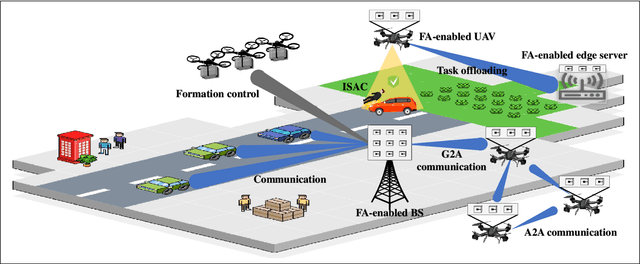
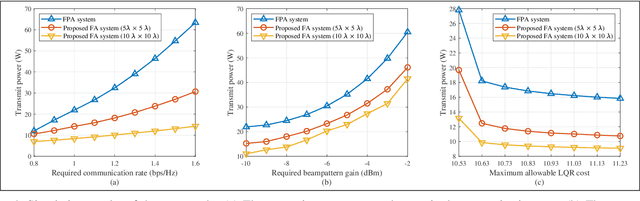
With the rapid development of low-altitude applications, there is an increasing demand for low-altitude wireless networks (LAWNs) to simultaneously achieve high-rate communication, precise sensing, and reliable control in the low-altitude airspace. In this paper, we first present a typical system architecture of LAWNs, which integrates three core functionalities: communication, sensing, and control. Subsequently, we explore the promising prospects of movable antenna (MA)-assisted wireless communications, with emphasis on its potential in flexible beamforming, interference management, and spatial multiplexing gain. Furthermore, we elaborate on the integrated communication, sensing, and control capabilities enabled by MAs in LAWNs, and illustrate their effectiveness through representative examples. A case study demonstrates that MA-enabled LAWNs achieve significant performance improvements over traditional fixed-position antenna-based LAWNs in terms of communication throughput, sensing accuracy, and control stability. Finally, we outline several promising directions for future research, including the MA-assisted unmanned aerial vehicle (UAV) communication/sensing, the MA-assisted reliable control, and the MA-enhanced physical layer security.
Coordinated Beamforming for RIS-Empowered ISAC Systems over Secure Low-Altitude Networks
May 30, 2025Emerging as a cornerstone for next-generation wireless networks, integrated sensing and communication (ISAC) systems demand innovative solutions to balance spectral efficiency and sensing accuracy. In this paper, we propose a coordinated beamforming framework for a reconfigurable intelligent surface (RIS)-empowered ISAC system, where the active precoding at the dual-functional base station (DFBS) and the passive beamforming at the RIS are jointly optimized to provide communication services for legitimate unmanned aerial vehicles (UAVs) while sensing the unauthorized UAVs. The sum-rate of all legitimate UAVs are maximized, while satisfying the radar sensing signal-to-noise ratio requirements, the transmit power constraints, and the reflection coefficients of the RIS. To address the inherent non-convexity from coupled variables, we propose a low-complexity algorithm integrating fractional programming with alternating optimization, featuring convergence guarantees. Numerical results demonstrate that the proposed algorithm achieves higher data rate compared to disjoint optimization benchmarks. This underscores RIS's pivotal role in harmonizing communication and target sensing functionalities for low-altitude networks.
Full-Duplex ISCC for Low-Altitude Networks: Resource Allocation and Coordinated Beamforming
Apr 25, 2025This paper investigates an integrated sensing, communication, and computing system deployed over low-altitude networks for enabling applications within the low-altitude economy. In the considered system, a full-duplex enabled unmanned aerial vehicle (UAV) is dispatched in the airspace, functioning as a UAV-enabled low-altitude platform (ULAP). The ULAP is capable of achieving simultaneous information transmission, target sensing, and mobile edge computing services. To reduce the overall energy consumption of the system while meeting the sensing beampattern threshold and user computation requirements, we formulate an energy consumption minimization problem by jointly optimizing the task allocation, computation resource allocation, transmit beamforming, and receive beamforming. Since the problem is non-convex and involves highly coupled variables, we propose an efficient algorithm based on alternation optimization, which decomposes the original problem into tractable convex subproblems. Moreover, we analyze the convergence and complexity of the proposed algorithm. Numerical results demonstrate that the proposed scheme saves up to 54.12\% energy consumption performance compared to the benchmark schemes.