 Add to Chrome
 Add to Firefox
 Add to Edge
Kimi K3: Open Frontier Intelligence
Jul 27, 2026
We introduce Kimi K3, a 2.8T parameter Mixture-of-Experts model with 104 billion activated parameters, native vision capabilities, and a 1-million-token context window. Kimi K3 is built on Kimi Delta Attention and Attention Residuals, which improve information flow across sequence length and model depth. Together with Stable LatentMoE, which effectively activates 16 of 896 routed experts per token, and refined training and data recipes, these advances yield an approximately 2.5x improvement in overall scaling efficiency over Kimi K2. Post-training highlights reinforcement learning across general, agentic, and coding domains and multiple reasoning-effort levels, enabling compositional generalization and robust long-horizon execution. At 2.8T scale, Kimi K3 is supported by infrastructure advances in multiple areas: algorithm-system co-design for KDA, perfectly balanced expert-parallel training with efficient memory management, million-token agentic RL with persistent rollout and sandbox states, and deployment innovations. Extensive evaluations show that Kimi K3 achieves frontier-level performance across long-horizon coding, agentic, knowledge, reasoning, and vision tasks. While its overall performance still trails the most powerful proprietary models, namely Claude Fable 5 and GPT-5.6 Sol, Kimi K3 consistently outperforms other open and proprietary models evaluated in our suite. We release the full Kimi K3 model weights to facilitate future research and accelerate the broader deployment and adoption of frontier intelligence.

Movable-Antenna Assisted Energy Minimization in UAV-Enabled Mobile Edge Computing Systems
Jul 25, 2026Driven by the exponential growth of latency-sensitive applications, mobile edge computing (MEC) has emerged as a pivotal paradigm, yet mitigating its substantial energy consumption remains critical. This paper explores a movable-antenna (MA) assisted energy minimization scheme in an uncrewed aerial vehicle (UAV)-enabled MEC system, where a UAV equipped with an MA array serves as an edge server to process tasks offloaded from terrestrial consumer electronics (CE) devices. To minimize the total system energy consumption, we jointly optimize computation resource allocation, CE transmit power, receive beamforming, and MA positions. To tackle the resulting non-convex problem with coupled variables, a robust alternating optimization algorithm based on the block coordinate descent method is developed. The problem is iteratively decomposed into three subproblems. In particular, the subproblem of transmit power and receive beamforming is reformulated and optimized using the quadratic transform technique, while the MA array positions are optimized via the particle swarm optimization algorithm. Numerical simulations verify that the proposed scheme achieves substantial energy savings over conventional benchmarks.
6DMA-Enabled ISAC for Low-Altitude Economy
May 04, 2026In this paper, we investigate a six dimensional movable antenna (6DMA) enable integrated sensing and communications (ISAC) network in low-altitude economy. The studied 6DMA can move in a three-dimensional space and rotate around its surface center, making full use of spatial freedom to adapt to the different location distributions of uncrewed aerial vehicles (UAVs) adjust channel conditions in time. However, since the rotation and location change of 6DMA requires the assistance of a physical device, it is unreasonable for 6DMA to change locations too frequently. Therefore, we propose a hierarchical deep reinforcement learning algorithm based on twin delayed deep deterministic policy gradient. The first layer optimizes the rotation and location of 6DMA with infrequent updates, and the second layer optimizes the UAV flight direction and base station transmit beamforming matrix in each time slot. Under the condition of satisfying the sensing intensity of the sensing target, the total data transmission rate to the UAVs is maximized. The numerical results show that the proposed 6DMA-enable ISAC algorithm through joint optimization of multiple variables performs significantly better than the partially movable scheme and the fixed antenna position scheme.
Movable-Antenna Enabled Robust Vehicular Consumer Networks Under Imperfect CSI
Apr 20, 2026The accelerating advancement of intelligent transportation systems has established consumer-oriented vehicular networks (CVNs) as a critical infrastructure for next-generation connected mobility. However, the high mobility of vehicular users (VUs) introduces significant channel state information (CSI) uncertainty, which severely undermines the performance of conventional fixed-position antenna systems. To address this, this paper explores the deployment of movable-antennas (MAs) to enhance communication robustness in CVNs under imperfect CSI conditions. We develop a joint optimization framework that dynamically coordinates the spatial positioning of MAs and transmit beamforming at the base station, with the objective of maximizing the worst-case sum rate across all VUs. The problem is formulated as a non-convex max-min optimization problem, subject to bounded CSI estimation errors, transmit power limits, and physical constraints on antenna displacement. By adopting an alternating optimization strategy, the original problem is decomposed into tractable subproblems, solved via techniques including the S-Procedure, Schur complement, and successive convex approximation. Numerical evaluations confirm that the proposed approach achieves substantial gains over existing benchmarks in terms of worst-case throughput.
UAV-Enabled Fluid Antenna Systems for Multi-Target Wireless Sensing over LAWCNs
Sep 26, 2025Fluid antenna system (FAS) is emerging as a key technology for enhancing spatial flexibility and sensing accuracy in future wireless systems. This paper investigates an unmanned aerial vehicle (UAV)-enabled FAS for multi-target wireless sensing in low-altitude wireless consumer networks (LAWCNs) for achieving the low-altitude economy (LAE) missions. We formulate an optimization problem aimed at minimizing the average Cram\'er-Rao bound (CRB) for multiple target estimations. To tackle this non-convex problem, an efficient alternating optimization (AO) algorithm is proposed, which jointly optimizes the UAV trajectory, the antenna position of the transmit fluid antennas (FAs) and the receive FAs, and the transmit beamforming at the UAV. Simulation results demonstrate significant performance improvements in estimation accuracy and sensing reliability compared to conventional schemes, e.g., the fixed position antenna scheme. The proposed system achieves enhanced sensing performance through adaptive trajectory design and beamforming, alongside effective interference suppression via the flexible FAS antenna repositioning, underscoring its practical potential for precision sensing in the UAV-enabled LAWCNs.
RSMA-Enhanced Data Collection in RIS-Assisted Intelligent Consumer Transportation Systems
Sep 11, 2025This paper investigates the data collection enhancement problem in a reconfigurable intelligent surface (RIS)-empowered intelligent consumer transportation system (ICTS). We propose a novel framework where a data center (DC) provides energy to pre-configured roadside unit (RSU) pairs during the downlink stage. While in the uplink stage, these RSU pairs utilize a hybrid rate-splitting multiple access (RSMA) and time-division multiple access (TDMA) protocol to transmit the processed data to the DC, while simultaneously performing local data processing using the harvested energy. Our objective is to maximize the minimal processed data volume of the RSU pairs by jointly optimizing the RIS downlink and uplink phase shifts, the transmit power of the DC and RSUs, the RSU computation resource allocation, and the time slot allocation. To address the formulated non-convex problem, we develop an efficient iterative algorithm integrating alternating optimization and sequential rank-one constraint relaxation methods. Extensive simulations demonstrate that the proposed algorithm significantly outperforms baseline schemes under diverse scenarios, validating its effectiveness in enhancing the data processing performance for intelligent transportation applications.
QoS-Aware Integrated Sensing, Communication, and Control with Movable Antenna
Aug 11, 2025Integrated sensing, communication, and control (ISCC) has emerged as a key enabler for low-altitude wireless networks with enhanced adaptability through resource allocation co-design and intelligent environment awareness. However, dynamic interference and channel attenuation constrain the potential of the ISCC system. To address this challenge, we propose a novel movable antenna-empowered ISCC system. An achievable data rate maximization problem is formulated while guaranteeing the sensing and control quality-of-service (QoS) by optimizing the positions of the antennas and the beamforming strategy for communication, sensing, and control co-design. An efficient alternating optimization (AO)-based algorithm is proposed to solve the highly coupled non-convex problem. Numerical results demonstrate that the proposed AO-based algorithm achieves substantial gains in the achievable data rate and the control QoS compared with benchmark schemes.
Latency Minimization for Multi-AAV-Enabled ISCC Systems with Movable Antenna
Aug 07, 2025This paper investigates an autonomous aerial vehicle (AAV)-enabled integrated sensing, communication, and computation system, with a particular focus on integrating movable antennas (MAs) into the system for enhancing overall system performance. Specifically, multiple MA-enabled AVVs perform sensing tasks and simultaneously transmit the generated computational tasks to the base station for processing. To minimize the maximum latency under the sensing and resource constraints, we formulate an optimization problem that jointly coordinates the position of the MAs, the computation resource allocation, and the transmit beamforming. Due to the non-convexity of the objective function and strong coupling among variables, we propose a two-layer iterative algorithm leveraging particle swarm optimization and convex optimization to address it. The simulation results demonstrate that the proposed scheme achieves significant latency improvements compared to the baseline schemes.
Movable Antennas Meet Low-Altitude Wireless Networks: Fundamentals, Opportunities, and Future Directions
Jun 16, 2025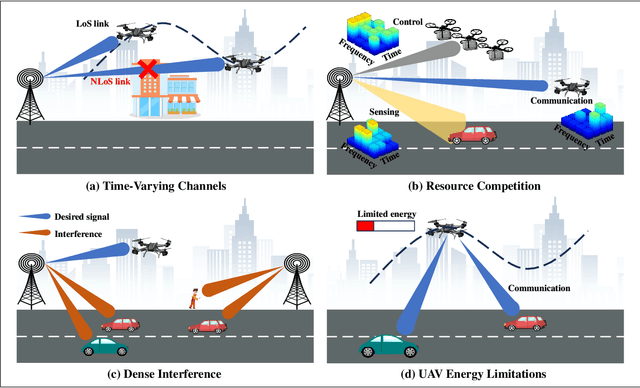
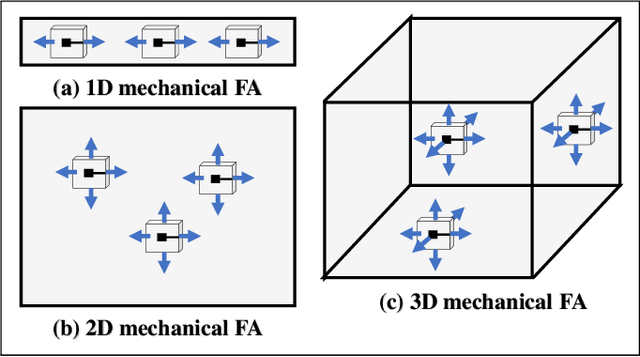
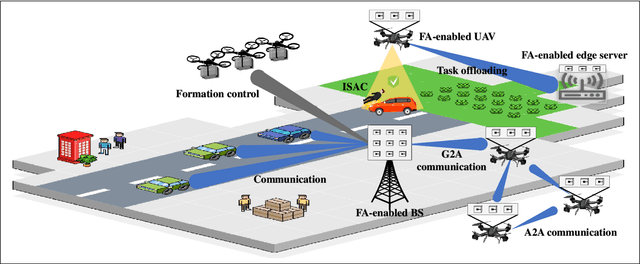
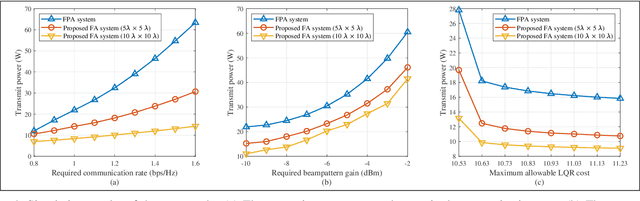
With the rapid development of low-altitude applications, there is an increasing demand for low-altitude wireless networks (LAWNs) to simultaneously achieve high-rate communication, precise sensing, and reliable control in the low-altitude airspace. In this paper, we first present a typical system architecture of LAWNs, which integrates three core functionalities: communication, sensing, and control. Subsequently, we explore the promising prospects of movable antenna (MA)-assisted wireless communications, with emphasis on its potential in flexible beamforming, interference management, and spatial multiplexing gain. Furthermore, we elaborate on the integrated communication, sensing, and control capabilities enabled by MAs in LAWNs, and illustrate their effectiveness through representative examples. A case study demonstrates that MA-enabled LAWNs achieve significant performance improvements over traditional fixed-position antenna-based LAWNs in terms of communication throughput, sensing accuracy, and control stability. Finally, we outline several promising directions for future research, including the MA-assisted unmanned aerial vehicle (UAV) communication/sensing, the MA-assisted reliable control, and the MA-enhanced physical layer security.
Coordinated Beamforming for RIS-Empowered ISAC Systems over Secure Low-Altitude Networks
May 30, 2025Emerging as a cornerstone for next-generation wireless networks, integrated sensing and communication (ISAC) systems demand innovative solutions to balance spectral efficiency and sensing accuracy. In this paper, we propose a coordinated beamforming framework for a reconfigurable intelligent surface (RIS)-empowered ISAC system, where the active precoding at the dual-functional base station (DFBS) and the passive beamforming at the RIS are jointly optimized to provide communication services for legitimate unmanned aerial vehicles (UAVs) while sensing the unauthorized UAVs. The sum-rate of all legitimate UAVs are maximized, while satisfying the radar sensing signal-to-noise ratio requirements, the transmit power constraints, and the reflection coefficients of the RIS. To address the inherent non-convexity from coupled variables, we propose a low-complexity algorithm integrating fractional programming with alternating optimization, featuring convergence guarantees. Numerical results demonstrate that the proposed algorithm achieves higher data rate compared to disjoint optimization benchmarks. This underscores RIS's pivotal role in harmonizing communication and target sensing functionalities for low-altitude networks.