 Add to Chrome
 Add to Firefox
 Add to Edge
Exact and Asymptotically Complete Robust Verifications of Neural Networks via Quantum Optimization
Feb 28, 2026
Deep neural networks (DNNs) enable high performance across domains but remain vulnerable to adversarial perturbations, limiting their use in safety-critical settings. Here, we introduce two quantum-optimization-based models for robust verification that reduce the combinatorial burden of certification under bounded input perturbations. For piecewise-linear activations (e.g., ReLU and hardtanh), our first model yields an exact formulation that is sound and complete, enabling precise identification of adversarial examples. For general activations (including sigmoid and tanh), our second model constructs scalable over-approximations via piecewise-constant bounds and is asymptotically complete, with approximation error vanishing as the segmentation is refined. We further integrate Quantum Benders Decomposition with interval arithmetic to accelerate solving, and propose certificate-transfer bounds that relate robustness guarantees of pruned networks to those of the original model. Finally, a layerwise partitioning strategy supports a quantum--classical hybrid workflow by coupling subproblems across depth. Experiments on robustness benchmarks show high certification accuracy, indicating that quantum optimization can serve as a principled primitive for robustness guarantees in neural networks with complex activations.

Kaiwu-PyTorch-Plugin: Bridging Deep Learning and Photonic Quantum Computing for Energy-Based Models and Active Sample Selection
Feb 22, 2026This paper introduces the Kaiwu-PyTorch-Plugin (KPP) to bridge Deep Learning and Photonic Quantum Computing across multiple dimensions. KPP integrates the Coherent Ising Machine into the PyTorch ecosystem, addressing classical inefficiencies in Energy-Based Models. The framework facilitates quantum integration in three key aspects: accelerating Boltzmann sampling, optimizing training data via Active Sampling, and constructing hybrid architectures like QBM-VAE and Q-Diffusion. Empirical results on single-cell and OpenWebText datasets demonstrate KPPs ability to achieve SOTA performance, validating a comprehensive quantum-classical paradigm.
Combinatorial optimization solving by coherent Ising machines based on spiking neural networks
Aug 16, 2022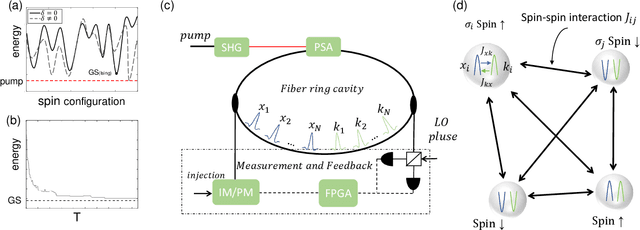
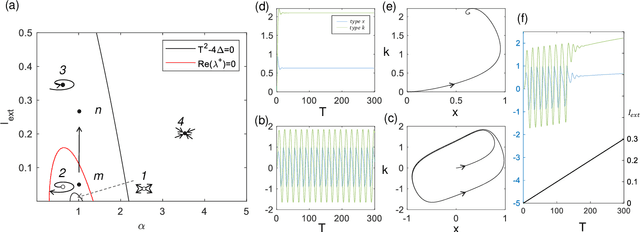
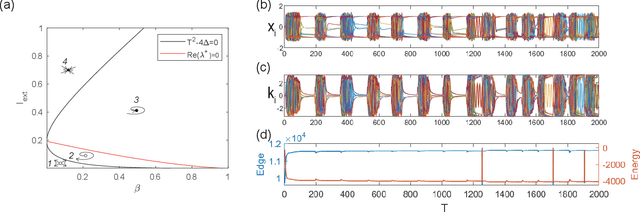
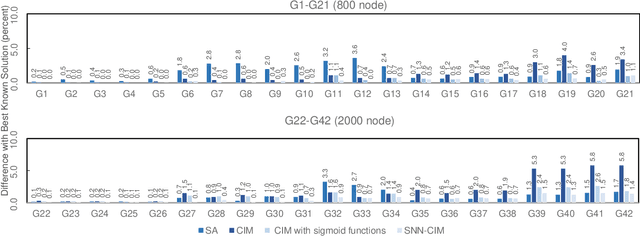
Spiking neural network is a kind of neuromorphic computing which is believed to improve on the level of intelligence and provide advabtages for quantum computing. In this work, we address this issue by designing an optical spiking neural network and prove that it can be used to accelerate the speed of computation, especially on the combinatorial optimization problems. Here the spiking neural network is constructed by the antisymmetrically coupled degenerate optical parametric oscillator pulses and dissipative pulses. A nonlinear transfer function is chosen to mitigate amplitude inhomogeneities and destabilize the resulting local minima according to the dynamical behavior of spiking neurons. It is numerically proved that the spiking neural network-coherent Ising machines has excellent performance on combinatorial optimization problems, for which is expected to offer a new applications for neural computing and optical computing.
Active Learning Approach to Optimization of Experimental Control
Mar 27, 2020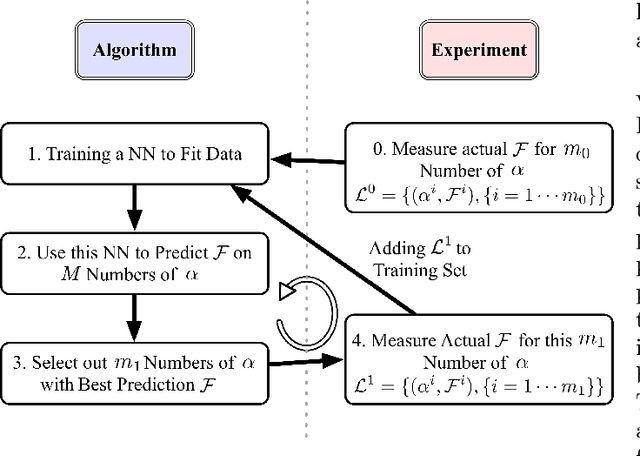
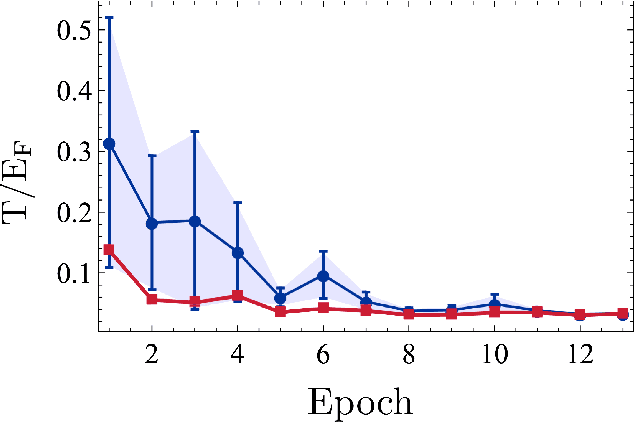
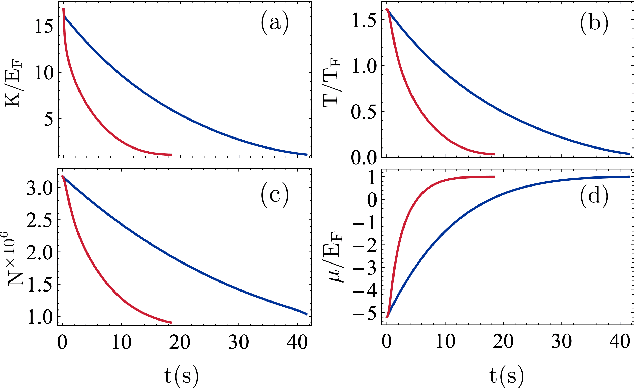
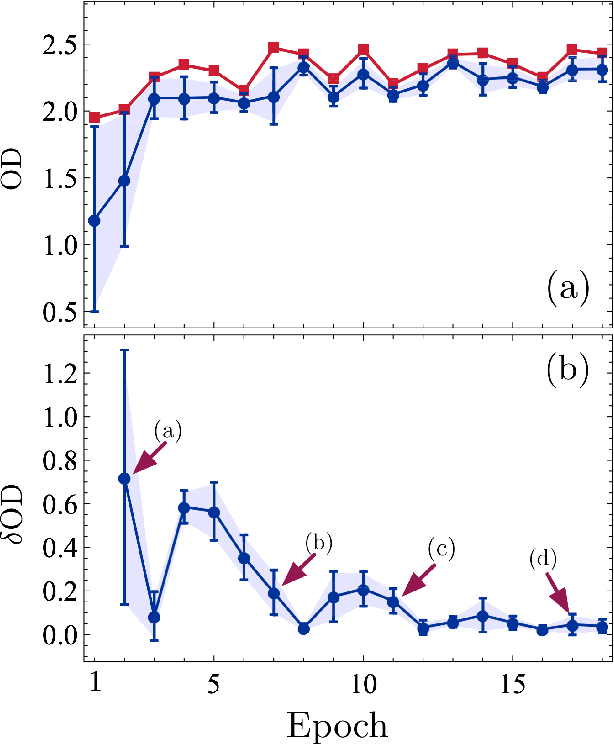
In this work we present a general machine learning based scheme to optimize experimental control. The method utilizes the neural network to learn the relation between the control parameters and the control goal, with which the optimal control parameters can be obtained. The main challenge of this approach is that the labeled data obtained from experiments are not abundant. The central idea of our scheme is to use the active learning to overcome this difficulty. As a demonstration example, we apply our method to control evaporative cooling experiments in cold atoms. We have first tested our method with simulated data and then applied our method to real experiments. We demonstrate that our method can successfully reach the best performance within hundreds of experimental runs. Our method does not require knowledge of the experimental system as a prior and is universal for experimental control in different systems.