 Add to Chrome
 Add to Firefox
 Add to Edge
CARD: Cluster-level Adaptation with Reward-guided Decoding for Personalized Text Generation
Jan 09, 2026
Adapting large language models to individual users remains challenging due to the tension between fine-grained personalization and scalable deployment. We present CARD, a hierarchical framework that achieves effective personalization through progressive refinement. CARD first clusters users according to shared stylistic patterns and learns cluster-specific LoRA adapters, enabling robust generalization and strong low-resource performance. To capture individual differences within each cluster, we propose an implicit preference learning mechanism that contrasts user-authored text with cluster-level generations, allowing the model to infer user-specific style preferences without manual annotation. At inference time, CARD injects personalization exclusively at decoding via lightweight user preference vectors and low-rank logit corrections, while keeping the base model frozen. Experiments on the LaMP and LongLaMP benchmarks show that CARD achieves competitive or superior generation quality compared to state-of-the-art baselines, while significantly improving efficiency and scalability for practical personalized text generation.

UniHetero: Could Generation Enhance Understanding for Vision-Language-Model at Large Data Scale?
Dec 30, 2025Vision-language large models are moving toward the unification of visual understanding and visual generation tasks. However, whether generation can enhance understanding is still under-explored on large data scale. In this work, we analysis the unified structure with a concise model, UniHetero, under large-scale pretraining (>200M samples). Our key observations are: (1) Generation can improve understanding, but Only if you generate Semantics, Not Pixels. A common assumption in unified vision-language models is that adding generation will naturally strengthen understanding. However, this is not always true at scale. At 200M+ pretraining samples, generation helps understanding only when it operates at the semantic level, i.e. when the model learns to autoregress high-level visual representations inside the LLM. Once pixel-level objectives (e.g., diffusion losses) directly interfere with the LLM, understanding performance often degrades. (2) Generation reveals a superior Data Scaling trend and higher Data Utilization. Unified generation-understanding demonstrates a superior scaling trend compared to understanding alone, revealing a more effective way to learn vision-only knowledge directive from vision modality rather than captioning to text. (3) Autoregression on Input Embedding is effective to capture visual details. Compared to the commonly-used vision encoder, make visual autoregression on input embedding shows less cumulative error and is modality independent, which can be extend to all modalities. The learned semantic representations capture visual information such as objects, locations, shapes, and colors; further enable pixel-level image generation.
Towards Better Optimization For Listwise Preference in Diffusion Models
Oct 02, 2025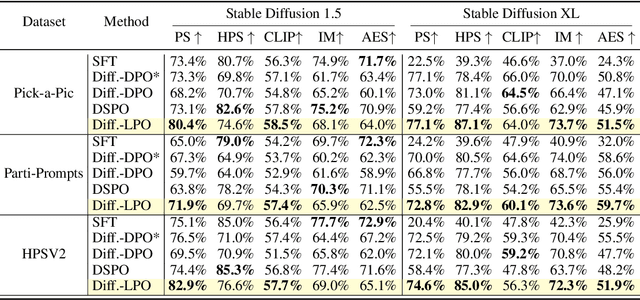

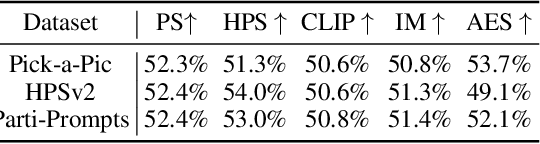
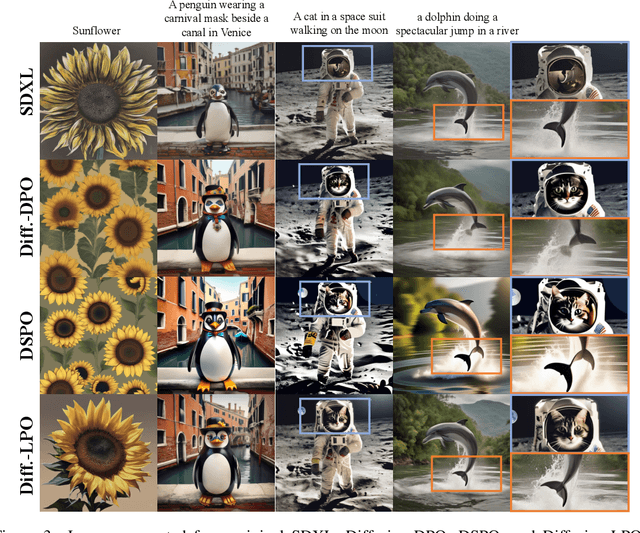
Reinforcement learning from human feedback (RLHF) has proven effectiveness for aligning text-to-image (T2I) diffusion models with human preferences. Although Direct Preference Optimization (DPO) is widely adopted for its computational efficiency and avoidance of explicit reward modeling, its applications to diffusion models have primarily relied on pairwise preferences. The precise optimization of listwise preferences remains largely unaddressed. In practice, human feedback on image preferences often contains implicit ranked information, which conveys more precise human preferences than pairwise comparisons. In this work, we propose Diffusion-LPO, a simple and effective framework for Listwise Preference Optimization in diffusion models with listwise data. Given a caption, we aggregate user feedback into a ranked list of images and derive a listwise extension of the DPO objective under the Plackett-Luce model. Diffusion-LPO enforces consistency across the entire ranking by encouraging each sample to be preferred over all of its lower-ranked alternatives. We empirically demonstrate the effectiveness of Diffusion-LPO across various tasks, including text-to-image generation, image editing, and personalized preference alignment. Diffusion-LPO consistently outperforms pairwise DPO baselines on visual quality and preference alignment.