 Add to Chrome
 Add to Firefox
 Add to Edge
Logics-Parsing-Omni Technical Report
Mar 12, 2026
Addressing the challenges of fragmented task definitions and the heterogeneity of unstructured data in multimodal parsing, this paper proposes the Omni Parsing framework. This framework establishes a Unified Taxonomy covering documents, images, and audio-visual streams, introducing a progressive parsing paradigm that bridges perception and cognition. Specifically, the framework integrates three hierarchical levels: 1) Holistic Detection, which achieves precise spatial-temporal grounding of objects or events to establish a geometric baseline for perception; 2) Fine-grained Recognition, which performs symbolization (e.g., OCR/ASR) and attribute extraction on localized objects to complete structured entity parsing; and 3) Multi-level Interpreting, which constructs a reasoning chain from local semantics to global logic. A pivotal advantage of this framework is its evidence anchoring mechanism, which enforces a strict alignment between high-level semantic descriptions and low-level facts. This enables ``evidence-based'' logical induction, transforming unstructured signals into standardized knowledge that is locatable, enumerable, and traceable. Building on this foundation, we constructed a standardized dataset and released the Logics-Parsing-Omni model, which successfully converts complex audio-visual signals into machine-readable structured knowledge. Experiments demonstrate that fine-grained perception and high-level cognition are synergistic, effectively enhancing model reliability. Furthermore, to quantitatively evaluate these capabilities, we introduce OmniParsingBench. Code, models and the benchmark are released at https://github.com/alibaba/Logics-Parsing/tree/master/Logics-Parsing-Omni.

GraphGPT: Graph Learning with Generative Pre-trained Transformers
Dec 31, 2023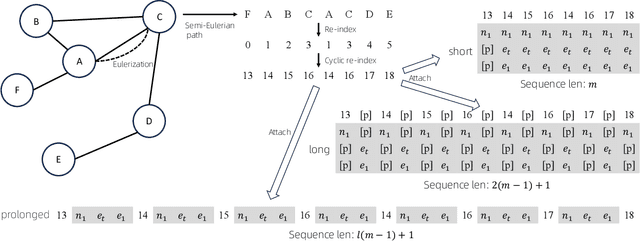
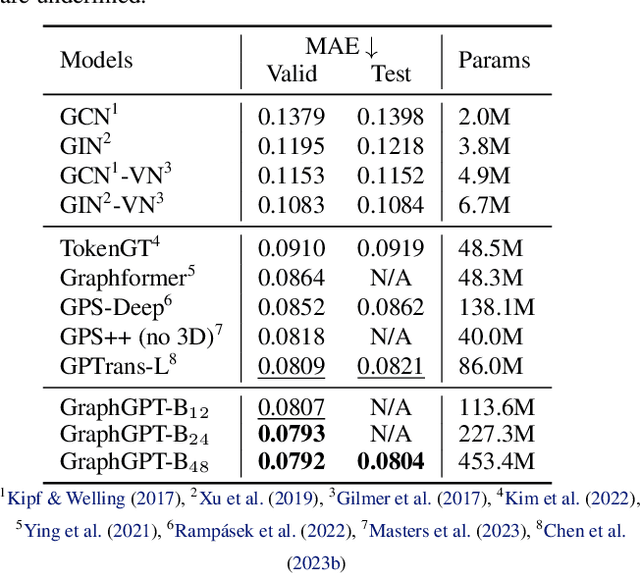
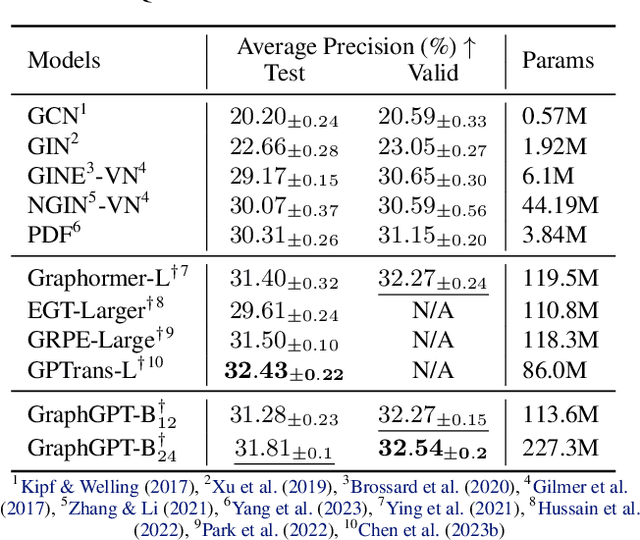
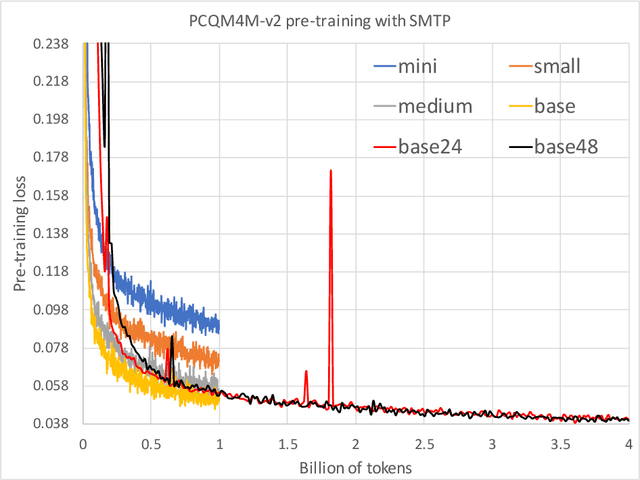
We introduce \textit{GraphGPT}, a novel model for Graph learning by self-supervised Generative Pre-training Transformers. Our model transforms each graph or sampled subgraph into a sequence of tokens representing the node, edge and attributes reversibly using the Eulerian path first. Then we feed the tokens into a standard transformer decoder and pre-train it with the next-token-prediction (NTP) task. Lastly, we fine-tune the GraphGPT model with the supervised tasks. This intuitive, yet effective model achieves superior or close results to the state-of-the-art methods for the graph-, edge- and node-level tasks on the large scale molecular dataset PCQM4Mv2, the protein-protein association dataset ogbl-ppa and the ogbn-proteins dataset from the Open Graph Benchmark (OGB). Furthermore, the generative pre-training enables us to train GraphGPT up to 400M+ parameters with consistently increasing performance, which is beyond the capability of GNNs and previous graph transformers. The source code and pre-trained checkpoints will be released soon\footnote{\url{https://github.com/alibaba/graph-gpt}} to pave the way for the graph foundation model research, and also to assist the scientific discovery in pharmaceutical, chemistry, material and bio-informatics domains, etc.