 Add to Chrome
 Add to Firefox
 Add to Edge
PEDRO: Parameter-Efficient Fine-tuning with Prompt DEpenDent Representation MOdification
Sep 26, 2024
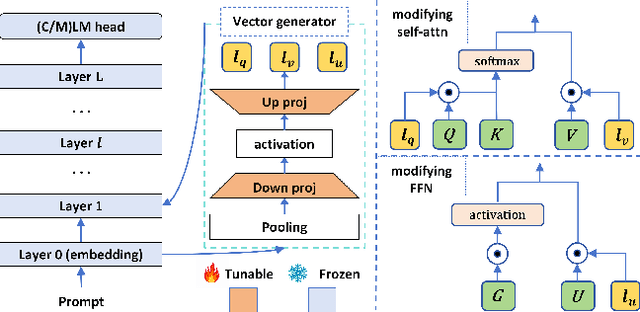
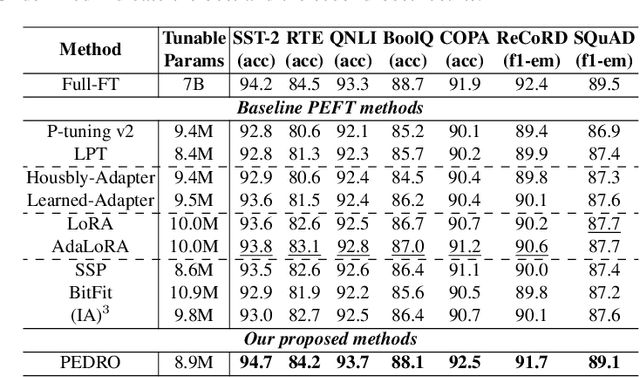
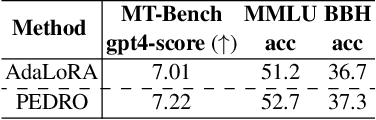
Due to their substantial sizes, large language models (LLMs) are typically deployed within a single-backbone multi-tenant framework. In this setup, a single instance of an LLM backbone must cater to multiple users or tasks through the application of various parameter-efficient fine-tuning (PEFT) models. Despite the availability of numerous effective PEFT techniques such as LoRA, there remains a need for a PEFT approach that achieves both high efficiency during inference and competitive performance on downstream tasks. In this research, we introduce a new and straightforward PEFT methodology named \underline{P}rompt D\underline{E}pen\underline{D}ent \underline{R}epresentation M\underline{O}dification (PEDRO). The proposed method involves integrating a lightweight vector generator into each Transformer layer, which generates vectors contingent upon the input prompts. These vectors then modify the hidden representations created by the LLM through a dot product operation, thereby influencing the semantic output and generated content of the model. Extensive experimentation across a variety of tasks indicates that: (a) PEDRO surpasses recent PEFT benchmarks when using a similar number of tunable parameters. (b) Under the single-backbone multi-tenant deployment model, PEDRO exhibits superior efficiency compared to LoRA, indicating significant industrial potential.

CorrAdaptor: Adaptive Local Context Learning for Correspondence Pruning
Aug 15, 2024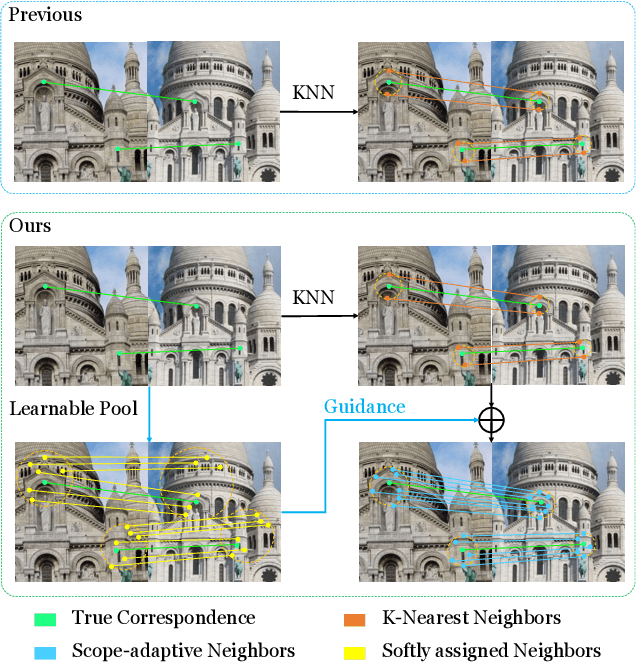
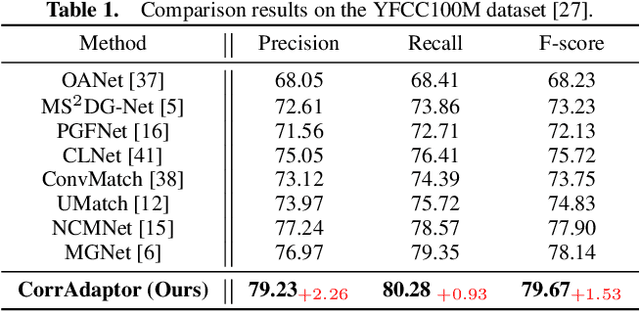
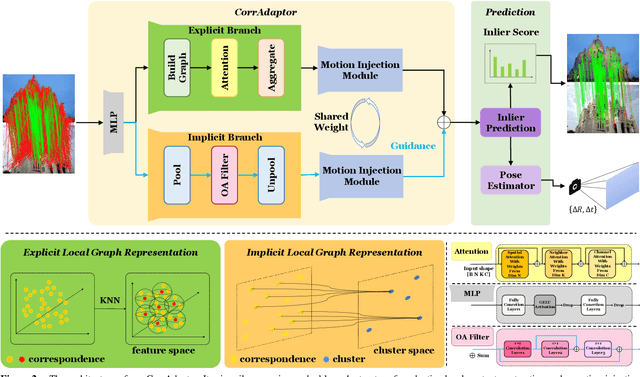
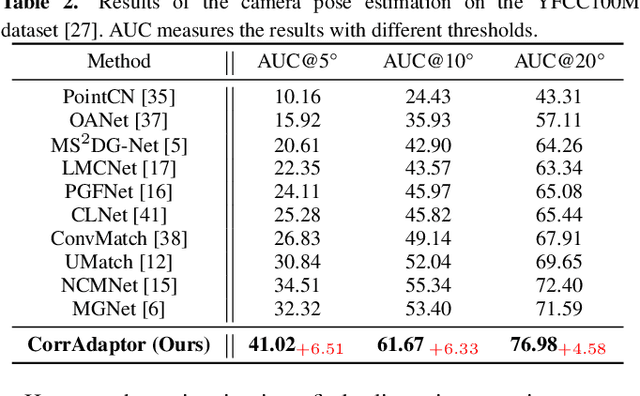
In the fields of computer vision and robotics, accurate pixel-level correspondences are essential for enabling advanced tasks such as structure-from-motion and simultaneous localization and mapping. Recent correspondence pruning methods usually focus on learning local consistency through k-nearest neighbors, which makes it difficult to capture robust context for each correspondence. We propose CorrAdaptor, a novel architecture that introduces a dual-branch structure capable of adaptively adjusting local contexts through both explicit and implicit local graph learning. Specifically, the explicit branch uses KNN-based graphs tailored for initial neighborhood identification, while the implicit branch leverages a learnable matrix to softly assign neighbors and adaptively expand the local context scope, significantly enhancing the model's robustness and adaptability to complex image variations. Moreover, we design a motion injection module to integrate motion consistency into the network to suppress the impact of outliers and refine local context learning, resulting in substantial performance improvements. The experimental results on extensive correspondence-based tasks indicate that our CorrAdaptor achieves state-of-the-art performance both qualitatively and quantitatively. The code and pre-trained models are available at https://github.com/TaoWangzj/CorrAdaptor.
TCMBench: A Comprehensive Benchmark for Evaluating Large Language Models in Traditional Chinese Medicine
Jun 03, 2024
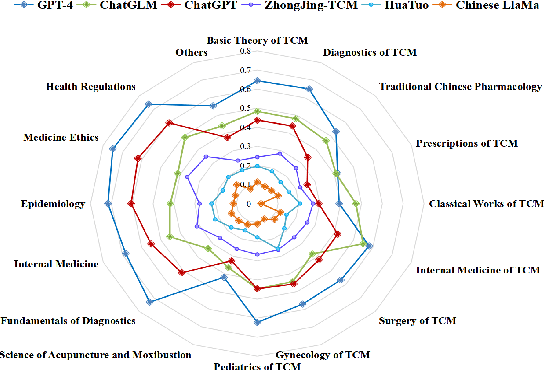

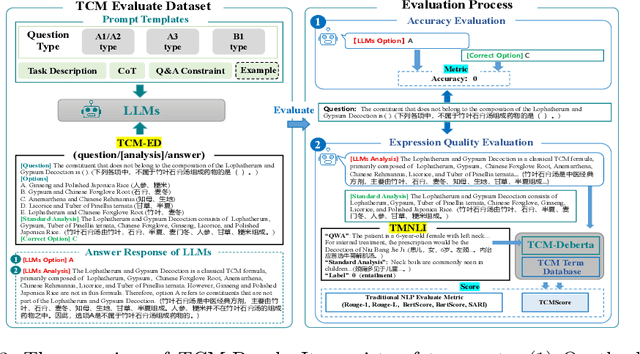
Large language models (LLMs) have performed remarkably well in various natural language processing tasks by benchmarking, including in the Western medical domain. However, the professional evaluation benchmarks for LLMs have yet to be covered in the traditional Chinese medicine(TCM) domain, which has a profound history and vast influence. To address this research gap, we introduce TCM-Bench, an comprehensive benchmark for evaluating LLM performance in TCM. It comprises the TCM-ED dataset, consisting of 5,473 questions sourced from the TCM Licensing Exam (TCMLE), including 1,300 questions with authoritative analysis. It covers the core components of TCMLE, including TCM basis and clinical practice. To evaluate LLMs beyond accuracy of question answering, we propose TCMScore, a metric tailored for evaluating the quality of answers generated by LLMs for TCM related questions. It comprehensively considers the consistency of TCM semantics and knowledge. After conducting comprehensive experimental analyses from diverse perspectives, we can obtain the following findings: (1) The unsatisfactory performance of LLMs on this benchmark underscores their significant room for improvement in TCM. (2) Introducing domain knowledge can enhance LLMs' performance. However, for in-domain models like ZhongJing-TCM, the quality of generated analysis text has decreased, and we hypothesize that their fine-tuning process affects the basic LLM capabilities. (3) Traditional metrics for text generation quality like Rouge and BertScore are susceptible to text length and surface semantic ambiguity, while domain-specific metrics such as TCMScore can further supplement and explain their evaluation results. These findings highlight the capabilities and limitations of LLMs in the TCM and aim to provide a more profound assistance to medical research.
IAPT: Instruction-Aware Prompt Tuning for Large Language Models
May 28, 2024
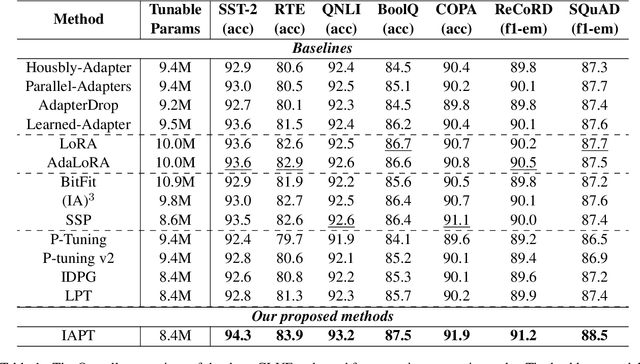
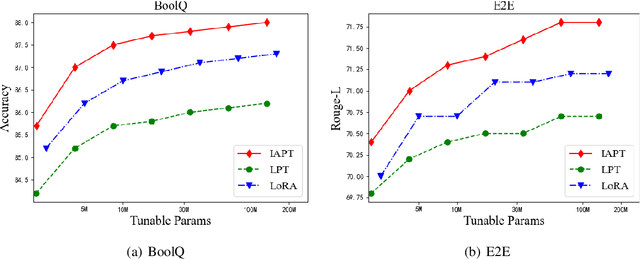

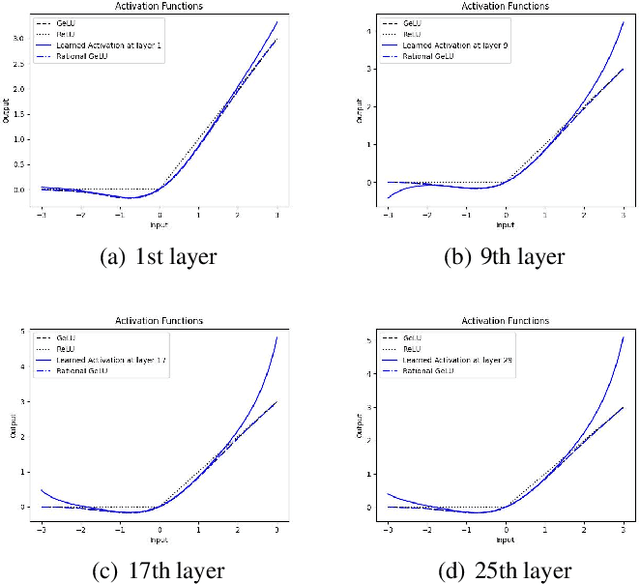
Soft prompt tuning is a widely studied parameter-efficient fine-tuning method. However, it has a clear drawback: many soft tokens must be inserted into the input sequences to guarantee downstream performance. As a result, soft prompt tuning is less considered than Low-rank adaptation (LoRA) in the large language modeling (LLM) era. In this work, we propose a novel prompt tuning method, Instruction-Aware Prompt Tuning (IAPT), that requires only four soft tokens. First, we install a parameter-efficient soft prompt generator at each Transformer layer to generate idiosyncratic soft prompts for each input instruction. The generated soft prompts can be seen as a semantic summary of the input instructions and can effectively guide the output generation. Second, the soft prompt generators are modules with a bottleneck architecture consisting of a self-attention pooling operation, two linear projections, and an activation function. Pilot experiments show that prompt generators at different Transformer layers require different activation functions. Thus, we propose to learn the idiosyncratic activation functions for prompt generators automatically with the help of rational functions. We have conducted experiments on various tasks, and the experimental results demonstrate that (a) our IAPT method can outperform the recent baselines with comparable tunable parameters. (b) Our IAPT method is more efficient than LoRA under the single-backbone multi-tenant setting.
Nonlinear denoising score matching for enhanced learning of structured distributions
May 24, 2024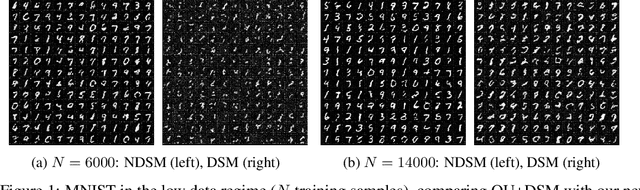

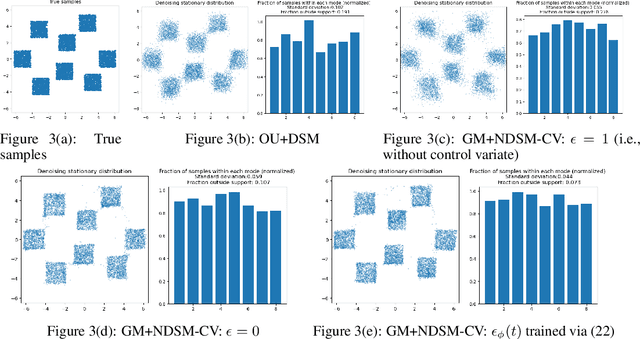
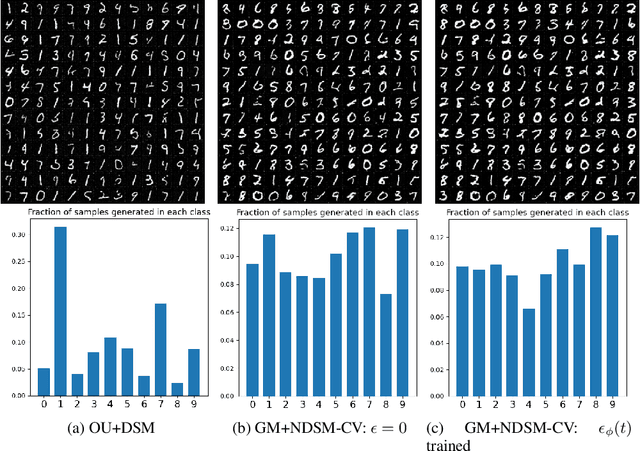
We present a novel method for training score-based generative models which uses nonlinear noising dynamics to improve learning of structured distributions. Generalizing to a nonlinear drift allows for additional structure to be incorporated into the dynamics, thus making the training better adapted to the data, e.g., in the case of multimodality or (approximate) symmetries. Such structure can be obtained from the data by an inexpensive preprocessing step. The nonlinear dynamics introduces new challenges into training which we address in two ways: 1) we develop a new nonlinear denoising score matching (NDSM) method, 2) we introduce neural control variates in order to reduce the variance of the NDSM training objective. We demonstrate the effectiveness of this method on several examples: a) a collection of low-dimensional examples, motivated by clustering in latent space, b) high-dimensional images, addressing issues with mode collapse, small training sets, and approximate symmetries, the latter being a challenge for methods based on equivariant neural networks, which require exact symmetries.
Learning heavy-tailed distributions with Wasserstein-proximal-regularized $α$-divergences
May 22, 2024In this paper, we propose Wasserstein proximals of $\alpha$-divergences as suitable objective functionals for learning heavy-tailed distributions in a stable manner. First, we provide sufficient, and in some cases necessary, relations among data dimension, $\alpha$, and the decay rate of data distributions for the Wasserstein-proximal-regularized divergence to be finite. Finite-sample convergence rates for the estimation in the case of the Wasserstein-1 proximal divergences are then provided under certain tail conditions. Numerical experiments demonstrate stable learning of heavy-tailed distributions -- even those without first or second moment -- without any explicit knowledge of the tail behavior, using suitable generative models such as GANs and flow-based models related to our proposed Wasserstein-proximal-regularized $\alpha$-divergences. Heuristically, $\alpha$-divergences handle the heavy tails and Wasserstein proximals allow non-absolute continuity between distributions and control the velocities of flow-based algorithms as they learn the target distribution deep into the tails.
ALoRA: Allocating Low-Rank Adaptation for Fine-tuning Large Language Models
Mar 24, 2024
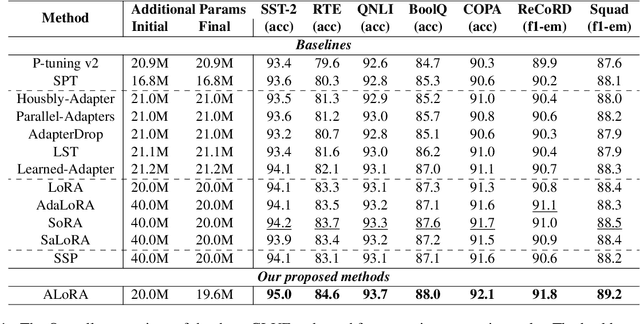
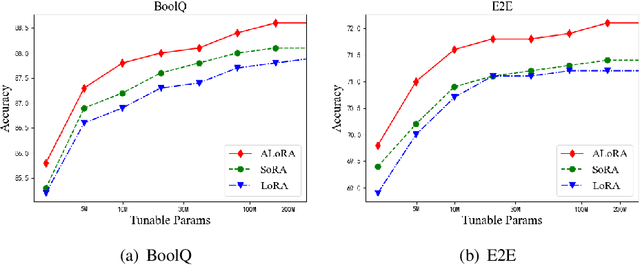
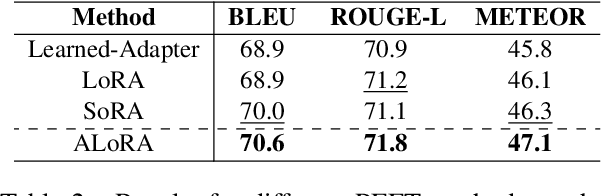
Parameter-efficient fine-tuning (PEFT) is widely studied for its effectiveness and efficiency in the era of large language models. Low-rank adaptation (LoRA) has demonstrated commendable performance as a popular and representative method. However, it is implemented with a fixed intrinsic rank that might not be the ideal setting for the downstream tasks. Recognizing the need for more flexible downstream task adaptation, we extend the methodology of LoRA to an innovative approach we call allocating low-rank adaptation (ALoRA) that enables dynamic adjustments to the intrinsic rank during the adaptation process. First, we propose a novel method, AB-LoRA, that can effectively estimate the importance score of each LoRA rank. Second, guided by AB-LoRA, we gradually prune abundant and negatively impacting LoRA ranks and allocate the pruned LoRA budgets to important Transformer modules needing higher ranks. We have conducted experiments on various tasks, and the experimental results demonstrate that our ALoRA method can outperform the recent baselines with comparable tunable parameters.
Text2MDT: Extracting Medical Decision Trees from Medical Texts
Jan 04, 2024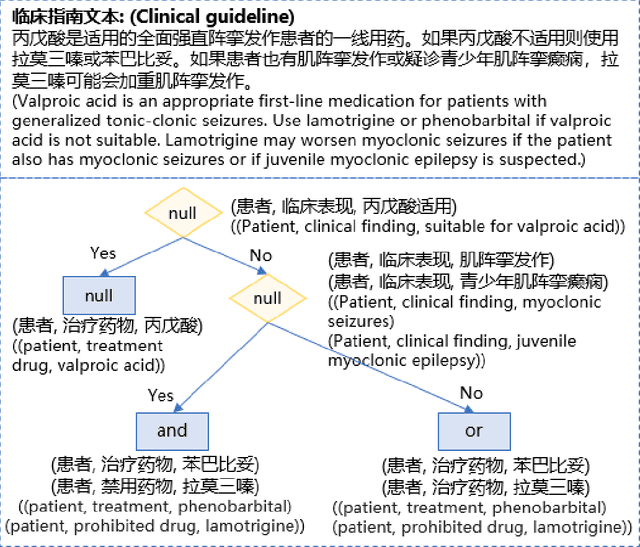
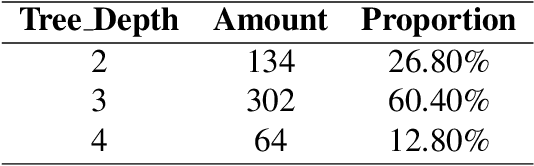

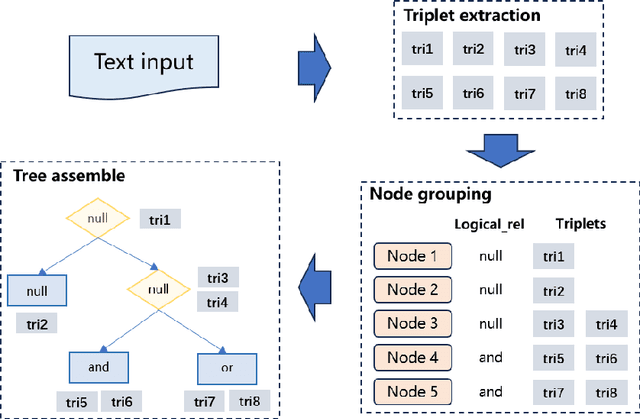
Knowledge of the medical decision process, which can be modeled as medical decision trees (MDTs), is critical to build clinical decision support systems. However, the current MDT construction methods rely heavily on time-consuming and laborious manual annotation. In this work, we propose a novel task, Text2MDT, to explore the automatic extraction of MDTs from medical texts such as medical guidelines and textbooks. We normalize the form of the MDT and create an annotated Text-to-MDT dataset in Chinese with the participation of medical experts. We investigate two different methods for the Text2MDT tasks: (a) an end-to-end framework which only relies on a GPT style large language models (LLM) instruction tuning to generate all the node information and tree structures. (b) The pipeline framework which decomposes the Text2MDT task to three subtasks. Experiments on our Text2MDT dataset demonstrate that: (a) the end-to-end method basd on LLMs (7B parameters or larger) show promising results, and successfully outperform the pipeline methods. (b) The chain-of-thought (COT) prompting method \cite{Wei2022ChainOT} can improve the performance of the fine-tuned LLMs on the Text2MDT test set. (c) the lightweight pipelined method based on encoder-based pretrained models can perform comparably with LLMs with model complexity two magnititudes smaller. Our Text2MDT dataset is open-sourced at \url{https://tianchi.aliyun.com/dataset/95414}, and the source codes are open-sourced at \url{https://github.com/michael-wzhu/text2dt}.
Efficient Multi-domain Text Recognition Deep Neural Network Parameterization with Residual Adapters
Jan 01, 2024Recent advancements in deep neural networks have markedly enhanced the performance of computer vision tasks, yet the specialized nature of these networks often necessitates extensive data and high computational power. Addressing these requirements, this study presents a novel neural network model adept at optical character recognition (OCR) across diverse domains, leveraging the strengths of multi-task learning to improve efficiency and generalization. The model is designed to achieve rapid adaptation to new domains, maintain a compact size conducive to reduced computational resource demand, ensure high accuracy, retain knowledge from previous learning experiences, and allow for domain-specific performance improvements without the need to retrain entirely. Rigorous evaluation on open datasets has validated the model's ability to significantly lower the number of trainable parameters without sacrificing performance, indicating its potential as a scalable and adaptable solution in the field of computer vision, particularly for applications in optical text recognition.
Overview of the PromptCBLUE Shared Task in CHIP2023
Dec 29, 2023This paper presents an overview of the PromptCBLUE shared task (http://cips-chip.org.cn/2023/eval1) held in the CHIP-2023 Conference. This shared task reformualtes the CBLUE benchmark, and provide a good testbed for Chinese open-domain or medical-domain large language models (LLMs) in general medical natural language processing. Two different tracks are held: (a) prompt tuning track, investigating the multitask prompt tuning of LLMs, (b) probing the in-context learning capabilities of open-sourced LLMs. Many teams from both the industry and academia participated in the shared tasks, and the top teams achieved amazing test results. This paper describes the tasks, the datasets, evaluation metrics, and the top systems for both tasks. Finally, the paper summarizes the techniques and results of the evaluation of the various approaches explored by the participating teams.