 Add to Chrome
 Add to Firefox
 Add to Edge
Knowdit: Agentic Smart Contract Vulnerability Detection with Auditing Knowledge Summarization
Mar 27, 2026
Smart contracts govern billions of dollars in decentralized finance (DeFi), yet automated vulnerability detection remains challenging because many vulnerabilities are tightly coupled with project-specific business logic. We observe that recurring vulnerabilities across diverse DeFi business models often share the same underlying economic mechanisms, which we term DeFi semantics, and that capturing these shared abstractions can enable more systematic auditing. Building on this insight, we propose Knowdit, a knowledge-driven, agentic framework for smart contract vulnerability detection. Knowdit first constructs an auditing knowledge graph from historical human audit reports, linking fine-grained DeFi semantics with recurring vulnerability patterns. Given a new project, a multi-agent framework leverages this knowledge through an iterative loop of specification generation, harness synthesis, fuzz execution, and finding reflection, driven by a shared working memory for continuous refinement. We evaluate Knowdit on 12 recent Code4rena projects with 75 ground-truth vulnerabilities. Knowdit detects all 14 high-severity and 77\% of medium-severity vulnerabilities with only 2 false positives, significantly outperforming all baselines. Applied to six real-world projects, Knowdit further discovers 12 high- and 10 medium-severity previously unknown vulnerabilities, proving its outstanding performance.

FuzzCoder: Byte-level Fuzzing Test via Large Language Model
Sep 03, 2024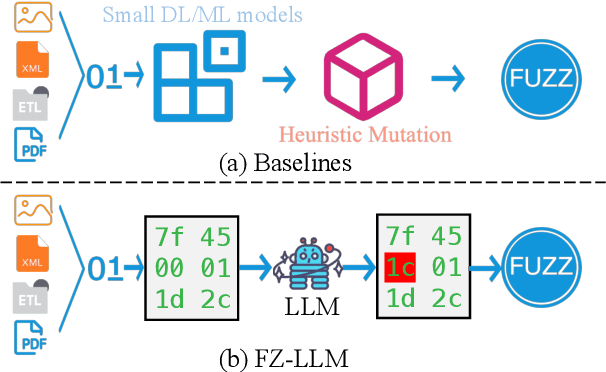
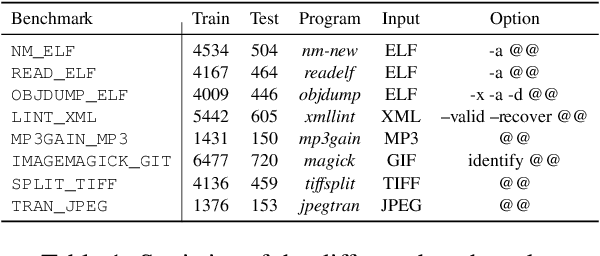
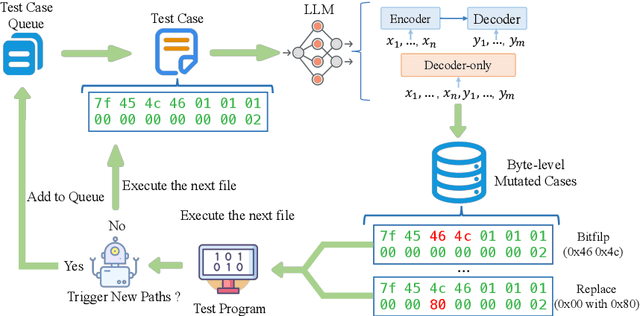
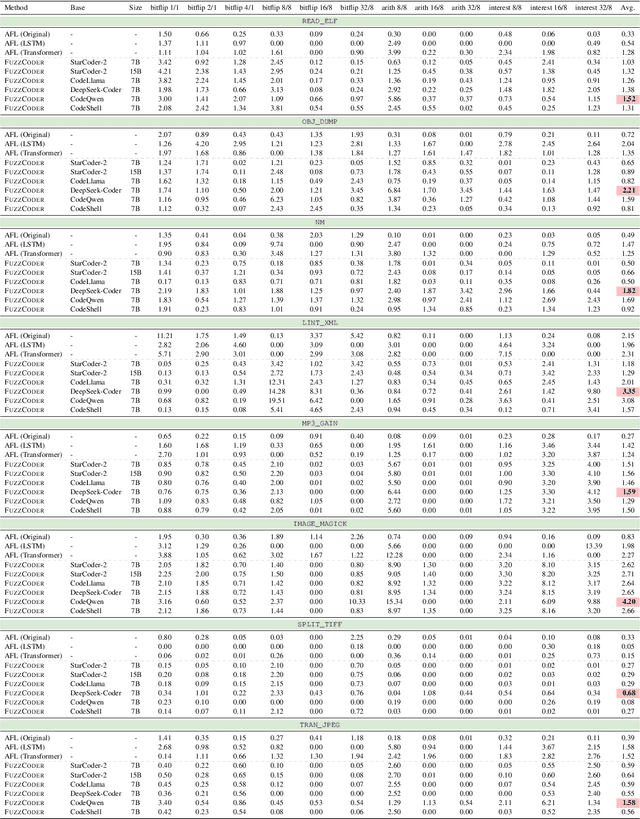
Fuzzing is an important dynamic program analysis technique designed for finding vulnerabilities in complex software. Fuzzing involves presenting a target program with crafted malicious input to cause crashes, buffer overflows, memory errors, and exceptions. Crafting malicious inputs in an efficient manner is a difficult open problem and the best approaches often apply uniform random mutations to pre-existing valid inputs. In this work, we propose to adopt fine-tuned large language models (FuzzCoder) to learn patterns in the input files from successful attacks to guide future fuzzing explorations. Specifically, we develop a framework to leverage the code LLMs to guide the mutation process of inputs in fuzzing. The mutation process is formulated as the sequence-to-sequence modeling, where LLM receives a sequence of bytes and then outputs the mutated byte sequence. FuzzCoder is fine-tuned on the created instruction dataset (Fuzz-Instruct), where the successful fuzzing history is collected from the heuristic fuzzing tool. FuzzCoder can predict mutation locations and strategies locations in input files to trigger abnormal behaviors of the program. Experimental results show that FuzzCoder based on AFL (American Fuzzy Lop) gain significant improvements in terms of effective proportion of mutation (EPM) and number of crashes (NC) for various input formats including ELF, JPG, MP3, and XML.