 Add to Chrome
 Add to Firefox
 Add to Edge
MHPR: Multidimensional Human Perception and Reasoning Benchmark for Large Vision-Languate Models
May 05, 2026
Multidimensional human understanding is essential for real-world applications such as film analysis and virtual digital humans, yet current LVLM benchmarks largely focus on single-task settings and lack fine-grained, human-centric evaluation. In this work, we introduce MHPR, a comprehensive benchmark for joint perception-reasoning over human-centric scenes spanning individual, multi-person, and human-object interaction dimensions. MHPR comprises a multi-level data design-Captioned Raw Data (C-RD), Supervised Fine-Tuning Data (SFT-D), Reinforcement Learning Data (RL-D), and Test Data (T-D)-together with an automated caption/VQA generation pipeline (ACVG) that performs category-wise attribute decomposition, attribute-specific rewriting, and multi-model voting to ensure high-quality, scalable annotations. We evaluate state-of-the-art vision-language models on fine-grained attributes (appearance, clothing, pose, parts) and high-level semantics (social relations, action semantics, spatial relations, intent and functionality). Our findings show that: 1) format-aligned SFT data substantially improves instruction following and stability; 2) challenge-focused RL data derived from bad-case analysis further enhances perception and reasoning on difficult instances; and 3) training Qwen2.5-VL-7B with MHPR yields significant gains, achieving near-parity with considerably larger models. We release ACVG and MHPR to facilitate reproducible, extensible research on human-centric perception and reasoning.

Knowledge Distillation for Detection Transformer with Consistent Distillation Points Sampling
Nov 16, 2022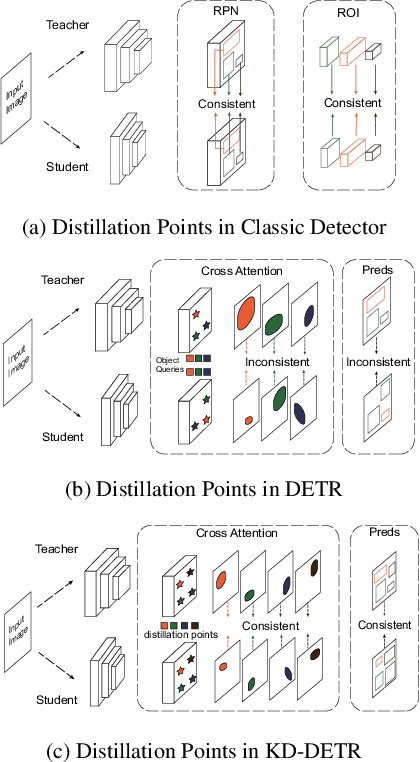
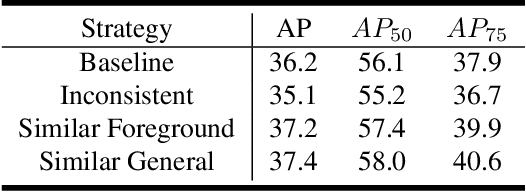
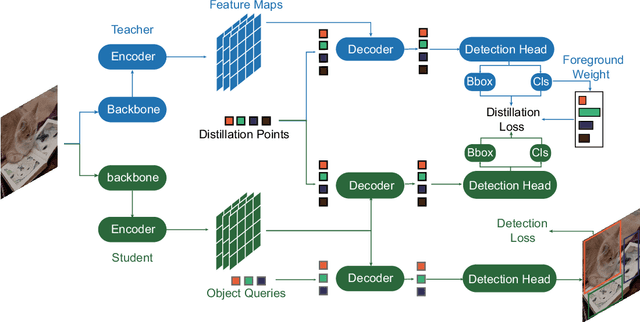
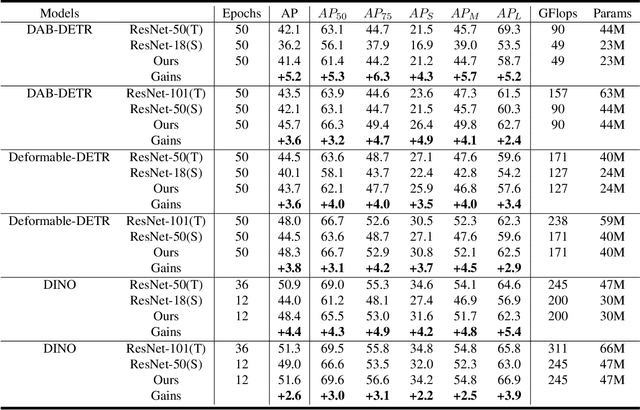
DETR is a novel end-to-end transformer architecture object detector, which significantly outperforms classic detectors when scaling up the model size. In this paper, we focus on the compression of DETR with knowledge distillation. While knowledge distillation has been well-studied in classic detectors, there is a lack of researches on how to make it work effectively on DETR. We first provide experimental and theoretical analysis to point out that the main challenge in DETR distillation is the lack of consistent distillation points. Distillation points refer to the corresponding inputs of the predictions for student to mimic, and reliable distillation requires sufficient distillation points which are consistent between teacher and student. Based on this observation, we propose a general knowledge distillation paradigm for DETR(KD-DETR) with consistent distillation points sampling. Specifically, we decouple detection and distillation tasks by introducing a set of specialized object queries to construct distillation points. In this paradigm, we further propose a general-to-specific distillation points sampling strategy to explore the extensibility of KD-DETR. Extensive experiments on different DETR architectures with various scales of backbones and transformer layers validate the effectiveness and generalization of KD-DETR. KD-DETR boosts the performance of DAB-DETR with ResNet-18 and ResNet-50 backbone to 41.4$\%$, 45.7$\%$ mAP, respectively, which are 5.2$\%$, 3.5$\%$ higher than the baseline, and ResNet-50 even surpasses the teacher model by $2.2\%$.