 Add to Chrome
 Add to Firefox
 Add to Edge
SoccerRef-Agents: Multi-Agent System for Automated Soccer Refereeing
Apr 25, 2026
Refereeing is vital in sports, where fair, accurate, and explainable decisions are fundamental. While intelligent assistant technologies are being widely adopted in soccer refereeing, current AI-assisted approaches remain preliminary. Existing research mostly focuses on isolated video perception tasks and lacks the ability to understand and reason about foul scenarios. To fill this gap, we propose SoccerRef-Agents, a holistic and explainable multi-agent decision-making framework for soccer refereeing. The main contributions are: (i) constructing the multimodal benchmark SoccerRefBench with over 1,200 referee theory questions and 600 foul video clips; (ii) building a vector-based knowledge base RefKnowledgeDB using the latest "Laws of the Game" and a classic case database for precise, knowledge-driven reasoning; (iii) designing a novel multi-agent architecture that collaborates via cross-modal RAG to bridge the semantic gap between visual content and regulatory texts. This work explores the technical capability of integrating MLLMs with refereeing expertise, and evaluations show our system significantly outperforms general-purpose MLLMs in decision accuracy and explanation quality. All databases, benchmarks, and code will be made available.

GenTac: Generative Modeling and Forecasting of Soccer Tactics
Apr 13, 2026Modeling open-play soccer tactics is a formidable challenge due to the stochastic, multi-agent nature of the game. Existing computational approaches typically produce single, deterministic trajectory forecasts or focus on highly structured set-pieces, fundamentally failing to capture the inherent variance and branching possibilities of real-world match evolution. Here, we introduce GenTac, a diffusion-based generative framework that conceptualizes soccer tactics as a stochastic process over continuous multi-player trajectories and discrete semantic events. By learning the underlying distribution of player movements from historical tracking data, GenTac samples diverse, plausible, long-horizon future trajectories. The framework supports rich contextual conditioning, including opponent behavior, specific team or league playing styles, and strategic objectives, while grounding continuous spatial dynamics into a 15-class tactical event space. Extensive evaluations on our proposed benchmark, TacBench, demonstrate four key capabilities: (1) GenTac achieves high geometric accuracy while strictly preserving the collective structural consistency of the team; (2) it accurately simulates stylistic nuances, distinguishing between specific teams (e.g., Auckland FC) and leagues (e.g., A-League versus German leagues); (3) it enables controllable counterfactual simulations, demonstrably altering spatial control and expected threat metrics based on offensive or defensive guidance; and (4) it reliably anticipates future tactical outcomes directly from generated rollouts. Finally, we demonstrate that GenTac can be successfully trained to generalize to other dynamic team sports, including basketball, American football, and ice hockey.
SoccerMaster: A Vision Foundation Model for Soccer Understanding
Dec 11, 2025Soccer understanding has recently garnered growing research interest due to its domain-specific complexity and unique challenges. Unlike prior works that typically rely on isolated, task-specific expert models, this work aims to propose a unified model to handle diverse soccer visual understanding tasks, ranging from fine-grained perception (e.g., athlete detection) to semantic reasoning (e.g., event classification). Specifically, our contributions are threefold: (i) we present SoccerMaster, the first soccer-specific vision foundation model that unifies diverse understanding tasks within a single framework via supervised multi-task pretraining; (ii) we develop an automated data curation pipeline to generate scalable spatial annotations, and integrate them with various existing soccer video datasets to construct SoccerFactory, a comprehensive pretraining data resource; and (iii) we conduct extensive evaluations demonstrating that SoccerMaster consistently outperforms task-specific expert models across diverse downstream tasks, highlighting its breadth and superiority. The data, code, and model will be publicly available.
Multi-Agent System for Comprehensive Soccer Understanding
May 06, 2025Recent advancements in AI-driven soccer understanding have demonstrated rapid progress, yet existing research predominantly focuses on isolated or narrow tasks. To bridge this gap, we propose a comprehensive framework for holistic soccer understanding. Specifically, we make the following contributions in this paper: (i) we construct SoccerWiki, the first large-scale multimodal soccer knowledge base, integrating rich domain knowledge about players, teams, referees, and venues to enable knowledge-driven reasoning; (ii) we present SoccerBench, the largest and most comprehensive soccer-specific benchmark, featuring around 10K standardized multimodal (text, image, video) multi-choice QA pairs across 13 distinct understanding tasks, curated through automated pipelines and manual verification; (iii) we introduce SoccerAgent, a novel multi-agent system that decomposes complex soccer questions via collaborative reasoning, leveraging domain expertise from SoccerWiki and achieving robust performance; (iv) extensive evaluations and ablations that benchmark state-of-the-art MLLMs on SoccerBench, highlighting the superiority of our proposed agentic system. All data and code are publicly available at: https://jyrao.github.io/SoccerAgent/.
Towards Universal Soccer Video Understanding
Dec 02, 2024As a globally celebrated sport, soccer has attracted widespread interest from fans over the world. This paper aims to develop a comprehensive multi-modal framework for soccer video understanding. Specifically, we make the following contributions in this paper: (i) we introduce SoccerReplay-1988, the largest multi-modal soccer dataset to date, featuring videos and detailed annotations from 1,988 complete matches, with an automated annotation pipeline; (ii) we present the first visual-language foundation model in the soccer domain, MatchVision, which leverages spatiotemporal information across soccer videos and excels in various downstream tasks; (iii) we conduct extensive experiments and ablation studies on action classification, commentary generation, and multi-view foul recognition, and demonstrate state-of-the-art performance on all of them, substantially outperforming existing models, which has demonstrated the superiority of our proposed data and model. We believe that this work will offer a standard paradigm for sports understanding research. The code and model will be publicly available for reproduction.
MatchTime: Towards Automatic Soccer Game Commentary Generation
Jun 26, 2024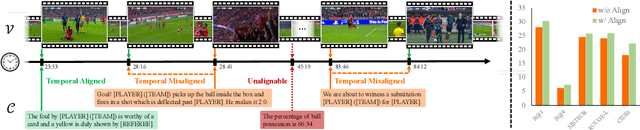
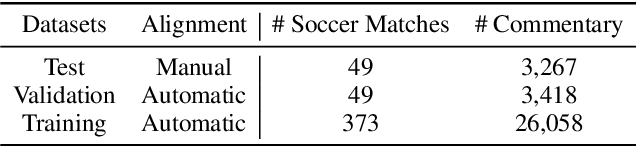
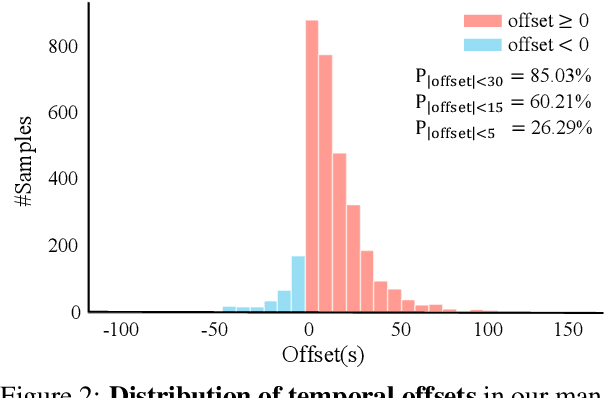
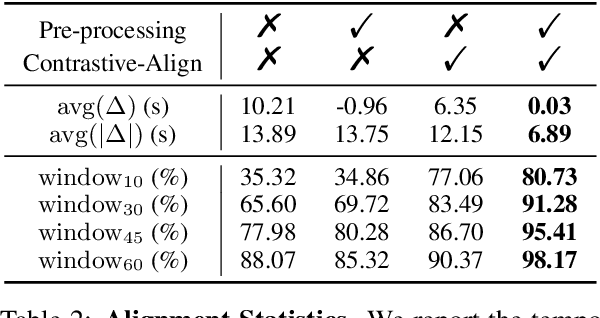
Soccer is a globally popular sport with a vast audience, in this paper, we consider constructing an automatic soccer game commentary model to improve the audiences' viewing experience. In general, we make the following contributions: First, observing the prevalent video-text misalignment in existing datasets, we manually annotate timestamps for 49 matches, establishing a more robust benchmark for soccer game commentary generation, termed as SN-Caption-test-align; Second, we propose a multi-modal temporal alignment pipeline to automatically correct and filter the existing dataset at scale, creating a higher-quality soccer game commentary dataset for training, denoted as MatchTime; Third, based on our curated dataset, we train an automatic commentary generation model, named MatchVoice. Extensive experiments and ablation studies have demonstrated the effectiveness of our alignment pipeline, and training model on the curated datasets achieves state-of-the-art performance for commentary generation, showcasing that better alignment can lead to significant performance improvements in downstream tasks.