 Add to Chrome
 Add to Firefox
 Add to Edge
Causal Semantic Communication for Digital Twins: A Generalizable Imitation Learning Approach
Apr 25, 2023
A digital twin (DT) leverages a virtual representation of the physical world, along with communication (e.g., 6G), computing (e.g., edge computing), and artificial intelligence (AI) technologies to enable many connected intelligence services. In order to handle the large amounts of network data based on digital twins (DTs), wireless systems can exploit the paradigm of semantic communication (SC) for facilitating informed decision-making under strict communication constraints by utilizing AI techniques such as causal reasoning. In this paper, a novel framework called causal semantic communication (CSC) is proposed for DT-based wireless systems. The CSC system is posed as an imitation learning (IL) problem, where the transmitter, with access to optimal network control policies using a DT, teaches the receiver using SC over a bandwidth limited wireless channel how to improve its knowledge to perform optimal control actions. The causal structure in the source data is extracted using novel approaches from the framework of deep end-to-end causal inference, thereby enabling the creation of a semantic representation that is causally invariant, which in turn helps generalize the learned knowledge of the system to unseen scenarios. The CSC decoder at the receiver is designed to extract and estimate semantic information while ensuring high semantic reliability. The receiver control policies, semantic decoder, and causal inference are formulated as a bi-level optimization problem within a variational inference framework. This problem is solved using a novel concept called network state models, inspired from world models in generative AI, that faithfully represents the environment dynamics leading to data generation. Simulation results demonstrate that the proposed CSC system outperforms state-of-the-art SC systems by achieving better semantic reliability and reduced semantic representation.

The Seven Worlds and Experiences of the Wireless Metaverse: Challenges and Opportunities
Apr 20, 2023


The wireless metaverse will create diverse user experiences at the intersection of the physical, digital, and virtual worlds. These experiences will enable novel interactions between the constituents (e.g., extended reality (XR) users and avatars) of the three worlds. However, remarkably, to date, there is no holistic vision that identifies the full set of metaverse worlds, constituents, and experiences, and the implications of their associated interactions on next-generation communication and computing systems. In this paper, we present a holistic vision of a limitless, wireless metaverse that distills the metaverse into an intersection of seven worlds and experiences that include the: i) physical, digital, and virtual worlds, along with the ii) cyber, extended, live, and parallel experiences. We then articulate how these experiences bring forth interactions between diverse metaverse constituents, namely, a) humans and avatars and b) connected intelligence systems and their digital twins (DTs). Then, we explore the wireless, computing, and artificial intelligence (AI) challenges that must be addressed to establish metaverse-ready networks that support these experiences and interactions. We particularly highlight the need for end-to-end synchronization of DTs, and the role of human-level AI and reasoning abilities for cognitive avatars. Moreover, we articulate a sequel of open questions that should ignite the quest for the future metaverse. We conclude with a set of recommendations to deploy the limitless metaverse over future wireless systems.
Reliable Beamforming at Terahertz Bands: Are Causal Representations the Way Forward?
Mar 14, 2023Future wireless services, such as the metaverse require high information rate, reliability, and low latency. Multi-user wireless systems can meet such requirements by utilizing the abundant terahertz bandwidth with a massive number of antennas, creating narrow beamforming solutions. However, existing solutions lack proper modeling of channel dynamics, resulting in inaccurate beamforming solutions in high-mobility scenarios. Herein, a dynamic, semantically aware beamforming solution is proposed for the first time, utilizing novel artificial intelligence algorithms in variational causal inference to compute the time-varying dynamics of the causal representation of multi-modal data and the beamforming. Simulations show that the proposed causality-guided approach for Terahertz (THz) beamforming outperforms classical MIMO beamforming techniques.
Collaborative Learning with a Drone Orchestrator
Mar 03, 2023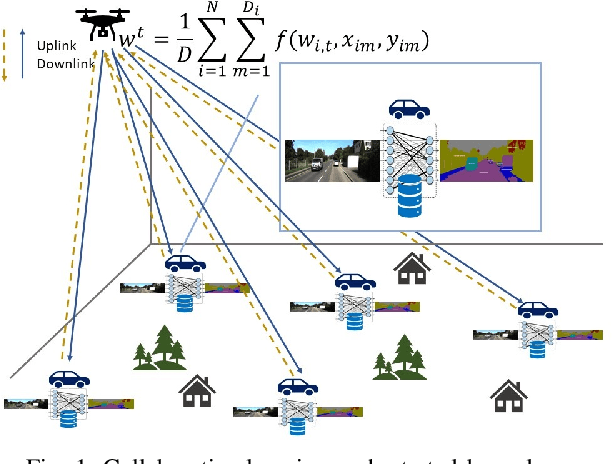
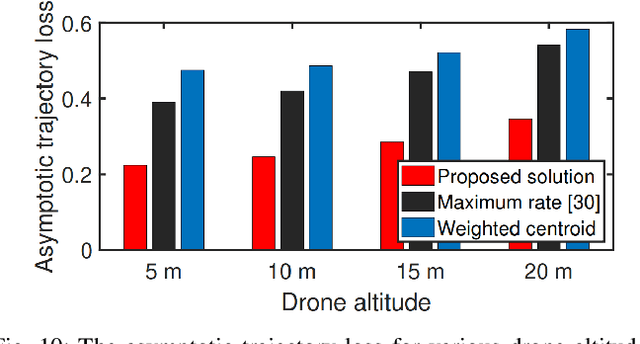
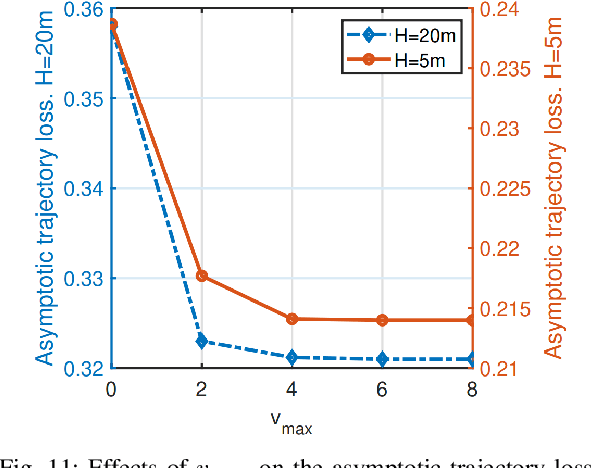
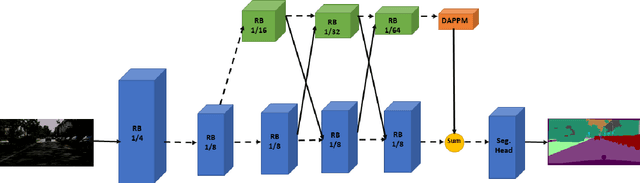
In this paper, the problem of drone-assisted collaborative learning is considered. In this scenario, swarm of intelligent wireless devices train a shared neural network (NN) model with the help of a drone. Using its sensors, each device records samples from its environment to gather a local dataset for training. The training data is severely heterogeneous as various devices have different amount of data and sensor noise level. The intelligent devices iteratively train the NN on their local datasets and exchange the model parameters with the drone for aggregation. For this system, the convergence rate of collaborative learning is derived while considering data heterogeneity, sensor noise levels, and communication errors, then, the drone trajectory that maximizes the final accuracy of the trained NN is obtained. The proposed trajectory optimization approach is aware of both the devices data characteristics (i.e., local dataset size and noise level) and their wireless channel conditions, and significantly improves the convergence rate and final accuracy in comparison with baselines that only consider data characteristics or channel conditions. Compared to state-of-the-art baselines, the proposed approach achieves an average 3.85% and 3.54% improvement in the final accuracy of the trained NN on benchmark datasets for image recognition and semantic segmentation tasks, respectively. Moreover, the proposed framework achieves a significant speedup in training, leading to an average 24% and 87% saving in the drone hovering time, communication overhead, and battery usage, respectively for these tasks.
Performance Limits of a Deep Learning-Enabled Text Semantic Communication under Interference
Feb 15, 2023Semantic communication (SemCom) has emerged as a 6G enabler while promising to minimize power usage, bandwidth consumption, and transmission delay by minimizing irrelevant information transmission. However, the benefits of such a semantic-centric design can be limited by radio frequency interference (RFI) that causes substantial semantic noise. The impact of semantic noise due to interference can be alleviated using an interference-resistant and robust (IR$^2$) SemCom design. Nevertheless, no such design exists yet. To shed light on this knowledge gap and stimulate fundamental research on IR$^2$ SemCom, the performance limits of a text SemCom system named DeepSC is studied in the presence of single- and multi-interferer RFI. By introducing a principled probabilistic framework for SemCom, we show that DeepSC produces semantically irrelevant sentences as the power of single- and multi-interferer RFI gets very large. Corroborated by Monte Carlo simulations, these performance limits offer design insights -- regarding IR$^2$ SemCom -- contrary to the theoretically unsubstantiated sentiment that SemCom techniques (such as DeepSC) work well in very low signal-to-noise ratio regimes. The performance limits also reveal the vulnerability of DeepSC and SemCom to a wireless attack using RFI. Furthermore, our introduced probabilistic framework inspires the performance analysis of many text SemCom techniques, as they are chiefly inspired by DeepSC.
Sensing aided Channel Estimation in Wideband Millimeter-Wave MIMO Systems
Feb 04, 2023In this work, the uplink channel estimation problem is considered for a millimeter wave (mmWave) multi-input multi-output (MIMO) system. It is well known that pilot overhead and computation complexity in estimating the channel increases with the number of antennas and the bandwidth. To overcome this, the proposed approach allows the channel estimation at the base station to be aided by the sensing information. The sensing information contains an estimate of scatterers locations in an environment. A simultaneous weighting orthogonal matching pursuit (SWOMP) - sparse Bayesian learning (SBL) algorithm is proposed that efficiently incorporates this sensing information in the communication channel estimation procedure. The proposed framework can cope with scenarios where a) scatterers present in the sensing information are not associated with the communication channel and b) imperfections in the scatterers' location. Simulation results show that the proposed sensing aided channel estimation algorithm can obtain good wideband performance only at the cost of fractional pilot overhead. Finally, the Cramer-Rao Bound (CRB) for the angle estimation and multipath channel gains in the SBL is derived, providing valuable insights into the local identifiability of the proposed algorithms.
Simultaneous Transmitting and Reflecting (STAR)-RIS for Harmonious Millimeter Wave Spectrum Sharing
Jan 25, 2023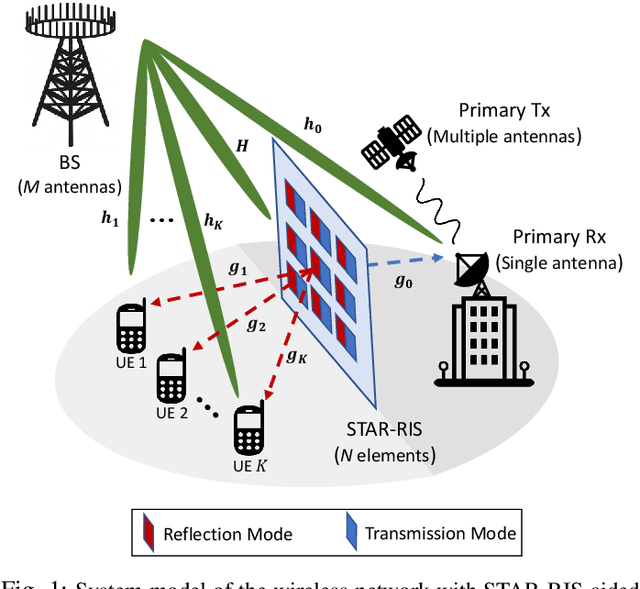
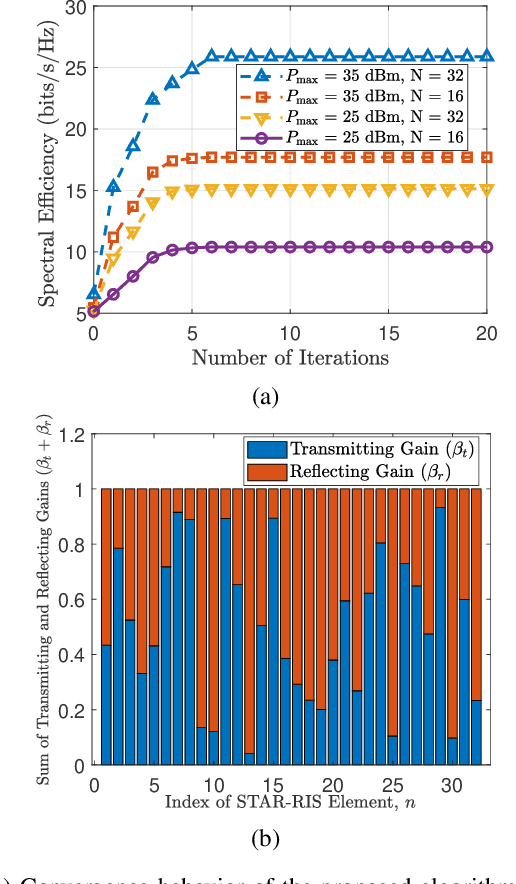


The opening of the millimeter wave (mmWave) spectrum bands for 5G communications has motivated the need for novel spectrum sharing solutions at these high frequencies. In fact, reconfigurable intelligent surfaces (RISs) have recently emerged to enable spectrum sharing while enhancing the incumbents' quality-of-service (QoS). Nonetheless, co-existence over mmWave bands remains persistently challenging due to their unfavorable propagation characteristics. Hence, initiating mmWave spectrum sharing requires the RIS to further assist in improving the QoS over mmWave bands without jeopardizing spectrum sharing demands. In this paper, a novel simultaneous transmitting and reflecting RIS (STAR-RIS)-aided solution to enable mmWave spectrum sharing is proposed. In particular, the transmitting and reflecting abilities of the STAR-RIS are leveraged to tackle the mmWave spectrum sharing and QoS requirements separately. The STAR-RIS-enabled spectrum sharing problem between a primary network (e.g. a radar transmit-receive pair) and a secondary network is formulated as an optimization problem whose goal is to maximize the downlink sum-rate over a secondary multiple-input-single-output (MISO) network, while limiting interference over a primary network. Moreover, the STAR-RIS response coefficients and beamforming matrix in the secondary network are jointly optimized. To solve this non-convex problem, an alternating iterative algorithm is employed, where the STAR-RIS response coefficients and beamforming matrix are obtained using the successive convex approximation method. Simulation results show that the proposed solution outperforms conventional RIS schemes for mmWave spectrum sharing by achieving a 14.57% spectral efficiency gain.
Disentangling Learnable and Memorizable Data via Contrastive Learning for Semantic Communications
Dec 18, 2022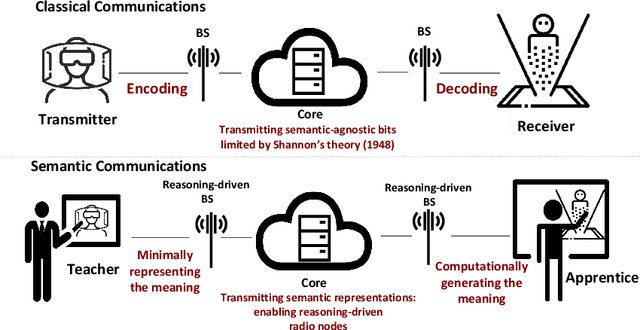
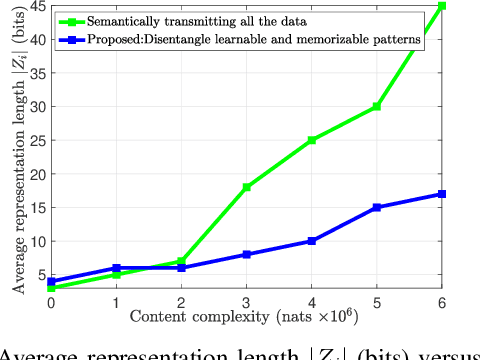
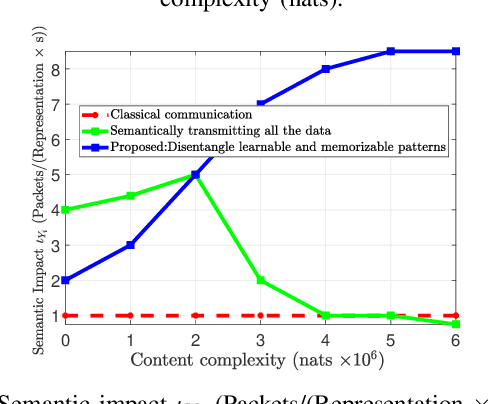
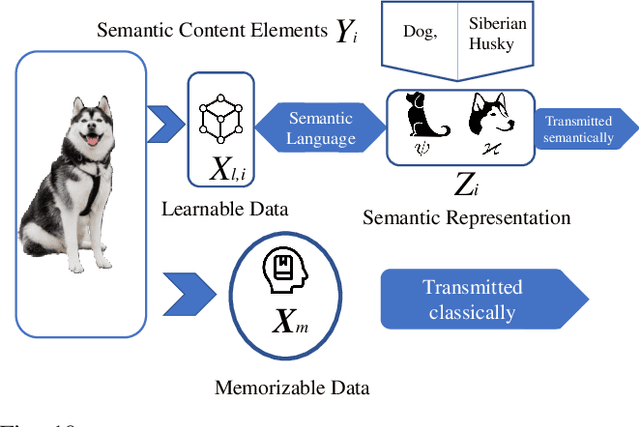
Achieving artificially intelligent-native wireless networks is necessary for the operation of future 6G applications such as the metaverse. Nonetheless, current communication schemes are, at heart, a mere reconstruction process that lacks reasoning. One key solution that enables evolving wireless communication to a human-like conversation is semantic communications. In this paper, a novel machine reasoning framework is proposed to pre-process and disentangle source data so as to make it semantic-ready. In particular, a novel contrastive learning framework is proposed, whereby instance and cluster discrimination are performed on the data. These two tasks enable increasing the cohesiveness between data points mapping to semantically similar content elements and disentangling data points of semantically different content elements. Subsequently, the semantic deep clusters formed are ranked according to their level of confidence. Deep semantic clusters of highest confidence are considered learnable, semantic-rich data, i.e., data that can be used to build a language in a semantic communications system. The least confident ones are considered, random, semantic-poor, and memorizable data that must be transmitted classically. Our simulation results showcase the superiority of our contrastive learning approach in terms of semantic impact and minimalism. In fact, the length of the semantic representation achieved is minimized by 57.22% compared to vanilla semantic communication systems, thus achieving minimalist semantic representations.
A Bargaining Game for Personalized, Energy Efficient Split Learning over Wireless Networks
Dec 12, 2022Split learning (SL) is an emergent distributed learning framework which can mitigate the computation and wireless communication overhead of federated learning. It splits a machine learning model into a device-side model and a server-side model at a cut layer. Devices only train their allocated model and transmit the activations of the cut layer to the server. However, SL can lead to data leakage as the server can reconstruct the input data using the correlation between the input and intermediate activations. Although allocating more layers to a device-side model can reduce the possibility of data leakage, this will lead to more energy consumption for resource-constrained devices and more training time for the server. Moreover, non-iid datasets across devices will reduce the convergence rate leading to increased training time. In this paper, a new personalized SL framework is proposed. For this framework, a novel approach for choosing the cut layer that can optimize the tradeoff between the energy consumption for computation and wireless transmission, training time, and data privacy is developed. In the considered framework, each device personalizes its device-side model to mitigate non-iid datasets while sharing the same server-side model for generalization. To balance the energy consumption for computation and wireless transmission, training time, and data privacy, a multiplayer bargaining problem is formulated to find the optimal cut layer between devices and the server. To solve the problem, the Kalai-Smorodinsky bargaining solution (KSBS) is obtained using the bisection method with the feasibility test. Simulation results show that the proposed personalized SL framework with the cut layer from the KSBS can achieve the optimal sum utilities by balancing the energy consumption, training time, and data privacy, and it is also robust to non-iid datasets.
Less Data, More Knowledge: Building Next Generation Semantic Communication Networks
Nov 25, 2022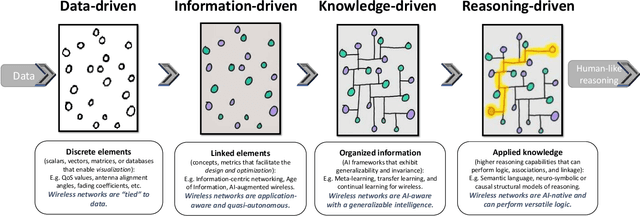
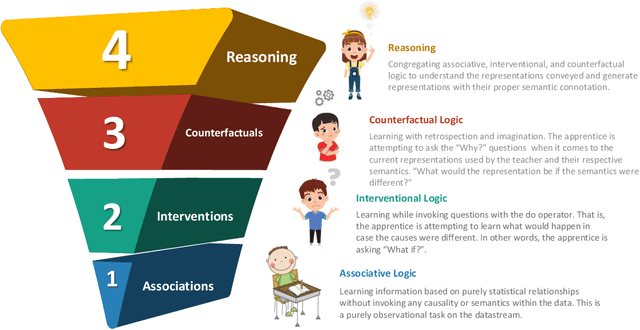
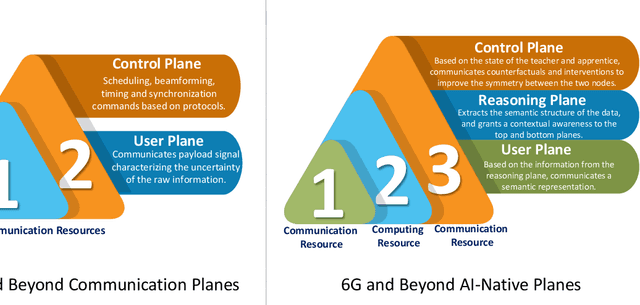
Semantic communication is viewed as a revolutionary paradigm that can potentially transform how we design and operate wireless communication systems. However, despite a recent surge of research activities in this area, the research landscape remains limited. In this tutorial, we present the first rigorous vision of a scalable end-to-end semantic communication network that is founded on novel concepts from artificial intelligence (AI), causal reasoning, and communication theory. We first discuss how the design of semantic communication networks requires a move from data-driven networks towards knowledge-driven ones. Subsequently, we highlight the necessity of creating semantic representations of data that satisfy the key properties of minimalism, generalizability, and efficiency so as to do more with less. We then explain how those representations can form the basis a so-called semantic language. By using semantic representation and languages, we show that the traditional transmitter and receiver now become a teacher and apprentice. Then, we define the concept of reasoning by investigating the fundamentals of causal representation learning and their role in designing semantic communication networks. We demonstrate that reasoning faculties are majorly characterized by the ability to capture causal and associational relationships in datastreams. For such reasoning-driven networks, we propose novel and essential semantic communication metrics that include new "reasoning capacity" measures that could go beyond Shannon's bound to capture the convergence of computing and communication. Finally, we explain how semantic communications can be scaled to large-scale networks (6G and beyond). In a nutshell, we expect this tutorial to provide a comprehensive reference on how to properly build, analyze, and deploy future semantic communication networks.