 Add to Chrome
 Add to Firefox
 Add to Edge
QUEST: Training Frontier Deep Research Agents with Fully Synthetic Tasks
May 22, 2026
Deep research agents extend the role of search engines from retrieving keyword-matched pages to synthesizing knowledge, fundamentally changing how humans interact with information. However, frontier systems remain proprietary, while existing open agents often generalize poorly across different task types, leaving unclear how to train a broadly capable deep research agent. We release QUEST, a family of open models (ranging from 2B to 35B) that serve as general-purpose deep research agents designed to handle a wide range of long-horizon search tasks, with strong capabilities in fact seeking, citation grounding, and report synthesis. To build QUEST, we propose an effective training recipe combining mid-training, supervised fine-tuning, and reinforcement learning. Central to this recipe is a curated data synthesis pipeline based on unified rubric trees, which applies to different task types and enables synthesizing training data with verifiable rewards without human annotation. In addition, QUEST incorporates a built-in context management mechanism that enables effective long-horizon reasoning and knowledge synthesis. Using only 8K synthesized tasks, QUEST approaches or even surpasses frontier closed-source agents across eight deep research benchmarks spanning diverse task types, and achieves the best overall performance among recent open-weight agents. We released everything: models, data, and training scripts.

Chip Placement with Diffusion
Jul 17, 2024

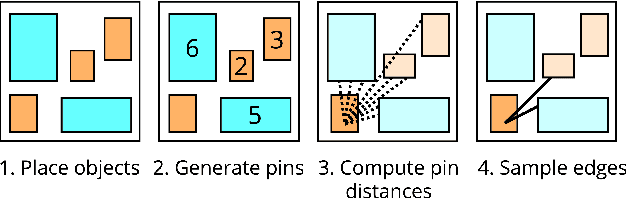
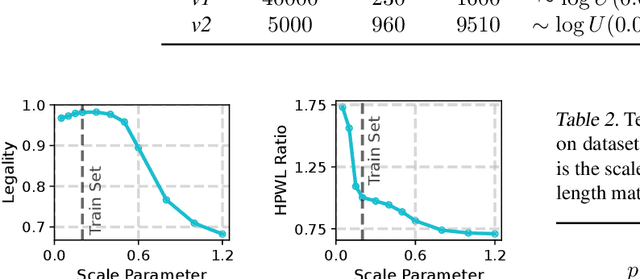
Macro placement is a vital step in digital circuit design that defines the physical location of large collections of components, known as macros, on a 2-dimensional chip. The physical layout obtained during placement determines key performance metrics of the chip, such as power consumption, area, and performance. Existing learning-based methods typically fall short because of their reliance on reinforcement learning, which is slow and limits the flexibility of the agent by casting placement as a sequential process. Instead, we use a powerful diffusion model to place all components simultaneously. To enable such models to train at scale, we propose a novel architecture for the denoising model, as well as an algorithm to generate large synthetic datasets for pre-training. We empirically show that our model can tackle the placement task, and achieve competitive performance on placement benchmarks compared to state-of-the-art methods.
DreamSmooth: Improving Model-based Reinforcement Learning via Reward Smoothing
Nov 02, 2023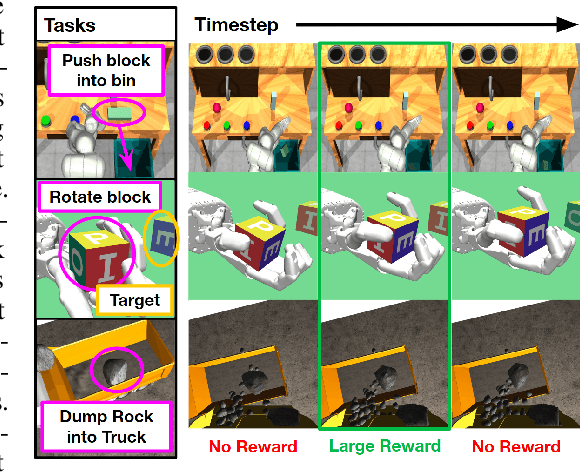
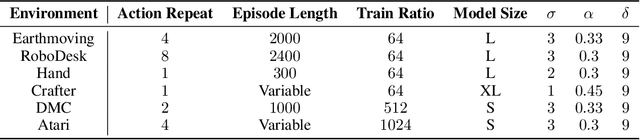
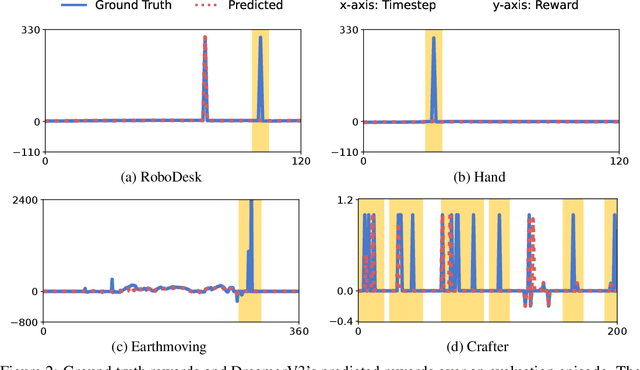

Model-based reinforcement learning (MBRL) has gained much attention for its ability to learn complex behaviors in a sample-efficient way: planning actions by generating imaginary trajectories with predicted rewards. Despite its success, we found that surprisingly, reward prediction is often a bottleneck of MBRL, especially for sparse rewards that are challenging (or even ambiguous) to predict. Motivated by the intuition that humans can learn from rough reward estimates, we propose a simple yet effective reward smoothing approach, DreamSmooth, which learns to predict a temporally-smoothed reward, instead of the exact reward at the given timestep. We empirically show that DreamSmooth achieves state-of-the-art performance on long-horizon sparse-reward tasks both in sample efficiency and final performance without losing performance on common benchmarks, such as Deepmind Control Suite and Atari benchmarks.