 Add to Chrome
 Add to Firefox
 Add to Edge
Federation of Experts: Communication Efficient Distributed Inference for Large Language Models
May 07, 2026
Mixture of experts has emerged as the primary mechanism for making Large Language Models (LLMs) computationally efficient. However, in distributed settings, communicating token embeddings between experts is a significant bottleneck. We present the novel Federation of Experts (FoE) architecture. FoE restructures the MoE block of a transformer layer into multiple MoE clusters. Each cluster is responsible for only one of the KV heads and expert parallelism is applied between those experts. Between clusters, a sum synchronizes the post-attention residuals, which then drives routing and dispatch for the next MoE block. In a single-node setting, FoE completely eliminates all-to-all communication as all experts within a group are contained on the same GPU. In multi-node settings, FoE confines all-to-all communication to the intra-node fabric, thus significantly reducing communication overhead. An implementation of FoE finds that on LongBench, FoE significantly improves inference throughput and latency in both single-node and multi-node settings, reducing the end-to-end forward-pass latency by up to 5.2x, TTFT by 3.62x, and TBT by 1.95x. It does so while achieving comparable generation quality to a mixture of experts model of the same size and training configuration.

Chip Placement with Diffusion
Jul 17, 2024

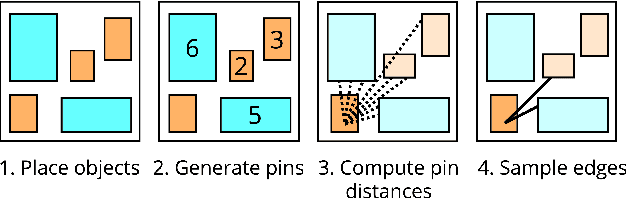
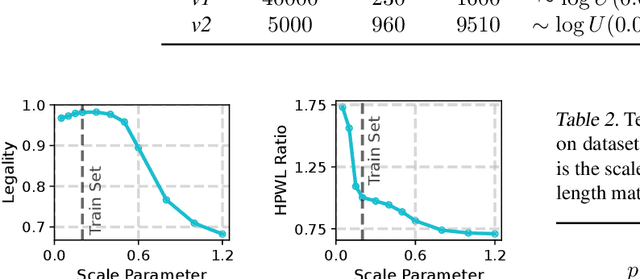
Macro placement is a vital step in digital circuit design that defines the physical location of large collections of components, known as macros, on a 2-dimensional chip. The physical layout obtained during placement determines key performance metrics of the chip, such as power consumption, area, and performance. Existing learning-based methods typically fall short because of their reliance on reinforcement learning, which is slow and limits the flexibility of the agent by casting placement as a sequential process. Instead, we use a powerful diffusion model to place all components simultaneously. To enable such models to train at scale, we propose a novel architecture for the denoising model, as well as an algorithm to generate large synthetic datasets for pre-training. We empirically show that our model can tackle the placement task, and achieve competitive performance on placement benchmarks compared to state-of-the-art methods.