 Add to Chrome
 Add to Firefox
 Add to Edge
ICLE++: Modeling Fine-Grained Traits for Holistic Essay Scoring
Jul 30, 2026
The majority of the recently-developed models for automated essay scoring (AES) are evaluated solely on the ASAP corpus. However, ASAP is not without its limitations. For instance, it is not clear whether models trained on ASAP can generalize well when evaluated on other corpora. In light of these limitations, we introduce ICLE++, a corpus of persuasive student essays annotated with both holistic scores and trait-specific scores. Not only can ICLE++ be used to test the generalizability of AES models trained on ASAP, but it can also facilitate the evaluation of models developed for newer AES problems such as multi-trait scoring and cross-prompt scoring. We believe that ICLE++, which represents a culmination of our long-term effort in annotating the essays in the ICLE corpus, contributes to the set of much-needed annotated corpora for AES research.

FailureMem: A Failure-Aware Multimodal Framework for Autonomous Software Repair
Mar 18, 2026Multimodal Automated Program Repair (MAPR) extends traditional program repair by requiring models to jointly reason over source code, textual issue descriptions, and visual artifacts such as GUI screenshots. While recent LLM-based repair systems have shown promising results, existing approaches face several limitations: rigid workflow pipelines restrict exploration during debugging, visual reasoning is often performed over full-page screenshots without localized grounding, and failed repair attempts are rarely transformed into reusable knowledge. To address these challenges, we propose FailureMem, a multimodal repair framework that integrates three key mechanisms: a hybrid workflow-agent architecture that balances structured localization with flexible reasoning, active perception tools that enable region-level visual grounding, and a Failure Memory Bank that converts past repair attempts into reusable guidance. Experiments on SWE-bench Multimodal demonstrate FailureMem improves the resolved rate over GUIRepair by 3.7%.
RepoRepair: Leveraging Code Documentation for Repository-Level Automated Program Repair
Mar 01, 2026Automated program repair (APR) struggles to scale from isolated functions to full repositories, as it demands a global, task-aware understanding to locate necessary changes. Current methods, limited by context and reliant on shallow retrieval or costly agent iterations, falter on complex cross-file issues. To this end, we propose RepoRepair, a novel documentation-enhanced approach for repository-level fault localization and program repair. Our core insight is to leverage LLMs to generate hierarchical code documentation (from functions to files) for code repositories, creating structured semantic abstractions that enable LLMs to comprehend repository-level context and dependencies. Specifically, RepoRepair first employs a text-based LLM (e.g., DeepSeek-V3) to generate file/function-level code documentation for repositories, which serves as auxiliary knowledge to guide fault localization. Subsequently, based on the fault localization results and the issue description, a powerful LLM (e.g., Claude-4) attempts to repair the identified suspicious code snippets. Evaluated on SWE-bench Lite, RepoRepair achieves a 45.7% repair rate at a low cost of $0.44 per fix. On SWE-bench Multimodal, it delivers state-of-the-art performance with a 37.1% repair rate despite a higher cost of $0.56 per fix, demonstrating robust and cost-effective performance across diverse problem domains.
Enhancing Technical Documents Retrieval for RAG
Sep 04, 2025In this paper, we introduce Technical-Embeddings, a novel framework designed to optimize semantic retrieval in technical documentation, with applications in both hardware and software development. Our approach addresses the challenges of understanding and retrieving complex technical content by leveraging the capabilities of Large Language Models (LLMs). First, we enhance user queries by generating expanded representations that better capture user intent and improve dataset diversity, thereby enriching the fine-tuning process for embedding models. Second, we apply summary extraction techniques to encode essential contextual information, refining the representation of technical documents. To further enhance retrieval performance, we fine-tune a bi-encoder BERT model using soft prompting, incorporating separate learning parameters for queries and document context to capture fine-grained semantic nuances. We evaluate our approach on two public datasets, RAG-EDA and Rust-Docs-QA, demonstrating that Technical-Embeddings significantly outperforms baseline models in both precision and recall. Our findings highlight the effectiveness of integrating query expansion and contextual summarization to enhance information access and comprehension in technical domains. This work advances the state of Retrieval-Augmented Generation (RAG) systems, offering new avenues for efficient and accurate technical document retrieval in engineering and product development workflows.
Automatic Prompt Generation and Grounding Object Detection for Zero-Shot Image Anomaly Detection
Nov 28, 2024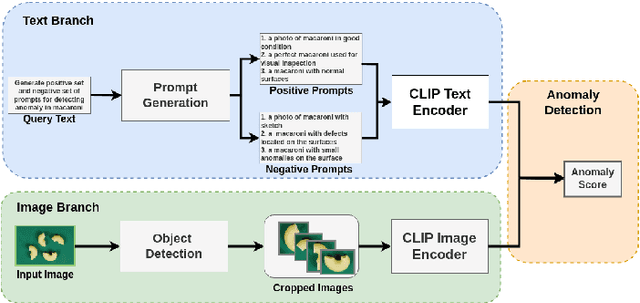

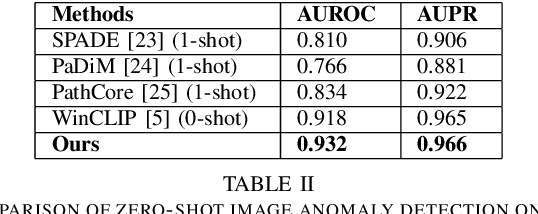
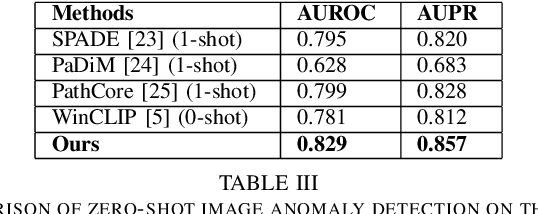
Identifying defects and anomalies in industrial products is a critical quality control task. Traditional manual inspection methods are slow, subjective, and error-prone. In this work, we propose a novel zero-shot training-free approach for automated industrial image anomaly detection using a multimodal machine learning pipeline, consisting of three foundation models. Our method first uses a large language model, i.e., GPT-3. generate text prompts describing the expected appearances of normal and abnormal products. We then use a grounding object detection model, called Grounding DINO, to locate the product in the image. Finally, we compare the cropped product image patches to the generated prompts using a zero-shot image-text matching model, called CLIP, to identify any anomalies. Our experiments on two datasets of industrial product images, namely MVTec-AD and VisA, demonstrate the effectiveness of this method, achieving high accuracy in detecting various types of defects and anomalies without the need for model training. Our proposed model enables efficient, scalable, and objective quality control in industrial manufacturing settings.
Oversampling Higher-Performing Minorities During Machine Learning Model Training Reduces Adverse Impact Slightly but Also Reduces Model Accuracy
Apr 27, 2023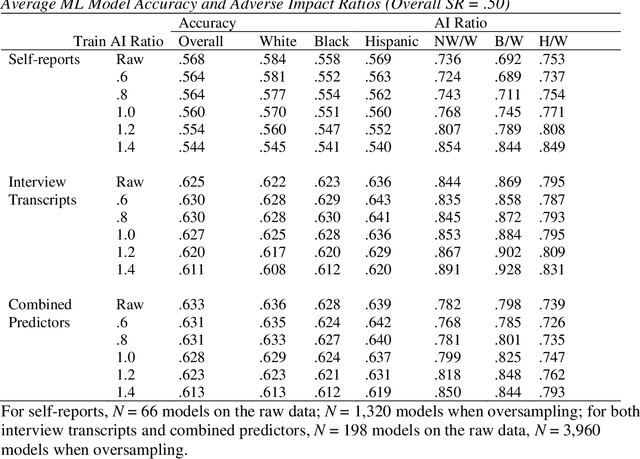
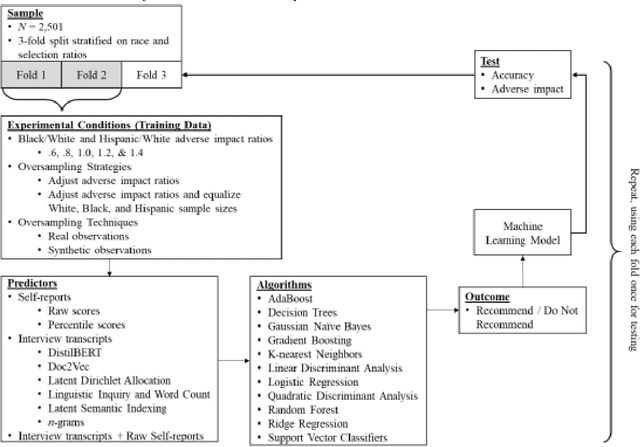
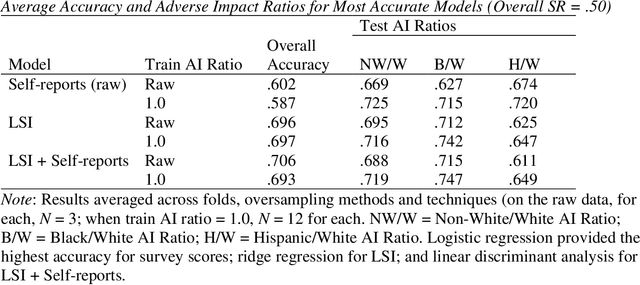
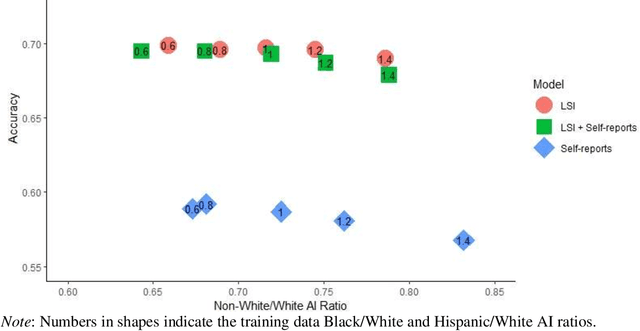
Organizations are increasingly adopting machine learning (ML) for personnel assessment. However, concerns exist about fairness in designing and implementing ML assessments. Supervised ML models are trained to model patterns in data, meaning ML models tend to yield predictions that reflect subgroup differences in applicant attributes in the training data, regardless of the underlying cause of subgroup differences. In this study, we systematically under- and oversampled minority (Black and Hispanic) applicants to manipulate adverse impact ratios in training data and investigated how training data adverse impact ratios affect ML model adverse impact and accuracy. We used self-reports and interview transcripts from job applicants (N = 2,501) to train 9,702 ML models to predict screening decisions. We found that training data adverse impact related linearly to ML model adverse impact. However, removing adverse impact from training data only slightly reduced ML model adverse impact and tended to negatively affect ML model accuracy. We observed consistent effects across self-reports and interview transcripts, whether oversampling real (i.e., bootstrapping) or synthetic observations. As our study relied on limited predictor sets from one organization, the observed effects on adverse impact may be attenuated among more accurate ML models.
Multimodal Propaganda Processing
Feb 17, 2023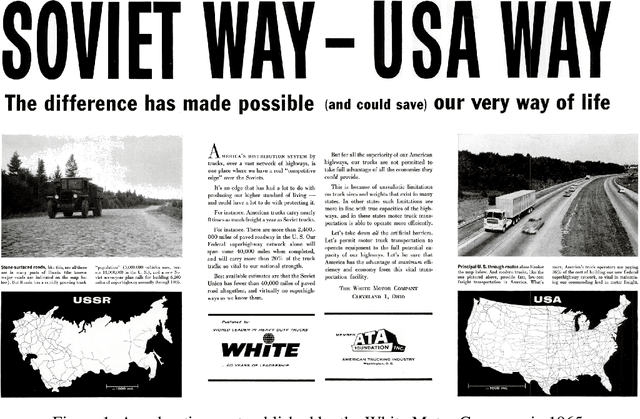

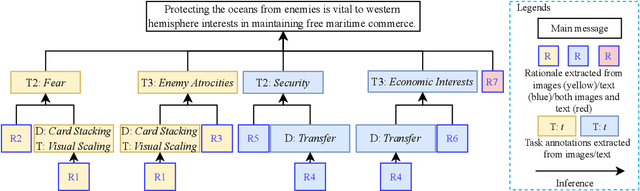
Propaganda campaigns have long been used to influence public opinion via disseminating biased and/or misleading information. Despite the increasing prevalence of propaganda content on the Internet, few attempts have been made by AI researchers to analyze such content. We introduce the task of multimodal propaganda processing, where the goal is to automatically analyze propaganda content. We believe that this task presents a long-term challenge to AI researchers and that successful processing of propaganda could bring machine understanding one important step closer to human understanding. We discuss the technical challenges associated with this task and outline the steps that need to be taken to address it.
CrossCodeBench: Benchmarking Cross-Task Generalization of Source Code Models
Feb 10, 2023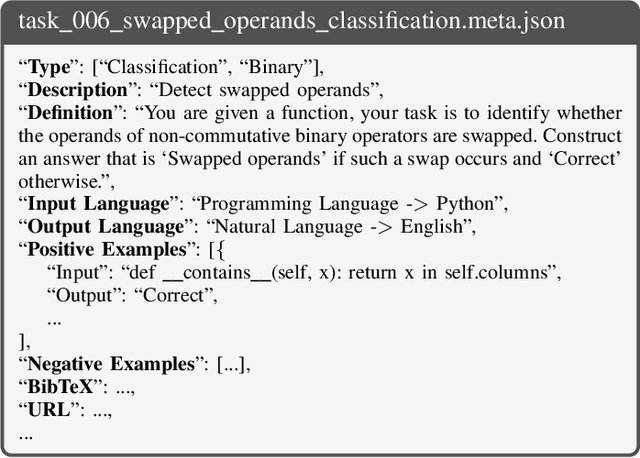
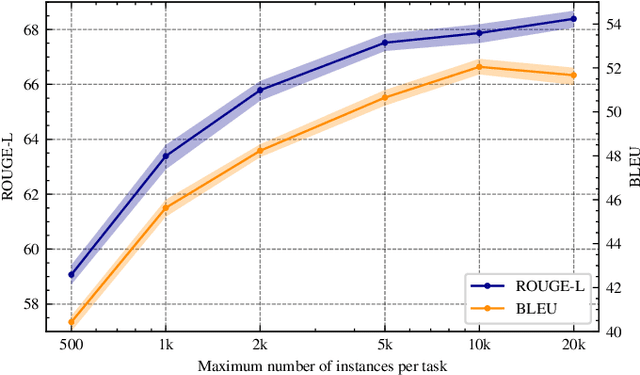
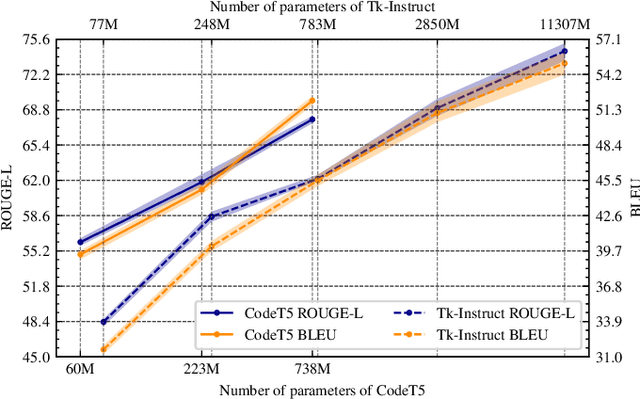
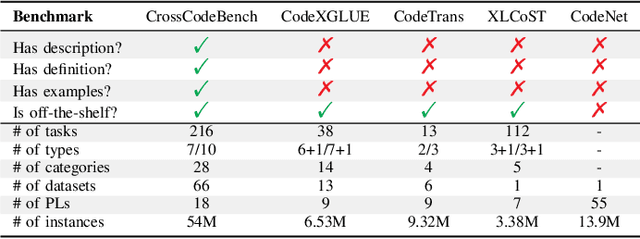
Despite the recent advances showing that a model pre-trained on large-scale source code data is able to gain appreciable generalization capability, it still requires a sizeable amount of data on the target task for fine-tuning. And the effectiveness of the model generalization is largely affected by the size and quality of the fine-tuning data, which is detrimental for target tasks with limited or unavailable resources. Therefore, cross-task generalization, with the goal of improving the generalization of the model to unseen tasks that have not been seen before, is of strong research and application value. In this paper, we propose a large-scale benchmark that includes 216 existing code-related tasks. Then, we annotate each task with the corresponding meta information such as task description and instruction, which contains detailed information about the task and a solution guide. This also helps us to easily create a wide variety of ``training/evaluation'' task splits to evaluate the various cross-task generalization capabilities of the model. Then we perform some preliminary experiments to demonstrate that the cross-task generalization of models can be largely improved by in-context learning methods such as few-shot learning and learning from task instructions, which shows the promising prospects of conducting cross-task learning research on our benchmark. We hope that the collection of the datasets and our benchmark will facilitate future work that is not limited to cross-task generalization.
End-to-End Neural Discourse Deixis Resolution in Dialogue
Dec 03, 2022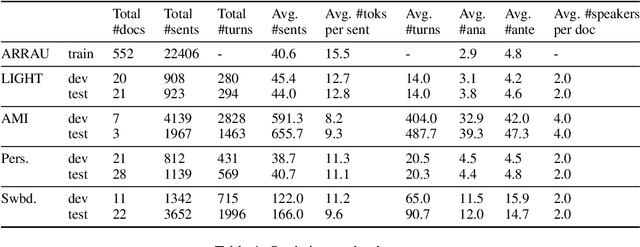
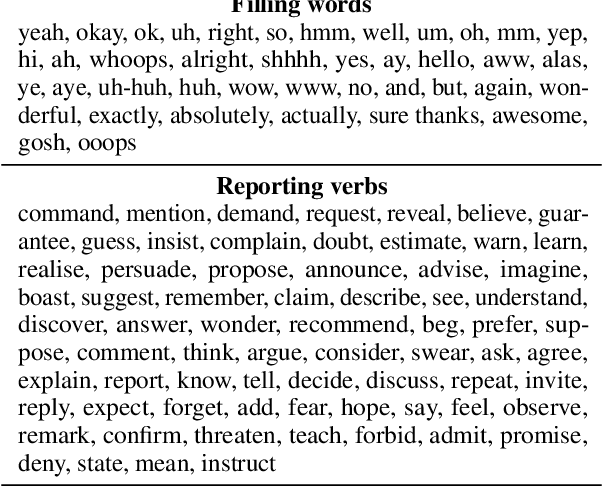

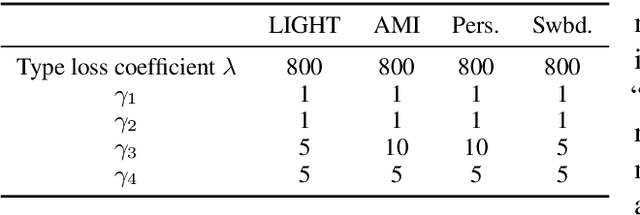
We adapt Lee et al.'s (2018) span-based entity coreference model to the task of end-to-end discourse deixis resolution in dialogue, specifically by proposing extensions to their model that exploit task-specific characteristics. The resulting model, dd-utt, achieves state-of-the-art results on the four datasets in the CODI-CRAC 2021 shared task.
DiscoSense: Commonsense Reasoning with Discourse Connectives
Oct 22, 2022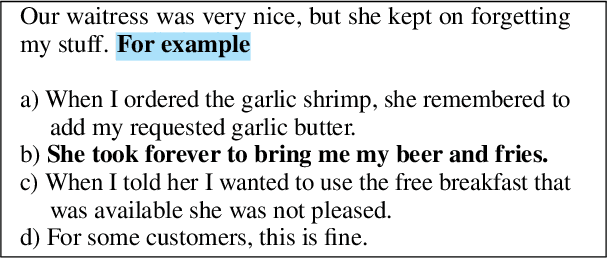
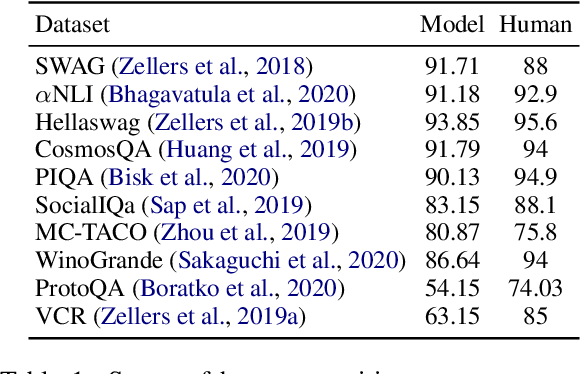
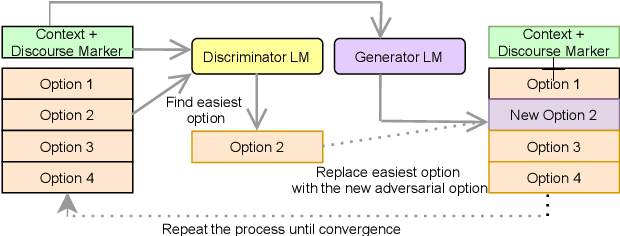
We present DiscoSense, a benchmark for commonsense reasoning via understanding a wide variety of discourse connectives. We generate compelling distractors in DiscoSense using Conditional Adversarial Filtering, an extension of Adversarial Filtering that employs conditional generation. We show that state-of-the-art pre-trained language models struggle to perform well on DiscoSense, which makes this dataset ideal for evaluating next-generation commonsense reasoning systems.