 Add to Chrome
 Add to Firefox
 Add to Edge
Benchmarking Multi-Modal Graph-based Social Media Popularity Prediction
Jun 25, 2026
Social media popularity prediction aims to forecast the future reach or influence of online content from early-stage observations. Accurate prediction enables key downstream applications, such as advertising optimization and strategic content planning by users, creators, and platforms. Despite substantial progress, existing popularity prediction works often fail to jointly consider multimodal content and temporal social interaction signals. Moreover, the literature remains highly fragmented across datasets, modalities, observation windows, prediction targets, and evaluation protocols. This fragmentation prevents fair comparison and obscures a systematic understanding of how textual, visual, temporal, and interaction-based signals jointly shape popularity dynamics. To address these challenges, we introduce MMG-Pop, a Multi-modal Graph-based Popularity Prediction benchmark, which unifies datasets, modalities, temporal interaction signals, and representative baselines under a standardized evaluation protocol. Furthermore, we propose MMG-PopNet, a unified multi-modal graph-based network that jointly models the aforementioned multi-modal signals and graph-structured social interactions. Extensive experiments on MMG-Pop, comprising four datasets across Bluesky and Reddit platforms, demonstrate the superior performance of MMG-PopNet and yield new insights into cross-platform training generalization, multi-task prediction benefits, multi-modality contributions, and LLM prediction limitation. These findings establish a unified foundation for future research on social dynamics modeling and intervention under heterogeneous modalities and socially-aware agentic ecosystem paradigms.

RL-Index: Reinforcement Learning for Retrieval Index Reasoning
Jun 15, 2026Retrieving external knowledge is essential for solving real-world tasks, yet it remains challenging when the relationship between a query and its relevant knowledge involves implicit and complex reasoning beyond surface-level semantic or lexical matching (e.g., mathematical problems relying on the same theorem or coding requiring deep reasoning). Existing approaches primarily rely on query-side reasoning (e.g., query rewriting), which introduces significant online latency and underutilizes the opportunity to perform reasoning over the knowledge corpus itself (i.e., index-side reasoning). In this paper, we propose RL-Index, an agentic indexing framework that formulates retrieval index reasoning as a reinforcement learning problem. Instead of performing reasoning at query time, RL-Index shifts reasoning to the indexing stage by augmenting documents with LLM-generated rationales that explicitly encode the latent query-knowledge relationship. To optimize the quality of these rationales, we employ Group Relative Policy Optimization (GRPO) and use retrieval similarity as a verifiable reward signal, enabling direct optimization of indexing decisions for retrieval effectiveness. Extensive experiments on the BRIGHT benchmark demonstrate that RL-Index consistently improves both retrieval and downstream question-answering performance, while significantly reducing online inference latency. Moreover, the learned rationale augmentation generalizes across diverse retrievers and generators, highlighting its robustness as a plug-and-play indexing strategy across different retrieval systems.
A Graph Perspective to Probe Structural Patterns of Knowledge in Large Language Models
May 25, 2025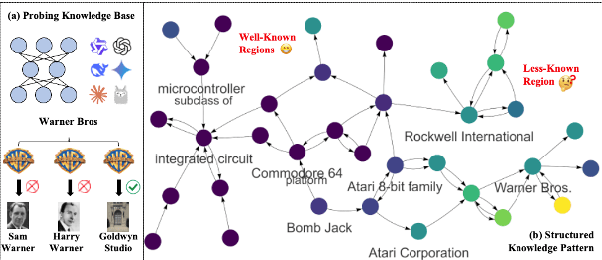
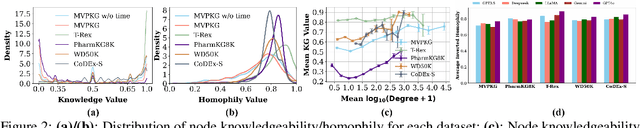
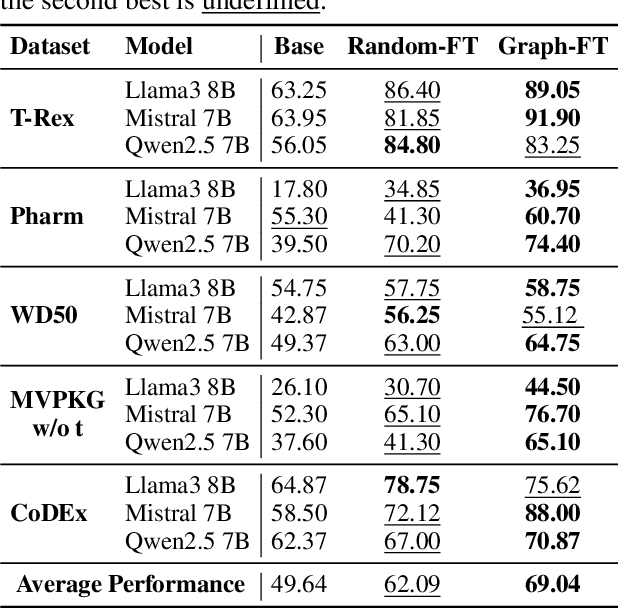
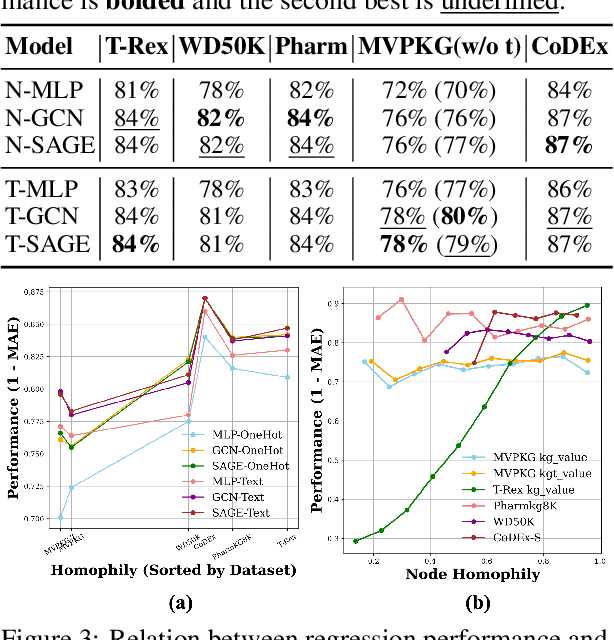
Large language models have been extensively studied as neural knowledge bases for their knowledge access, editability, reasoning, and explainability. However, few works focus on the structural patterns of their knowledge. Motivated by this gap, we investigate these structural patterns from a graph perspective. We quantify the knowledge of LLMs at both the triplet and entity levels, and analyze how it relates to graph structural properties such as node degree. Furthermore, we uncover the knowledge homophily, where topologically close entities exhibit similar levels of knowledgeability, which further motivates us to develop graph machine learning models to estimate entity knowledge based on its local neighbors. This model further enables valuable knowledge checking by selecting triplets less known to LLMs. Empirical results show that using selected triplets for fine-tuning leads to superior performance.