 Add to Chrome
 Add to Firefox
 Add to Edge
IsoCompute Playbook: Optimally Scaling Sampling Compute for LLM RL
Mar 12, 2026
While scaling laws guide compute allocation for LLM pre-training, analogous prescriptions for reinforcement learning (RL) post-training of large language models (LLMs) remain poorly understood. We study the compute-optimal allocation of sampling compute for on-policy RL methods in LLMs, framing scaling as a compute-constrained optimization over three resources: parallel rollouts per problem, number of problems per batch, and number of update steps. We find that the compute-optimal number of parallel rollouts per problem increases predictably with compute budget and then saturates. This trend holds across both easy and hard problems, though driven by different mechanisms: solution sharpening on easy problems and coverage expansion on hard problems. We further show that increasing the number of parallel rollouts mitigates interference across problems, while the number of problems per batch primarily affects training stability and can be chosen within a broad range. Validated across base models and data distributions, our results recast RL scaling laws as prescriptive allocation rules and provide practical guidance for compute-efficient LLM RL post-training.

The Inductive Bias of Convolutional Neural Networks: Locality and Weight Sharing Reshape Implicit Regularization
Mar 05, 2026We study how architectural inductive bias reshapes the implicit regularization induced by the edge-of-stability phenomenon in gradient descent. Prior work has established that for fully connected networks, the strength of this regularization is governed solely by the global input geometry; consequently, it is insufficient to prevent overfitting on difficult distributions such as the high-dimensional sphere. In this paper, we show that locality and weight sharing fundamentally change this picture. Specifically, we prove that provided the receptive field size $m$ remains small relative to the ambient dimension $d$, these networks generalize on spherical data with a rate of $n^{-\frac{1}{6} +O(m/d)}$, a regime where fully connected networks provably fail. This theoretical result confirms that weight sharing couples the learned filters to the low-dimensional patch manifold, thereby bypassing the high dimensionality of the ambient space. We further corroborate our theory by analyzing the patch geometry of natural images, showing that standard convolutional designs induce patch distributions that are highly amenable to this stability mechanism, thus providing a systematic explanation for the superior generalization of convolutional networks over fully connected baselines.
Stable Minima of ReLU Neural Networks Suffer from the Curse of Dimensionality: The Neural Shattering Phenomenon
Jun 25, 2025We study the implicit bias of flatness / low (loss) curvature and its effects on generalization in two-layer overparameterized ReLU networks with multivariate inputs -- a problem well motivated by the minima stability and edge-of-stability phenomena in gradient-descent training. Existing work either requires interpolation or focuses only on univariate inputs. This paper presents new and somewhat surprising theoretical results for multivariate inputs. On two natural settings (1) generalization gap for flat solutions, and (2) mean-squared error (MSE) in nonparametric function estimation by stable minima, we prove upper and lower bounds, which establish that while flatness does imply generalization, the resulting rates of convergence necessarily deteriorate exponentially as the input dimension grows. This gives an exponential separation between the flat solutions vis-\`a-vis low-norm solutions (i.e., weight decay), which knowingly do not suffer from the curse of dimensionality. In particular, our minimax lower bound construction, based on a novel packing argument with boundary-localized ReLU neurons, reveals how flat solutions can exploit a kind of ''neural shattering'' where neurons rarely activate, but with high weight magnitudes. This leads to poor performance in high dimensions. We corroborate these theoretical findings with extensive numerical simulations. To the best of our knowledge, our analysis provides the first systematic explanation for why flat minima may fail to generalize in high dimensions.
Atrial Septal Defect Detection in Children Based on Ultrasound Video Using Multiple Instances Learning
Jun 06, 2023

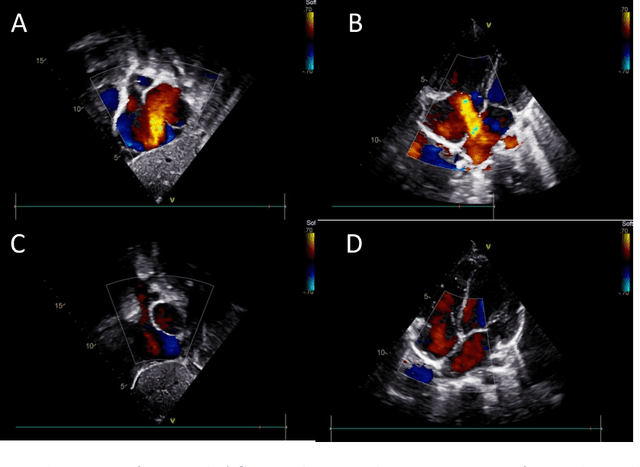

Purpose: Congenital heart defect (CHD) is the most common birth defect. Thoracic echocardiography (TTE) can provide sufficient cardiac structure information, evaluate hemodynamics and cardiac function, and is an effective method for atrial septal defect (ASD) examination. This paper aims to study a deep learning method based on cardiac ultrasound video to assist in ASD diagnosis. Materials and methods: We select two standard views of the atrial septum (subAS) and low parasternal four-compartment view (LPS4C) as the two views to identify ASD. We enlist data from 300 children patients as part of a double-blind experiment for five-fold cross-validation to verify the performance of our model. In addition, data from 30 children patients (15 positives and 15 negatives) are collected for clinician testing and compared to our model test results (these 30 samples do not participate in model training). We propose an echocardiography video-based atrial septal defect diagnosis system. In our model, we present a block random selection, maximal agreement decision and frame sampling strategy for training and testing respectively, resNet18 and r3D networks are used to extract the frame features and aggregate them to build a rich video-level representation. Results: We validate our model using our private dataset by five-cross validation. For ASD detection, we achieve 89.33 AUC, 84.95 accuracy, 85.70 sensitivity, 81.51 specificity and 81.99 F1 score. Conclusion: The proposed model is multiple instances learning-based deep learning model for video atrial septal defect detection which effectively improves ASD detection accuracy when compared to the performances of previous networks and clinical doctors.
EDMAE: An Efficient Decoupled Masked Autoencoder for Standard View Identification in Pediatric Echocardiography
Mar 17, 2023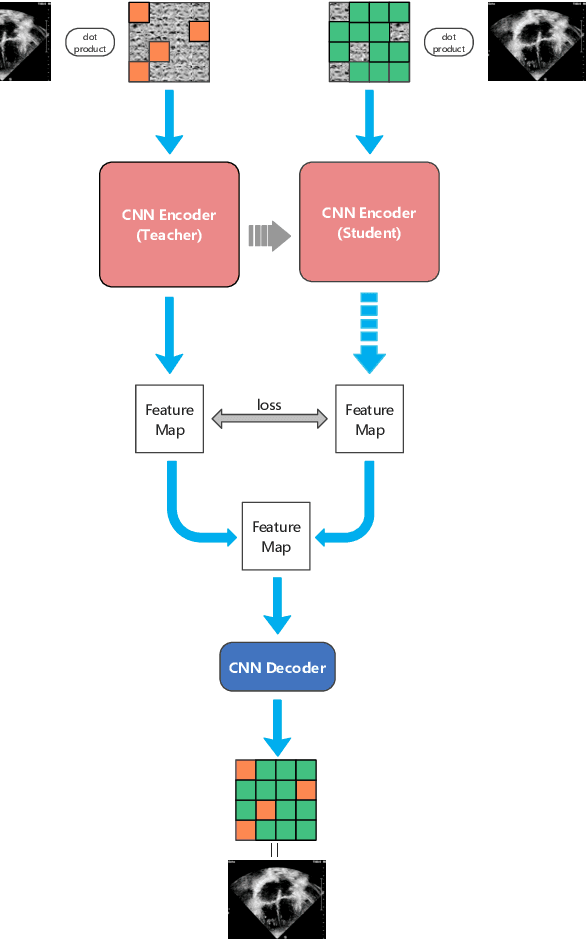
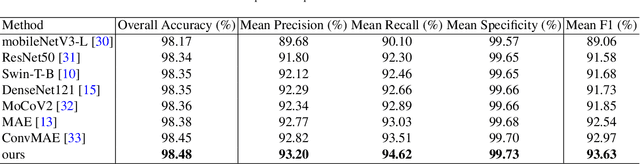
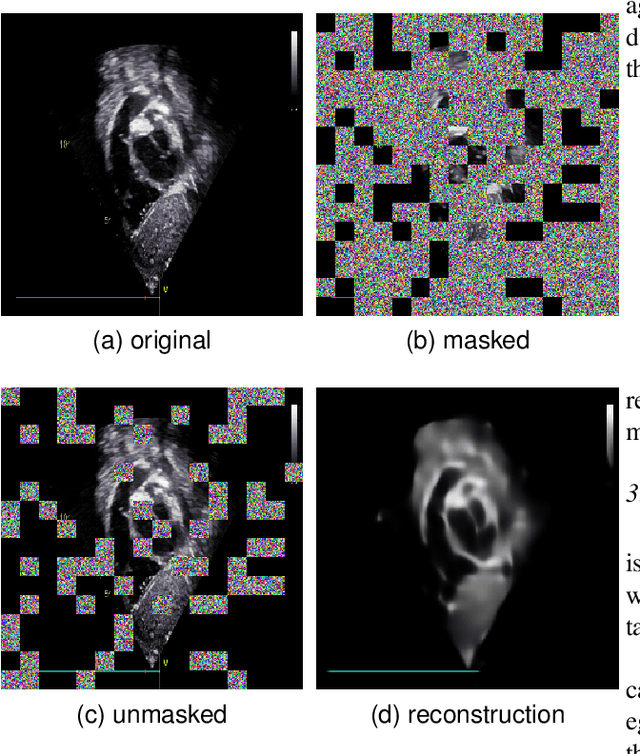
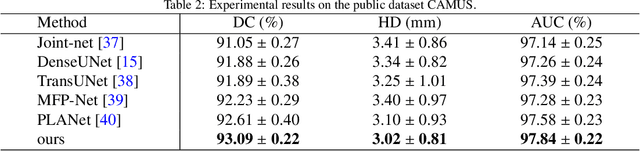
An efficient decoupled masked autoencoder (EDMAE), which is a novel self-supervised method is proposed for standard view recognition in pediatric echocardiography in this paper. The proposed EDMAE based on the encoder-decoder structure forms a new proxy task. The decoder of EDMAE consists of a teacher encoder and a student encoder, in which the teacher encoder extracts the latent representation of the masked image blocks, while the student encoder extracts the latent representation of the visible image blocks. A loss is calculated between the feature maps output from two encoders to ensure consistency in the latent representations they extracted. EDMAE replaces the VIT structure in the encoder of traditional MAE with pure convolution operation to improve training efficiency. EDMAE is pre-trained in a self-supervised manner on a large-scale private dataset of pediatric echocardiography, and then fine-tuned on the downstream task of standard view recognition. The high classification accuracy is achieved in 27 standard views of pediatric echocardiography. To further validate the effectiveness of the proposed method, another downstream task of cardiac ultrasound segmentation is performed on a public dataset CAMUS. The experiments show that the proposed method not only can surpass some recent supervised methods but also has more competitiveness on different downstream tasks.