 Add to Chrome
 Add to Firefox
 Add to Edge
Beyond Dataset Distillation: Lossless Dataset Concentration via Diffusion-Assisted Distribution Alignment
Mar 30, 2026
The high cost and accessibility problem associated with large datasets hinder the development of large-scale visual recognition systems. Dataset Distillation addresses these problems by synthesizing compact surrogate datasets for efficient training, storage, transfer, and privacy preservation. The existing state-of-the-art diffusion-based dataset distillation methods face three issues: lack of theoretical justification, poor efficiency in scaling to high data volumes, and failure in data-free scenarios. To address these issues, we establish a theoretical framework that justifies the use of diffusion models by proving the equivalence between dataset distillation and distribution matching, and reveals an inherent efficiency limit in the dataset distillation paradigm. We then propose a Dataset Concentration (DsCo) framework that uses a diffusion-based Noise-Optimization (NOpt) method to synthesize a small yet representative set of samples, and optionally augments the synthetic data via "Doping", which mixes selected samples from the original dataset with the synthetic samples to overcome the efficiency limit of dataset distillation. DsCo is applicable in both data-accessible and data-free scenarios, achieving SOTA performances for low data volumes, and it extends well to high data volumes, where it nearly reduces the dataset size by half with no performance degradation.

Multi-Modal Building Change Detection for Large-Scale Small Changes: Benchmark and Baseline
Mar 19, 2026Change detection in optical remote sensing imagery is susceptible to illumination fluctuations, seasonal changes, and variations in surface land-cover materials. Relying solely on RGB imagery often produces pseudo-changes and leads to semantic ambiguity in features. Incorporating near-infrared (NIR) information provides heterogeneous physical cues that are complementary to visible light, thereby enhancing the discriminability of building materials and tiny structures while improving detection accuracy. However, existing multi-modal datasets generally lack high-resolution and accurately registered bi-temporal imagery, and current methods often fail to fully exploit the inherent heterogeneity between these modalities. To address these issues, we introduce the Large-scale Small-change Multi-modal Dataset (LSMD), a bi-temporal RGB-NIR building change detection benchmark dataset targeting small changes in realistic scenarios, providing a rigorous testing platform for evaluating multi-modal change detection methods in complex environments. Based on LSMD, we further propose the Multi-modal Spectral Complementarity Network (MSCNet) to achieve effective cross-modal feature fusion. MSCNet comprises three key components: the Neighborhood Context Enhancement Module (NCEM) to strengthen local spatial details, the Cross-modal Alignment and Interaction Module (CAIM) to enable deep interaction between RGB and NIR features, and the Saliency-aware Multisource Refinement Module (SMRM) to progressively refine fused features. Extensive experiments demonstrate that MSCNet effectively leverages multi-modal information and consistently outperforms existing methods under multiple input configurations, validating its efficacy for fine-grained building change detection. The source code will be made publicly available at: https://github.com/AeroVILab-AHU/LSMD
SPEGC: Continual Test-Time Adaptation via Semantic-Prompt-Enhanced Graph Clustering for Medical Image Segmentation
Mar 12, 2026In medical image segmentation tasks, the domain gap caused by the difference in data collection between training and testing data seriously hinders the deployment of pre-trained models in clinical practice. Continual Test-Time Adaptation (CTTA) aims to enable pre-trained models to adapt to continuously changing unlabeled domains, providing an effective approach to solving this problem. However, existing CTTA methods often rely on unreliable supervisory signals, igniting a self-reinforcing cycle of error accumulation that culminates in catastrophic performance degradation. To overcome these challenges, we propose a CTTA via Semantic-Prompt-Enhanced Graph Clustering (SPEGC) for medical image segmentation. First, we design a semantic prompt feature enhancement mechanism that utilizes decoupled commonality and heterogeneity prompt pools to inject global contextual information into local features, alleviating their susceptibility to noise interference under domain shift. Second, based on these enhanced features, we design a differentiable graph clustering solver. This solver reframes global edge sparsification as an optimal transport problem, allowing it to distill a raw similarity matrix into a refined and high-order structural representation in an end-to-end manner. Finally, this robust structural representation is used to guide model adaptation, ensuring predictions are consistent at a cluster-level and dynamically adjusting decision boundaries. Extensive experiments demonstrate that SPEGC outperforms other state-of-the-art CTTA methods on two medical image segmentation benchmarks. The source code is available at https://github.com/Jwei-Z/SPEGC-for-MIS.
RTS-Mono: A Real-Time Self-Supervised Monocular Depth Estimation Method for Real-World Deployment
Nov 18, 2025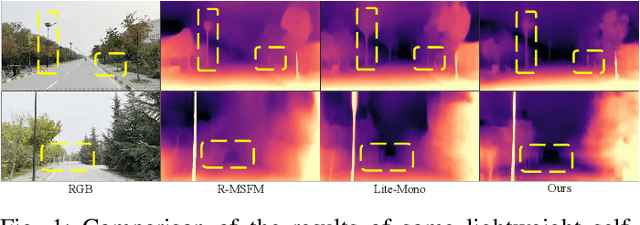
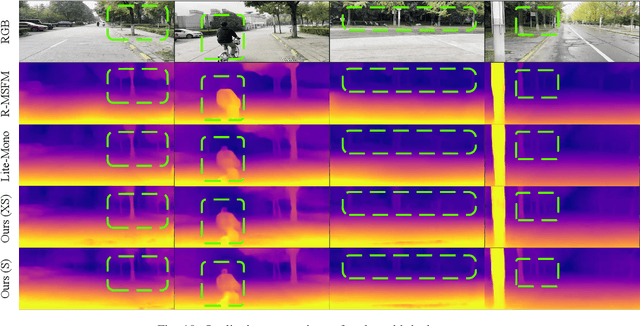
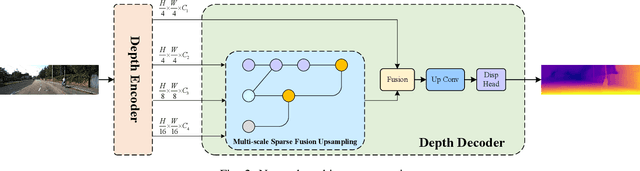
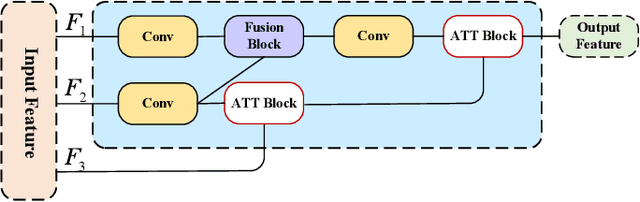
Depth information is crucial for autonomous driving and intelligent robot navigation. The simplicity and flexibility of self-supervised monocular depth estimation are conducive to its role in these fields. However, most existing monocular depth estimation models consume many computing resources. Although some methods have reduced the model's size and improved computing efficiency, the performance deteriorates, seriously hindering the real-world deployment of self-supervised monocular depth estimation models in the real world. To address this problem, we proposed a real-time self-supervised monocular depth estimation method and implemented it in the real world. It is called RTS-Mono, which is a lightweight and efficient encoder-decoder architecture. The encoder is based on Lite-Encoder, and the decoder is designed with a multi-scale sparse fusion framework to minimize redundancy, ensure performance, and improve inference speed. RTS-Mono achieved state-of-the-art (SoTA) performance in high and low resolutions with extremely low parameter counts (3 M) in experiments based on the KITTI dataset. Compared with lightweight methods, RTS-Mono improved Abs Rel and Sq Rel by 5.6% and 9.8% at low resolution and improved Sq Rel and RMSE by 6.1% and 1.9% at high resolution. In real-world deployment experiments, RTS-Mono has extremely high accuracy and can perform real-time inference on Nvidia Jetson Orin at a speed of 49 FPS. Source code is available at https://github.com/ZYCheng777/RTS-Mono.